The equestrian statue of Henri IV stands on Place du Pont-Neuf in Paris, France, behind Place Dauphine on Pont Neuf extending Rue Dauphine. Inaugurated in 1818, it is a bronze statue created by sculptor François-Frédéric Lemot. The figure represents King Henri IV of France on horseback, crowned with laurel and holding a fleur-de-lys scepter in his right hand. Henri IV faces the Quai des Orfèvres, while the horse faces the Quai de l'Horloge.
The statue rests on a pedestal with bas-reliefs on the sides, a Latin inscription on the front, and an engraved inscription on the back. The south bas-relief depicts Henri IV bringing supplies into besieged Paris, and the north bas-relief shows him entering Paris in 1594. The monument replaces an original equestrian statue commissioned by Marie de Médicis in 1614 and destroyed in 1792, as well as a second temporary statue erected in 1814.
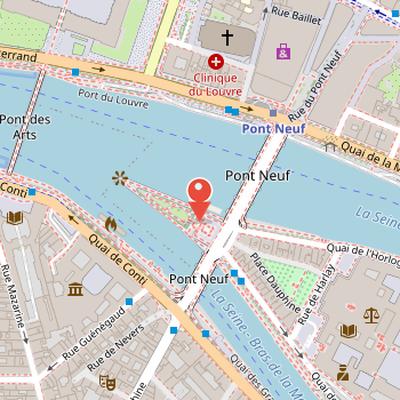
Nearby Objects
-
 Pont Neuf 70 m away
 -
 Saint-Germain l'Auxerrois 250 m away
 -
 French Academy of Sciences 300 m away
 -
 Bibliothèque Mazarine 300 m away
 -
 Académie des beaux-arts 300 m away
Creation and Replacement History
The equestrian statue of Henri IV stands on Place du Pont-Neuf in Paris, France, and was inaugurated in 1818. It is a bronze statue created by sculptor Francois-Francois-Frédéric Lemot. The figure shows Henri IV on horseback, crowned with laurel and holding a scepter. The monument replaced an original equestrian statue from 1614, commissioned by Marie de Medici and destroyed in 1792. It also replaced a second temporary statue erected in 1814.
Form and Setting of the Equestrian Statue
The equestrian statue of Henri IV is located behind Place Dauphine on Pont Neuf, extending Rue Dauphine, a route that Henri IV himself ordered to be constructed. Made of bronze, the statue represents King Henri IV of France in armor and crowned with laurel. He holds a fleur-de-lys scepter in his right hand. The figure of Henri IV faces the Quai des Orfevres, while the horse is oriented toward the Quai de l'Horloge.
The statue rests on a pedestal decorated with bas-reliefs on the sides. The front of the pedestal carries a Latin inscription, and the back has an engraved inscription. The south bas-relief shows Henri IV bringing supplies into besieged Paris, while the north bas-relief depicts him entering Paris in 1594. These elements connect the monument to specific moments in Henri IV's relationship with the city and its historic streets.
The First Equestrian Statue of Henri IV
The history of the first equestrian statue of Henri IV is associated with an initiative by Marie de Medici. Executed by Jean Bologne and Pietro Tacca, the monument formed part of the composition of Place Dauphine. Its pedestal was completed in 1635, and the four captives were completed in 1618. The statue was inaugurated on an unspecified date. During the French Revolution, it was destroyed.
The statue was based on a plaster mold taken from one of the horses of the Quadriga of the Brandenburg Gate. In 1806, Napoleon stole the horse mold and stored it at Menus-Plaisirs. The mold was later taken by the Prussians in 1814.
History and construction of the statue
The current statue is the work of the sculptor Francois-Fredric Lemot. In making it, he used some original elements that are now at the musee Carnavalet. A head of Henri IV now in a private collection may also have inspired the sculpture, and the count of Vaublanc served as a model for Lemot's statue of Henri IV. The monument was inaugurated on August 25, 1818, the day of Saint Louis. During its erection, documents on parchment were placed inside the statue, together with twenty-six medals and three books on Henri IV. These items were placed inside the belly of the horse and are now kept in the Armoire de fer at the Archives nationales. The monument was listed as a historic monument in 1992. The base of the temporary monument bore the inscription: 'Le retour de Louis fait revivre Henri'.
Early Photographic Anecdotes
An anecdote reports that the first photograph of a human may have been taken at the foot of the statue of Henri IV. It also notes that the daguerreotype of the Pont-Neuf by Daguerre and Fordos is conserved at the musee des Arts et Metiers. In that image, two people appear lying down in the lower part. The photograph is suggested to date from the summer of 1837, based on the foliage of the trees, and is said to predate Daguerre's photo of boulevard du Temple with the shoeshiner.
Heritage status and setting
The Equestrian statue of Henry IV is a French bronze sculpture from the 19th century and an artwork located in the 1st arrondissement of Paris, on the Ile de la Cite. It is a monument historique, classified in 1992. The monument is associated with Henri IV and is connected to Henri IV, King of France. These references place the statue within the protected heritage landscape of central Paris, where its historical and artistic identity are recognized as part of its official status.