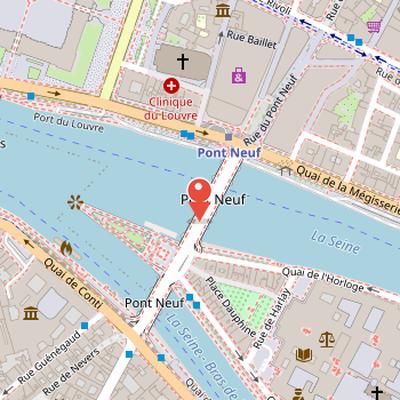
Pont Neuf is the oldest existing bridge in Paris despite its name, which is currently usually spelled le pont Neuf. It crosses the Seine at the western tip of the Île de la Cité and was built from the late 16th century to the beginning of the 17th century. It is also the first stone bridge in Paris to cross the Seine entirely and the first uncovered bridge in the city. The bridge was named for its design as a bridge without houses, with sidewalks intended to protect pedestrians from mud and horses.
Construction was authorized by the king and began with the laying of the foundation stone in the presence of Queen Mother Catherine de Médicis and Queen Louise de Lorraine-Vaudémont. After delays caused by civil unrest, work resumed under Henri IV and continued until 1607. The bridge is made up of a series of short arches. Pont Neuf has been classified as a historic monument since 1889 and was inscribed in 1991 as part of the UNESCO World Heritage Site of the quais of the Seine in Paris.
Nearby Objects
-
 Equestrian Statue of Henri IV 70 m away
 -
 Saint-Germain l'Auxerrois 200 m away
 -
 Palais de la Cité 300 m away
 -
 Sainte-Chapelle 350 m away
 -
 French Academy of Sciences 350 m away
Pont Neuf: Paris's Oldest Surviving Bridge
Pont Neuf is the oldest existing bridge in Paris, despite its name. It crosses the Seine at the western tip of the Ile de la Cite and was built from the late 16th century, with completion at the beginning of the 17th century. It is the first stone bridge in Paris to cross the Seine entirely. The bridge was named for a practical feature: unlike earlier bridges, it had no houses on it and included sidewalks intended to protect pedestrians from mud and horses. Its currently preferred spelling is le pont Neuf. The bridge has been classified as a historic monument since 1889 and was inscribed in 1991 as part of the UNESCO World Heritage Site of the quais of the Seine in Paris. It is served by Metro line 7 at the Pont-Neuf station.
Bridge Design and Public Life
Pont Neuf is currently the oldest bridge in Paris and the first uncovered bridge in the city. Its construction was authorized by letters patent from the king, and the king laid the foundation stone the following day in the presence of Queen Mother Catherine de Medicis and Queen Louise de Lorraine-Vaudemont. The king had just returned from the funerals of two of his favorites, and the historical account notes that he wept during the ceremony. Parisians first called the bridge Le pont des Pleurs. Construction continued until 1607 under Henri IV, although a city uprising against the king caused a ten-year suspension from 1588 to 1598. Henri IV ordered work to resume in 1599 and assigned Guillaume Marchant and Francois Petit to lead the works.
The initial architect, Baptiste Androuet du Cerceau, had planned houses on the bridge, similar to other Paris bridges. He also arranged cellars in the piers and under the arches. When Henri IV chose an uncovered bridge design after construction resumed, these cellars remained, and a tunnel connected them before they were later sealed. The bridge consists of a series of short arches. Small buildings housing shops were erected in the corbels, and Pont Neuf became a place where itinerant merchants such as dog shearers and umbrella renters did business. It also served as a meeting place for charlatans. Booksellers competed with local bookstores, leading to a ban on commercial presence in 1619, later reaffirmed by a royal ordinance in 1742.
Pont Neuf is documented under that name in a 1636 manuscript. In 1702, when it was part of the Cite district, it had 20 lanterns and 12 stone shops. A 1615 aerial view appears in the Merian plan, and later depictions include a 1777 view by Nicolas Jean-Baptiste Raguenet, a painting by Canella in 1832, an engraving from 1845, a photograph around 1860 by Adolphe Braun, and an image of election poster readers from April 1898 by Eugene Trutat. The bridge's appearance was also recorded in 1981. Its route began at Quai des Augustins opposite Place Dauphine and ended at the corners of Quais de la Vieille-Vallee-de-Misere and de l'Ecole opposite Carrefour des Trois-Maries.
In the 19th century, the buildings in the corbels were removed and the cellars sealed, and the last shop disappeared around 1854. The bridge was also the site of the first public electric lighting test. Witness markers of the 1910 Seine flood were found on both sides of the bridge, and the average flood level is above the average level of the Marais district. For restoration at the end of the 19th century, limestone from the Saint-Pierre-Aigle quarry replaced Lutetian limestone from Paris quarries, which were no longer exploitable or were depleted. Full restoration, including the last arch and mascarons on the right bank and the riverside road, was completed in the first quarter of 2007. A History of Paris panel was also installed at Quai des Grands-Augustins at the bridge corner.
The Henri IV Statue and the Pont Neuf Site
The location at the tip of the island has long been desired by architects and urban planners. On the Pont Neuf, the equestrian statue of Henri IV was commissioned by Marie de Medici from Jean de Bologne for the Ile de la Cite. It was placed on the terre-plein of the island, between the two cullees of the bridge, and was inaugurated four years after the king's assassination by Francois Ravaillac. The monument became part of broader urban projects, including Pierre Patte's 1775 plan for statue locations in Paris. These projects included a proposal to place a statue of Louis XV facing the Henri IV statue, as well as a plan in which the Henri IV statue would be replaced by Louis XV and the base turned into a large fountain.
The original statue and two lateral bas-reliefs by Pierre Francheville were melted down for cannons in 1792 during the French Revolution. Fragments of the horse and four statues representing slaves or conquered nations by Pierre Francheville are preserved at the Louvre Museum. Under the Restoration, the statue was replaced by a new one after a subscription launched by Louis XVIII. This later statue, inaugurated in 1818, was made from bronze taken from the effigy of Desaix and was based on Lemot's model, itself inspired by Pietro Tacca, the first assistant of Jean de Bologne.
The Samaritaine Pump on Pont Neuf
The Samaritaine was a historic water-lifting machine on Pont Neuf, authorized by royal decree and built by Jean Lintlaer from 1602 to 1608 on the second arch from the right bank. It was the first water lifting machine built in Paris. The structure was a small residential building on stilts with a large water wheel inside, and it was topped by a campanile containing a carillon with a jacquemart.
The pump supplied water to the Louvre district and to the palaces of the Louvre and Tuileries, as well as their gardens. It was rebuilt by Robert de Cotte between 1712 and 1719 and renovated by Soufflot and Gabriel around 1771. Its name came from a bronze high-relief on the facade showing the meeting of Jesus and the Samaritan woman at Jacob's well, created by Bernard and Rene Fremin between 1672 and 1744.
The structure later underwent major changes: Louis XVI gave its fountain to the municipality, the facade was stripped, and the Christ and Samaritan sculptures were sent to the foundry. It became a National Guard post before deteriorating and being destroyed in 1813. A bell from the building was later transferred to Saint-Eustache church. The site remained important in local commercial history, since Ernest Cognacq opened his first shop in Pont Neuf's corbeille on the former pump site, and that shop later expanded into a famous department store near the right bank of the river.
The Equestrian Statue Project
The project for an equestrian statue in Paris was considered by the Valois as a monument similar to Michelangelo's Marc Aurelius statue. Queen Marie de Medicis later wrote to her uncle, Grand Duke Ferdinand de Medicis, to request help with her own equestrian statue project. Ferdinand de Medicis had already created an equestrian statue by Jean de Bologne, and Marie de Medicis offered to send the horse made by Jean de Bologne in 1602 for Ferdinand de Medicis. The molds from Ferdinand de Medicis' horse were then reused for the equestrian statues of Henry IV and Philip III.
The casting of the three horses was carried out consecutively at Jean de Bologne's foundry at Borgo Pinti. Giovan Battista Cresci requested metal to cast the horses in his role as Provveditore of Fortezza di basso, and Historique's horse was cast before Ferdinand de Medicis came to see it. For the statue sent to Florence in 1606, Pierre de Francqueville created the king's head in wax and later traveled to Florence in 1606 and 1607 to settle affairs and bring his family. He also collaborated with Pietro Tacca on the equestrian statue. The statue remained unfinished in the workshop inventory of Jean de Bologne after his death. The project restarted after the king's assassination, while Ferdinand de Medicis died in 1609.
The Statue of Henri IV on the Pont Neuf
The statue was completed in 1611, and its transfer was ordered by Grand Duchess Christine. It was floated down the Arno to the port of Livorno under the supervision of Giovan Battista Crespi, where the statue crates remained for one year. The horse and statue crates were then shipped from Livorno on a specific date. Six months later, the ship carrying them sank off Savona, but the crates were recovered. They were then moved from Savona to Marseille on a Genoese ship, before another vessel carried them from Marseille to Le Havre. A barge then took them to Rouen, and the statue arrived in Paris on a specific date.
Marie de Medici ordered chevalier Picciolini to remove the bronzes from the crates quickly and assemble the statue. The solemn inauguration took place without the queen mother and Louis XIII. It was the first royal statue erected in a public square, and it was oriented towards the Quai des Orfevres. Later, the bronzes were torn from the pedestal on an unspecified date. Only the slave bronzes that had decorated the base were preserved at the Louvre Museum, along with some debris.
After the return of the Bourbons, Louis XVIII decided to remake the statue of Henri IV. A provisional effigy of Historique was installed in 1814, and Louis XVIII inaugurated the pedestal on an unspecified date. The equestrian statue of Historique, created by the sculptor Francois-Francois Lemot, was inaugurated on an unspecified date. During World War I, a shell launched by the Grosse Bertha exploded in the Seine opposite the Pont-Neuf near the Samaritaine.
Architecture and Sculptural Details
Pont Neuf is a masonry bridge whose design includes a carriageway and two sidewalks. It is the first bridge to cross the Seine in its full width, and it connects the left bank, the right bank, and the western end of the Ile de la Cite. Its sidewalks were the first in Paris. The bridge has two unequal sections: the grande bras with seven arches, and the petit bras with five arches. Semi-circular balconies rise above each pier, where merchants and artisans have shops. Unlike many other bridges, Pont Neuf lacks houses along its edge.
The bridge also carries an equestrian statue honoring Henri IV. Its cornices were originally decorated with 381 mascarons, grotesque heads representing Greco-Roman forest or countryside deities and serving as protective figures against evil spirits. These mascarons were known for their sculpted beards and hair, with nearly all of them different in design. A tradition dating back to Henri Sauval incorrectly attributed them to Germain Pilon. The mascarons in place today are copies, installed during restoration campaigns in 1851-1855 and 1993-1994. Three mascarons and circular stone benches formerly on the bridge were installed in the Jardin des Petites-Rigoles in the arrondissement. The bridge also has candelabras designed by Victor Baltard in 1854, with a stone pedestal, a base with four figures of Neptune and dolphins, a column with vegetal motifs, and a lamp topped by a crown representing a castle.
Pont Neuf in Art and Later Projects
Pont Neuf has been frequently represented in later artistic and architectural works, and many of these are preserved in the Carnavalet Museum in Paris. The museum holds an anonymous painting from the second half of the 16th century, inspired by a drawing approved by Henri III in 1577, as well as a painting by Lallemand from around 1775 and a painting by Giuseppe Canella from 1832. Other depictions include works by Johan Barthold Jongkind circa 1849 to 1850 in the Metropolitan Museum in New York, Pierre-Auguste Renoir in 1872, Arthur Joseph Meadows in 1897, Felix Vallotton in 1901, Camille Pissarro in 1902, Hippolyte Petitjean between 1912 and 1914, and Enneking John Joseph.
The bridge also appears in a series of architectural projects inspired by it from the 17th to the 19th century. These include a project for the Pont Neuf terre-plein by Nicolas de l'Espine in 1662, a project for Place Louis-XV with a triumphal arch on Pont Neuf by Germain Boffrand in 1748, a project for an arch and a statue of Louis XVI on Pont Neuf by Jacques-Pierre Gisors in 1787, and another project for the Pont Neuf terre-plein by Guy de Gisors in 1804.
In contemporary usage, Pont Neuf has also served as a site for fashion events, including the Louis Vuitton men's ready-to-wear show during Spring-Summer 2024 Fashion Week and the presentation of Pharrell Williams' first collection for Louis Vuitton.