The French Academy of Sciences is a learned society founded in 1666 by Louis XIV at the suggestion of Jean-Baptiste Colbert. Created to encourage and protect the spirit of French scientific research, it became one of the earliest Academies of Sciences and a leading force in European scientific development during the 17th and 18th centuries. The academy traces its origin to Colbert’s plan to create a general academy, and its early meetings began on 22 December 1666 in the King’s library with a small group of scholars. For its first decades, the academy operated informally, without statutes, and much of its activity centered on elections to fill vacancies. In 1699, it received its first rules and was named the Royal Academy of Sciences, with installation in the Louvre in Paris. The academy was founded as an organ of government in Paris and is one of the five Academies of the .
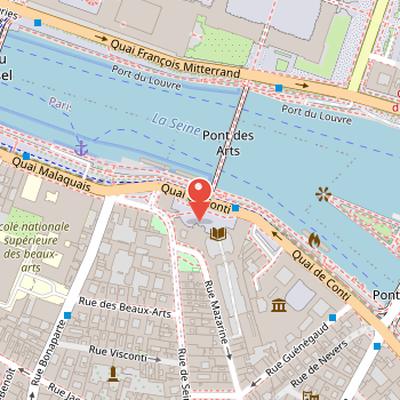
Nearby Objects
-
 Bibliothèque Mazarine 20 m away
 -
 Académie des beaux-arts 20 m away
 -
 Equestrian Statue of Henri IV 300 m away
 -
 Musée national Eugène-Delacroix 350 m away
 -
 Pont Neuf 350 m away
Founding and Role of the French Academy of Sciences
The French Academy of Sciences is a learned society founded in 1666 by Louis XIV at the suggestion of Jean-Baptiste Colbert. It was created to encourage and protect the spirit of French scientific research, and it was at the forefront of scientific developments in Europe during the 17th and 18th centuries. As one of the earliest Academies of Sciences, it holds an important place in the history of scientific institutions. The academy is currently headed by Patrick Flandrin and is one of the five Academies of the .
Origins and Early Organization
The French Academy of Sciences traces its origin to Colbert's plan to create a general academy. Colbert selected a small group of scholars, who met on 22 December 1666 in the King's library. The group held twice-weekly working meetings in two rooms assigned to them. For its first 30 years, the academy functioned in a relatively informal way and had no statutes. It was founded in Paris as an organ of government.
Election Practices and Institutional Change
Membership openings in the French Academy of Sciences were historically few, and elections to fill them were often contentious. Elections formed a large part of the academy's proceedings, and even a single vacancy could require many meetings. Discussion of possible candidates also continued privately among members. Election did not always result in full membership, since some elected individuals entered as associates or correspondents. At first, the process was limited to replacing members within a specific section: if a mathematician left, only candidates focused on mathematics could be nominated. As a result, some positions remained vacant when no specialists could be found in the relevant field. In 1987, the academy changed this practice and decided to fill vacancies with people from new disciplines, a reform intended to diversify fields of expertise and address internal aging. Throughout its history, the academy was also expected to remain apolitical and avoid discussion of religious and social issues.
Institutional Development and Public Role
On 20 January 1699, the Company received its first rules, was named the Royal Academy of Sciences, and was installed in the Louvre in Paris. It began publishing a yearly volume containing members' work and obituaries, and it also codified a system for pensions based on members' work. The academy was organized hierarchically into Pensionaires, Pupils, Honoraires, and Associes, and later reforms added new groups such as Veteran while expanding some membership limits and removing or combining certain roles. The Honoraires, appointed by the King, remained recognized until their abolishment in 1793.
Membership remained closely regulated. Vacancies were opened only when members died, since members served for life, and in 1976 the academy adopted a reorganization allowing 130 resident members, 160 correspondents, and 80 foreign associates. Half of the vacancies in elections were reserved for people under 55 years old, and the last two sections were bundled because of the large number of qualified candidates and the level of competition. By 1976, membership exceeded 100 officially recognised full members. The academy did not create a new study category despite the advancements of Francois Magendie.
The academy also had a strong public and institutional role. In the eighteenth century it controlled French patent laws and acted as a liaison between artisans' knowledge and the public domain, while its academicians dominated technological activities in France. In 1798 it elected Napoleon Bonaparte as a member and in 1801 as president. The Royal Academy of Sciences became autonomous and part of the Institute of France in 1816, with the head of State as its patron. During the Second Republic, its name returned to Academie des sciences, and it was funded by and accountable to the Ministry of Public Instruction. Its proceedings were published under a title used from 1835 to 1965, and the publication now continues as a journal series with seven titles. These publications are available through the site of the French National Library.
The 1818 Light Theory Competition
In 1818, the French Academy of Sciences launched a competition to explain the properties of light. Civil engineer Augustin-Jean Fresnel entered with a new wave theory of light. The theory was closely examined by Simen Denis Poisson, a member of the judging committee, who supported the particle theory and tried to disprove Fresnel's proposal. Poisson argued that the theory predicted a bright spot on the axis in the shadow of a circular obstacle, a result later known as the Poisson spot. Because this effect is not easily observed in everyday situations, committee head Dominique-Francois-Jean Arago decided to test it more carefully. He molded a 2-mm metallic disk to a glass plate with wax and succeeded in observing the predicted spot. Arago's experiment convinced most scientists of the wave nature of light.
Membership and Representation
For three centuries, women were not allowed to be members of the French Academy of Sciences. Among those excluded were two-time Nobel Prize winner Marie Curie, Nobel Prize winner Irene Joliot-Curie, and mathematician Sophie Germain. The first woman admitted to the academy was Marguerite Perey, who became a correspondent member in 1962. Perey had been a student of Marie Curie. The first female full member was Yvonne Choquet-Bruhat in 1979.
The academy has also been described as being highly geared toward representing the common French populace in its membership. In response to population growth and social change in the early 21st century, the academy expanded its reference population sizes through a reform in early 2002.
Government Control and Reorganization
Government interference played a significant role in the early organization and later restructuring of the institute. In 1795, the initial nomination of members was influenced by the government, and the members it nominated made up one third of the institute's membership. These nominated members were then free to nominate the remaining members, creating a system in which official involvement extended beyond the first appointments. In some cases, membership ended suddenly for political reasons, and the government also refused to accept the results of academy elections.
A further intervention came in 1803, when Bonaparte ordered a general reorganization. As part of this change, he abolished the second class of the academy entirely. The remaining members of the second and third classes were redistributed into new second and third classes. The government also expected members to receive payment of an honorarium, adding another administrative element to the academy's operation.
Membership and International Role
The present use of the French Academy of Sciences is one of five academies comprising the institution. Its members are elected for life, and it currently has 150 full members, 300 corresponding members, and 120 foreign associates. The academy is divided into two scientific groups: Mathematical and Physical sciences, and Chemical, Biological, Geological and Medical sciences.
The academy pursues five missions: encouraging scientific life, promoting science teaching, transmitting knowledge, fostering international collaborations, and providing expertise and advice. Its international development work originally focused on creating a co-development Euro-African program beginning in 1997, and later broadened to other regions of the world.
International development projects are handled by COPED, the academy's standing committee. COPED has hosted workshops or colloquia in Paris involving African academies, universities, and research centers. Its work addresses themes and challenges related to African development, including education in sciences and research practices, renewable energy, infectious diseases, animal pathologies, food resources, access to safe water, agriculture, and urban health. Pierre Auger is the current president of COPED, Michel Delseny its vice president, and Francois Gros its honorary president; all three are current members of the academy.