The Académie des beaux-arts is an artistic institution and a member of the Institut de France. It was created by the ordonnance of 21 March 1816 and is the heir of the Académies royales de peinture et sculpture, created in 1648, the Académie royale de musique, dating from 1669, and the Académie royale d'architecture, founded in 1671. Its history is linked to the reorganization of artistic institutions after the French Revolution, when old academies were abolished and a new class for beaux-arts became the basis of the Académie in 1816.
The Académie contributes to the defense, illustration, and development of French artistic heritage, while respecting pluralism of expression. It also promotes awareness of the arts in general education, supports quality in specialized schools, and encourages international artistic relations through cooperation and exchange. Under statutes approved by decree, the institution is divided into nine sections and sixty-nine seats according to a 2026 decree. In 2026, its president is Jean Gaumy, a member of the Photography section.
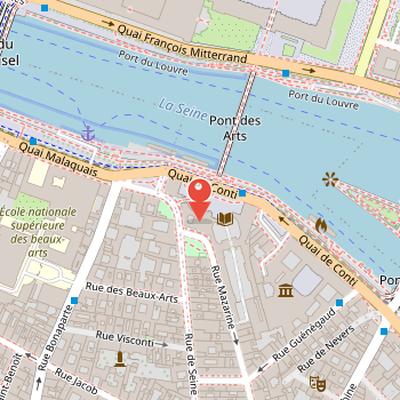
Nearby Objects
-
 Bibliothèque Mazarine 0 m away
 -
 French Academy of Sciences 20 m away
 -
 Equestrian Statue of Henri IV 300 m away
 -
 Musée national Eugène-Delacroix 300 m away
 -
 Pont Neuf 350 m away
Origins and Institutional Role
The Acade9mie des beaux-arts is an artistic institution and a member of the Institut de France. It was created by the ordonnance of 21 March 1816. The institution is presented as the heir to several earlier royal academies: the Acade9mies royales de peinture et sculpture, created in 1648; the Acade9mie royale de musique, dating from 1669; and the Acade9mie royale d'architecture, founded in 1671. This lineage places the Acade9mie des beaux-arts within a long institutional history of artistic and architectural practice in France.
Formation and Institutional Status
After the French Revolution abolished the old academies, the Institut de France was organized with three classes. One of these was the class of Littarature et Beaux-Arts, which included eight sections, among them grammar and languages. A consuls' decree then divided this class into three new classes, including one devoted to beaux-arts. This beaux-arts class became the basis of the new Academie in 1816. The Academie des beaux-arts later remained a public legal entity with special status under the 2006 research program law. In 1835, it held sessions on Saturdays, and its only public session that year took place on the first Saturday of October. The Grande salle de seances of the Institut de France was also proposed as the setting for a haute-couture fashion show by Pierre Cardin on the occasion of his 70 years career anniversary.
Vocation and Public Role
The vocation of the Académie des beaux-arts is centered on the defense and illustration of French artistic heritage, while also contributing to its development. It upholds a respect for pluralism in artistic expression, reflecting an approach that recognizes diversity within the heritage it supports. The Académie also plays an educational role by helping to ensure awareness of the arts in general education and by supporting the quality of education in specialized schools. Beyond its national responsibilities, it promotes the development of international artistic relations and establishes cooperation and exchange reports to support those connections.
Organization and Structure
The organization follows statutes of the Acadamie approved by decree. Under the 2026 decree, it is divided into nine sections and comprises sixty-nine seats distributed across them. In 2026, the Cinema and audiovisual section was renamed the Mise en scene section and gained two new seats. The president for 2026 is Jean Gaumy, a member of the Photography section. The organisation's secretaire perpetuel is Laurent Petitgirard, who was elected and reelected on unspecified dates.
Foreign Associate Members
The Academie des beaux-arts includes a group of foreign associate members, known as les membres associes etrangers. This group is made up of 16 members and represents each discipline by at least one foreign associate member. Their presence contributes to the international influence of the Academie des beaux-arts and supports the fulfillment of its missions. The arrangement reflects the institution's effort to maintain representation across disciplines while extending its reach beyond France.
Current Membership and Vacancies
The current membership of the Académie des beaux-arts includes a number of vacant and unfilled seats across its different categories. In section VII, there are 8 vacant seats out of 69, according to Decree No. 2026-142 of February 26, 2026. The oldest vacancy in this section is seat 2 of the painting section, left open since the death of Pierre Carron in 2022. Another long-standing vacancy is the seat of sculptor William Chattaway, whose death also left a seat open. As of the date given, 5 of the Academy's 61 members have been elected but not yet installed: Dominique Issermann, Marjane Satrapi, Guy Savoy, Eva Jospin, and Francoise Petrovitch. The Academy has elected 18 women since 2000, beginning with Jeanne Moreau, and currently has 17 women among its members. It also has 16 seats reserved for foreign associates, with 3 vacancies since the election of Diebedo Francis Kere and Jean Claude Gandur on May 13, 2026. In addition, the Academy has 59 correspondent seats for French or foreign members.
Grands Prix and Support for Artists
The Grands Prix de l'Academie were created in 2023 as part of the Academie des beaux-arts' support for artistic creation through artist residencies and prize donations. Each grand prix is awarded every three years for each of the nine sections of the Academie, with an endowment attached to the prize. The prize is granted to a laureate, who then distributes the amount to several artists chosen by the laureate. The awards are intended both to recognize an artist's work and to highlight less-known artists.
Publication History of Les Proces-Verbaux
The editorial project for Les proces-verbaux was launched at the Ecole des chartes by Jean-Michel Leniaud. Three volumes were first published by the Societe d'histoire de l'art francais, covering the period from 1796 to 1810. Publication was interrupted in 1943, then relaunched in 2001 with the thesis publication by Agnes Goudail. Between 2001 and 2008, nine additional volumes were added.