Bibliothèque Mazarine is a public library in Paris and the oldest library in France. It is located on the Quai de Conti in the Monnaie neighborhood of the 6th arrondissement, in the eastern wing of the Palais de l'Institut de France. The library is a library of scientific and literary interest and is under the supervision of the Ministry of Higher Education and Research, while remaining administratively dependent on the Institut de France.
Its collections originated from the personal library of Cardinal Mazarin. The first library was organized by librarian Gabriel Naudé, and its foundation is marked by the acquisition of Canon Descordes' library in August 1643. Naudé also enriched the collection with acquisitions from France and neighboring countries. Around 1648, the library had reached approximately forty thousand volumes and had become the most important collection in Europe. The Fronde interrupted its development, and the first library was destroyed when Mazarin fled Paris. A second library was later formed with the help of François de la Poterie and the remains of the first collection. Mazarin bequeathed this second library to the Collège des Quatre Nations, founded in 1661. The library has been open to the public since 1643.
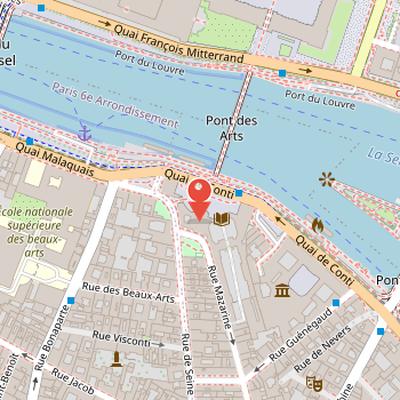
Nearby Objects
-
 Académie des beaux-arts 0 m away
 -
 French Academy of Sciences 20 m away
 -
 Equestrian Statue of Henri IV 300 m away
 -
 Musée national Eugène-Delacroix 300 m away
 -
 Pont Neuf 350 m away
The Mazarine Library in Paris
The Bibliotheque Mazarine is a public library in Paris and is recognized as the oldest library in France. It is located on the Quai de Conti in the Monnaie neighborhood of the 6th arrondissement. The library is devoted to scientific and literary interests, reflecting the breadth of its collections and use. Administratively, it is dependent on the Institut de France and is under the supervision of the Ministry of Higher Education and Research. Its collections originated from the personal library of Cardinal Mazarin, giving the institution a historical foundation linked to a major private collection.
From Cardinal Mazarin's Library to a Public Institution
The Bibliotheque Mazarine was created from Cardinal Mazarin's private library, and its foundation is marked by the acquisition of Canon Descordes' library in August 1643. Its first library was organized by librarian Gabriel Naude, who enriched it with acquisitions from France and neighboring countries. By around 1648, the collection had grown to approximately forty thousand volumes and was considered the most important collection in Europe. This early development was interrupted by the Fronde revolution, when the first library was destroyed after Mazarin fled Paris.
A second library was then formed with the help of Francois de la Poterie and the remains of the first collection. Mazarin later bequeathed this second library to the College des Quatre Nations, founded in 1661. The library has been open to the public since 1643, and it is located in the eastern wing of the building named Palais de l'Institut de France in 1805. Over time, it incorporated collections including Brienne, Rollan, and Jean Tileman Stella, reinforcing its role as an important scholarly resource.
Survival of the Mazarin Library
In 1649, the Parliament of Paris threatened to confiscate Mazarin's goods, including the library, and authorized the sale of furniture and paintings, although no final decision was made about the library itself. Gabriel Naude was entrusted with its custody during this period of danger. The Peace of Saint-Germain on 1 April 1649 provisionally saved the collection, and Mazarin's return to Paris allowed it to survive for a time.
The situation worsened in December 1651, when Parliament placed a price on Mazarin's head and decided to sell all the contents of his palace, including the library, to raise 150,000 livres. The collection was dispersed between 8 January and 17 February 1652. Even so, Naude managed to save a small part of it through various tactics. Mazarin returned triumphantly to Paris in February 1653.
Naude's Role in the Reconstruction
After returning to Paris, Mazarino called Naude back into the project. Naude had previously served as librarian for Queen Christina of Sweden, but he died on the way back. Responsibility for rebuilding the library was then entrusted to Francois de la Poterie. He recovered works that Naude had saved, repurchased Naude's personal library, and continued using Naude's methodology. This made the reconstruction a direct continuation of Naude's earlier approach, even after his death.
Growth, Bequest, and Revolutionary Survival
By 1661, Mazarino's second library had reached the importance of the first, and in that year he decided to leave it to the College des Quatre-Nations. He had founded the College by will for the education of sixty youths from Alsace, Flanders, Roussillon, and Pignerol. The legacy was later set out in the Cartas flagrantes given by King Louis XIV in March 1688, and these were registered in Parliament on March 23, 1688.
The library reopened in 1689 in the east wing of the College des Quatre-Nations building. During the eighteenth century, it served college students, foreign visitors, and scholars, and its collections expanded to more than sixty thousand volumes by the end of that century. Among its holdings is the Gutenberg Bible, known as the Biblia Mazarino.
The library remained active during the French Revolution because of its public status, even as the College disappeared. It also benefited from revolutionary confiscations through the work of librarian Gaspard Michel, called Abbot Leblond. From 1926 to 1945, the library was part of the Reunion des bibliotheques nationales de France.
Administration and Access
The Bibliotheque Mazarine depends administratively on the Institut de France since 1805 and occupies the old premises of the College of the Four Nations. It has been public and open to everyone since 1643. Its collections can only be consulted on site, and rare and valuable books are available for consultation only under certain conditions.
Collections and Guided Visits
The Bibliotheque Mazarine today holds around 600,000 volumes, with a valuable old collection of about 200,000 volumes of encyclopedic nature and a modern collection specialized in history. Its areas of emphasis include religious, literary, and cultural history of the Middle Ages and the 17th and 18th centuries, as well as the history of the book and local and regional history of France. The library retains more than 4,600 manuscripts, even though the Mazarino manuscript collection is now at the National Library of France, and it also holds 2,360 incunables. It is known for having the world's most important collection of mazarinades.
The collections were enriched in the 19th and 20th centuries by several important acquisitions, including the archives of Pierre-Antoine Lebrun, Joseph Tastu, and Arsene Thiabaud de Berneaud. Other holdings include the library and scientific archives of Albert Demangeon and Aime Perpillou in geography, the rich library of Dr. Marcel Chatillon on the history of the Antilles, and parts of the collections of chevalier de Paravey on travels, Jean-Jacques Ampere on Nordic civilizations, and Prosper Faugere on Pascal and Jansenism. The library continues to purchase books and manuscripts and remains specialized in historical disciplines.
For visitors, the library offers free guided tours for individuals. These last about one and a half hours and focus on the history of the library and its collections, its architecture and decoration, and its resources and services.