Saint-Germain l’Auxerrois is a Catholic church located in the 1st arrondissement of Paris. It was also called Saint-Germain-le-Rond and has been known as the “paroisse des artistes” since the Ancien Régime. The church is named in honor of Bishop Saint Germain d’Auxerre. Its site is on one of the mounds closest to the Seine and the Île de la Cité, in an area that also includes the mounds of Saint-Gervais, Saint-Merri, and Saint-Jacques. These elevations were surrounded by marshy lands called the Marais, which were flooded by the river during floods, and they hosted the first settlements on the right bank of Paris.
The origins of Saint-Germain l’Auxerrois were the subject of multiple 16th-century dissertations. Different authors attributed its foundation to Childebert, while others noted early references and rejected later traditions about its origin. A small oratory was first built in the 5th century at the site associated with Saint Germain of Auxerre, and the first church was built around 650 by King Chilpéric or Saint Landry. The present history of the church is linked to these early devotional and textual traditions.
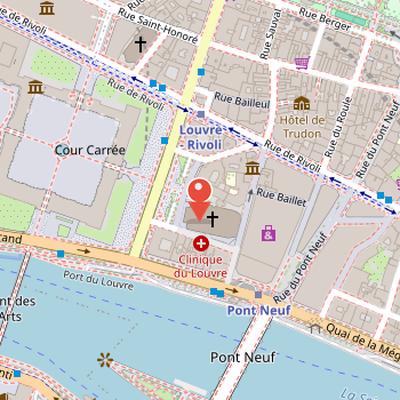
Nearby Objects
-
 Pont Neuf 200 m away
 -
 Equestrian Statue of Henri IV 250 m away
 -
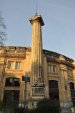 La colonne Médicis 350 m away
 -
 French Academy of Sciences 400 m away
 -
 Bibliothèque Mazarine 400 m away
Name and Cultural Identity
Saint-Germain l'Auxerrois is a Catholic church located in the 1st arrondissement of Paris. It was also known as the church Saint-Germain-le-Rond. The church is named in honor of Bishop Saint Germain d'Auxerre. Since the Ancien Regime, it has been known as the paroisse des artistes, or parish of artists, which gives it a lasting cultural association within the city.
The Church Mound and Early Settlement
The mound for the church Saint-Germain l'Auxerrois is described as one of the closest mounds to the Seine and the Ile de la Cite. Histoire notes that it belongs to a group of nearby mounds, including Saint-Gervais, Saint-Merri, and Saint-Jacques, which were surrounded by marshy lands called Marais and flooded by the river during floods. These mounds hosted the first settlements on the right bank of Paris, giving the site an early place in the city's urban history.
Origins, Restorations, and Royal Parish Status
The origins of Saint-Germain-l'Auxerrois were the subject of multiple 16th-century dissertations, and the historical record presents several competing traditions. Some writers, including Gilles Corrozet, François de Belleforest, and Germain Brice, linked the church to Childebert and proposed foundation dates in the mid-6th century. Other accounts challenged this attribution. Henri Sauval rejected Childebert and Ultrogothe as founders and also argued that the dedication to Saint Vincent was of recent origin, while noting that no charters on the church's beginnings were available to him. Abbé Lebeuf, by contrast, found a will from 690 that mentioned the church in a prominent position after the cathedral of Paris and before the abbey Saint-Vincent. Further early references appear in a diploma of Charles the Bald from 870, which names the church Saint-Germain-le-Rond, and in Abbon's Histoire du siege de Paris par les Normands, where the same name is used and an oratory is associated with a miracle of Saint Germain of Auxerre. Abbon also opposed the idea of an ancient dedication to Saint Vincent. The name abbatia Sancti Germani Rotundi later appears in papal bulls of 983 and 1165.
According to Histoire, a small oratory may first have stood on the site in the 5th century, at the location of a meeting between Saint Germain of Auxerre and Saint Genevieve during his second trip to Brittany, or possibly where a miracle was performed. A first church was then built around 650 by King Chilperic or Saint Landry, on the site of a chapel from 540 dedicated to Saint Germain d'Auxerre for King Childebert and Queen Ultrogothe. Chilperic intended it to become the future tomb of Saint Germain, but he died assassinated in 584, leaving the church unfinished on rue Perrault. Histoire also notes that the church was one of four sites marking the cardinal points of Paris in 581, with Saint-Germain-l'Auxerrois corresponding to the north. Saint Landry, bishop of Paris, died around 655 or 656 and is buried at the church.
The first church was destroyed during the Viking siege of Paris in 885-886 and rebuilt in the 11th century under Robert II the Pious. Under Pepin the Short, Saint Germain's body was moved from chapel Saint-Symphorien to the chancel of the Saint-Vincent church. The church was then renamed Saint-Germain or Saint-Vincent and Saint-Germain des Pres, possibly to distinguish it from similarly named churches. During the reign of Philippe le Bel, a papal indulgence of 1290 by Pope Nicolas IV introduced Saint Vincent as a second patron, although Histoire states this dedication appeared only at that time.
From the late 10th century, the parish belonged to one of the oldest in Paris and was originally the largest, extending from rue Saint-Denis to Montmartre and Chaillot. Before the Battle of Bouvines, King Philip Augustus took Saint Germain as protector, and after the battle he gave thanks at the church near the newly built Louvre. This action made the parish a royal parish. In the 13th century, its territory was reduced by the creation of the parishes of Sainte-Opportune, Saints-Innocents, and Saint-Leufroy, while Saint-Eustache was founded in 1223 from chapel Sainte-Agnes. These new parishes corresponded with urban development around the Champeaux market. By 1300, the parish was limited to the area inside the Philippe-Auguste enclosure west of rue Saint-Denis, between rue Saint-Honore and the Seine, and Histoire describes it as the most populated parish in Paris. In the 14th century, after the Valois reestablished themselves at the Louvre, Saint-Germain-l'Auxerrois became the church appointed to the royal family.
Medieval Fabric and Historical Associations
Histoire describes Saint-Germain l'Auxerrois as one of the oldest edifices in Paris. The oldest part of the church is the bell tower, which dates from the 12th century. It was once topped by a spire that was removed around 1754 and replaced by the current balustrade. Other early parts include the western portal and the chapel of the Virgin, both constructed around 1220-1230. The chapel of the Virgin occupies the second south collateral of the present church and contained the parish altar. Histoire attributes the probable complete reconstruction of the choir to the years 1340-1358, followed by a large-scale reconstruction of the nave, transept, and western porch in the 15th century.
The church is also linked to major events in French history. It is associated with the Saint Bartholomew's Day massacre, which was triggered by its alarm ringing on the night of August 23. Jacques Hillairet notes that such bell ringing on Saint Bartholomew's Day was customary to call the faithful to midnight matins. Histoire adds that the signal used by the Guisards came from the church's small south tower, not from the town hall belfry. A bell named Marie, dating from 1527, still exists. The church later appears in other cultural references, including the marriage of Moliere there on February 20, 1662. In 1745, the jubee designed by Pierre Lescot and sculpted by Jean Goujon was destroyed during the chapter meetings that united Saint-Germain-l'Auxerrois with Notre-Dame de Paris. New choir arrangements began in 1756 from plans by architect Claude Bacarit approved by the Academy of Architecture, after which the choir columns were fluted and fitted with capitals sculpted with angel heads.
From Revolutionary Use to an Artists' Parish
During the Terror, Saint-Germain-l'Auxerrois was emptied and put to multiple non-religious uses, including as a fodder store, printing press, police station, and saltpeter factory. In 1795, Theophilanthropic worship was celebrated there, and the church restored its Catholic vocation in 1802. At that time, a project to demolish the church in order to open the Louvre colonnade with Place du Pont Neuf was considered but then abandoned.
The church also continued to be tied to major public and royal events. Louis XVII made his first communion there after the royal family returned to the Tuileries. Later, the church was devastated on the eleventh commemoration of the Duke of Berry's assassination by supporters of the July Monarchy, after which it was closed and destruction was again considered.
In the 19th century, Saint-Germain-l'Auxerrois became especially associated with artists. It had been the parish of artists since the end of the Ancien Regime, and Jean-Philippe Rameau was married there. The Society of Saint John for Christian art, founded by Lacordaire in 1839, held monthly mass at Saint-Germain, and the Willette vow mass for deceased artists was celebrated there on Ash Wednesday. The church also became the final resting place for many artists living near the Louvre, which earned it the nickname Saint-Denis du Genie et Talent. Since 1846, it has been protected as a historic monument.
Architectural Layout and Major Elements
Saint-Germain l'Auxerrois is built on a longitudinal plan in the shape of a cross, with a transept that is approximately long and wide. The church has little projection at the transept, and its exterior includes a porch with five arcades and flying buttresses. A rose window is surmounted by a gable, and a Romanesque bell tower stands at the corner of the south transept arm and the choir.
The nave was built between 1476 and 1486 and is almost high. It consists of four bays in the Flamboyant Gothic style and is flanked by two aisles with shallow chapels. The nave is organized on two levels, with large arcades and high windows, and it is covered by quadripartite rib vaults.
The choir is the oldest part of the building, although its reconstruction date is unknown. It has five bays and was remodeled in the 16th century with fluting of the pillars. The choir ends with a semicircular apse with a sometimes double ambulatory and radiating chapels. At the first level, the building ends with a flat apse.
Architectural Features and Decorative Program
Saint-Germain l'Auxerrois preserves notable elements from several periods of construction and restoration. It contains the only preserved porch example for a medieval Parisian church. The porch was originally built between 1435 and 1439 by Jean Gaussel, during the English occupation of Paris, but only the two lateral pavilions survived after a reconstruction between 1490 and 1498. Its flamboyant Gothic vaults have liernes and tiercerons, with keystones representing the Nativity and the Last Supper, alongside usual vegetal and animal ornamentation.
The church also features stained glass windows dating from the 16th century, and its interior contains numerous works of art, including paintings, statues, and furniture. Most of the saints' statues date from the 19th century and are copies of the original works, while the main entrance portal also dates from the 19th century. The main portal tympanum, now missing, depicted the Last Judgment, and the archivolts and niches were heavily restored in the 19th century.
On the facade, the second-level rose window was redone during restorations in the first half of the 19th century. The gable is pierced by an oculus and surmounted by an angel resting on a turtle, a sculpture commissioned in 1840 from Carlo Marochetti and restored around 1928. The nave buttresses and gargoyles are also decorated with sculpted animals, including hippopotamus, monkeys, and bears. Around the central chapel facing rue de l'Arbre-Sec, a decorative frieze of carp sections and rosettes was funded in 1505 by the wealthy draper Tronson.
Interior Chapels and Decorative Program
The interior of Saint-Germain l'Auxerrois reflects a long sequence of additions and restorations carried out under Louis XV, while preserving a complex architectural and devotional layout. The nave is elevated in flamboyant gothic style, with four bays and double collateral aisles. It has two levels without a triforium, and its large high windows, now filled with white glass, date from 1728. In the north collateral fourth bay, an honorary bench with a wooden canopy was installed for Louis XIV and the royal family. Sculpted by Mercier between 1682 and 1684 from designs by Perrault and Lebrun, it was mutilated in 1831 and later restored under Louis-Philippe in keeping with the original design. Opposite it stands a pulpit designed by Lebrun in 1684.
The choir contains an organ and a one-lancet stained glass window. The church also includes several chapels, among them Saint-Michel and baptismal fonts, Saint John the Baptist, and Saint Madeleine. In the Notre-Dame de Compassion chapel, a monumental varnished Flemish wooden retable from the early 19th century was donated by the count of Montalivet, minister of Louis-Philippe. Its first register presents five scenes: Marriage of the Virgin, Nativity of Christ, Dream of Jesse, Adoration of the Magi, and Presentation at the Temple. The upper register shows Mount to Calvary, Crucifixion, and Descent from the Cross, scenes compared with corresponding Passion retable scenes exhibited at the Louvre. A copy of the Vierge du pilier de la cathedrale Notre-Dame was placed in the same chapel in 2024.
The transept arms retained most of their stained glass windows until 2009, when a fire at the restoration workshop destroyed most of them and pieces of the stained glass. They were replaced by white glass. The north arm still preserves the legend of Saint Vincent and the legend of a saint pope, while other scenes, including those of the Passion, martyrs, the Public Life of Christ, and the Heavenly Court in the rose, have disappeared. In the north ambulatory, the Sainte-Clotilde chapel contains a retable by Sebastien Bourdon representing Saint Pierre Nolasque receiving the habit of the order of Notre-Dame de la Merci, as well as a stained glass window from 1845 by Quantin and Vigue showing Sainte Clotilde giving nuns the plan of the monastery she founded on the Sainte-Genevieve mountain.
The Notre-Dame de la Bonne-Garde chapel, also known as Saint-Louis chapel, was conceded in 1647 to the Marquis de Rostaing. It contains a stained glass window depicting Saint Louis rendering justice under the oak of Vincennes and a statue of the Holy Virgin from 1812, which was miraculously spared during the 1831 riots. Since 1850, the chapel has been covered with ex-voto plaques on the walls and columns as thanks for the Virgin Mary's intercession. The exterior sculptural program also includes northern statues of Queen Ultrogothe, King Childebert I or King Robert and Queen Constance, Saint Germain, Saint Genevieve, and an angel, while the central door trumeau statue of the Madonna dates from 1841 and replaces the original Saint Germain statue, which survives in the Chapel of the Virgin. Louis Desprez created several other statues in 1841, including Sainte Bathilde, Sainte Clotilde, Sainte Isabelle de France, Sainte Jeanne de Valois, and Sainte Radegonde. A statue of Sainte Marie d'Egypte, copied from a late 17th-century original now in the Chapel of the Virgin, is also part of the decoration.
Chapels, Tombs, and Later Decorations
Saint-Germain l'Auxerrois contains several chapels with distinct histories and fittings. Among them are the chapelle saint Vincent de Paul, which has a Louis XIII wooden altar and four twisted columns entwined with ivy leaves, the chapelle saint Charles Borromee, the chapelle Sainte-Genevieve, and the chapelle des Saints-Patrons, completed in 1583. The chapelle des martyrs saint Denys, saint Rustique et saint Eleuther is described as the narrowest chapel and the only one with a semicircular vault.
The church also possessed many tombs, including a vault for persons without individual graves who had been granted burial rights in the church. During remodeling of a chapel in 1841, many coffins were discovered. One chapel contains the mausoleum-cenotaph of the marquis de Rostaing family, commissioned in 1659 and created by Philippe de Buyster. Originally placed in the chapelle Notre-Dame-de-la-Bonne-Garde, it was transferred to the French Monuments Museum and returned in 1824 to another chapel in the same church. It is decorated with two kneeling orants, Charles and Tristan, facing visitors.
The chapelle du Tombeau, founded in 1505 by Jehan Tronson, a wealthy cloth merchant, still contains the remains of the Tronson family. Tronson had decorated the church exterior with a carp frieze, and the chapel later became the seat of the cloth merchants' confraternity for meetings and mass celebrations. Its tombs were desecrated during the 1831 sack, after which the chapel was painted and decorated in antique style by Auguste Couder in 1844. The chapel also has stained glass windows by Etienne Thevenot from 1840, inspired by Sainte-Chapelle, and a Louis XVI style altar from 1840 made of Conflans stone with a Christ figure of uncertain origin.
Other features include the chapelle de la Bonne-Mort, formerly called du Saint-Sacrement, which was completely rebuilt in 1841. It contains stained glass windows by Etienne Thevenot from 1859, showing Saint Pierre barefoot with two crossed keys, four central compartments with Saint Joseph, the Virgin, Christ, and Saint Michel, and a heraldic-looking figure holding a pot of aromatics and a spade. The church also has two statuettes near the communion rail depicting Sainte Anne and Saint Antoine de Padoue, a stained glass window representing Tobie by Etienne Thevenot, and a life-size marble Pieta by Bonnardel from 1859.
Chapelle Saint-Landry
The chapelle Saint-Landry contains decoration dating from 1843 to 1845. Its walls are decorated with oil-painted murals by Joseph Guichard showing the life of Saint Landry, and the altar includes a Neo-Gothic retable by the same artist. The chapel also houses two 17th century funerary statues of Etienne d'Aligre, father and son, by Laurent Magnier. These statues came from the d'Aligre family tomb, which was originally in the church of Saint-Germain l'Auxerrois. They were later included in Alexandre Lenoir's first museum of French Monuments collections, restored by Louis-Denis Caillouette around 1838, and then reinstalled in the chapelle Saint-Landry.
Chapels, Retables, and Later Restorations
The description of Saint-Germain l'Auxerrois includes several chapels and devotional furnishings from different periods, as well as later additions and restorations. Among the chapels are the Chapel of the Holy Apostles, built in 1502; the Chapel of Fathers and Doctors of the Church, built in 1504; and the Chapel of Saint Peter, built in 1506. The Chapel of Fathers and Doctors of the Church contains The Consecration of Saint Genevieve by Jacques-Augustin Pajou, dated 1818 and offered by Louis XVIII. The former Chapel of Saint Victor, or of the Dying, was suppressed around 1730 and converted into a small sacristy for chaplains.
The church also includes an ambulatory with chapelles rayonnantes on the south side, as well as a Gothic door of the sacristy. One description mentions a door decorated with acanthus leaves and curled cabbages, designed by Lassus and sculpted by Plantard, with a polychrome 15th-century statue of the Virgin, called Virgin with the Bird, from Troyes, placed above it.
Several artworks are associated with the interior. These include a retable neo-gothique by Joseph Guichard, a retable of Flemish style, and a Marian triptych from the French school dated between 1510 and 1530, originating from La Flamengrie (Aisne). This triptych has painted panels and a polychrome wooden sculpted case. Confiscated during the Revolution and initially sold, it was purchased by the parish in 1831 during restoration works, but remains incomplete and has not been restored to its original state.
Other described elements include frescoes by Victor Mottez on the former sacristy door, including Saint Martin on horseback cutting his cloak for a poor person, and an inscription on the inner face of the square tower pillar related to Willette's vow concerning a mass held every Ash Wednesday for artists to die that year. The descriptions are also associated with Etienne d'Aligre, Etienne II d'Aligre, and a fresco of Saint Martin cutting his cloak by Victor Mottez.
The Chapel of the Virgin and Its Glass
The Chapel of the Virgin was formed in the 20th century by combining four old chapels from the right side after the south transept. It is isolated from the south collateral by woodwork and is not placed on the central axis of the church at the extremity of the apse. Most of its decoration dates from the 20th century, although it also contains several older statues added later. Among these are the original statue of Saint Mary the Egyptian under the porch and a 16th century statue of Saint Germain of Auxerre. The chapel is nearly closed on the interior collateral side by a richly styled Gothic wooden panel about 6 m high from restoration works, while its east side is closed by a wall bearing a fresco titled Coronation of the Virgin by Amaury-Duval, a pupil of Ingres. This fresco shows a statue of Mary Queen of Heaven with a crown and blue garment at its center. The chapel also contains various artworks, paintings, sculptures, and many tombs, including the tombstone of Theophraste Renaudot. One of its notable glass works is the stained glass window of the Passion, installed in 1839 and regarded as a prototype of neo-Gothic work by chemists, historians, and archaeologists. It is composed of small juxtaposed scenes set in mostly red and blue medallions and is described as historicist, inspired by windows of past centuries such as those of the Sainte-Chapelle and manuscripts.
The churchs stained glass heritage was long preserved in the north and south arms of the transept, which kept most of the windows until 2009. In July 2009, a fire at the restoration workshop destroyed most of the stained glass windows and some pieces. Among the losses were the rose window of the facade and the Incredulity of Saint Thomas window, executed by Jean Chastellain in 1532 on cartons by Noel Bellemare. Jean Chastellain also executed another stained glass window in 1533, and an Assumption of the Virgin window was made around 1534-1535. The church also presents 19th century stained glass windows in the chapels, including works by Laurent-Charles Marechal and Louis Napoleon Gugnon between 1844 and 1847. The right side in the Chapel of the Virgin at the south collateral shows Old Testament characters, while the small chapels of the north collateral show mainly New Testament figures. All of the stained glass windows are classified as MH.
The Organ of Saint-Germain l'Auxerrois
Saint-Germain l'Auxerrois had large parish organs before the Revolution, and its first organ was arranged on the south transept gallery. The current organ was transported from Sainte-Chapelle; it had been built twenty years earlier by Francois-Henri Clicquot and was installed in a case designed by Pierre-Noel Rousset. It also recovered instrumental material from the Ecole militaire and the collegiale Saint-Honore. At the time, the instrument featured a Bourdon 16' on four manuals and a 16' pedal. Louis-Paul Dallery maintained the organ from its installation and was then entrusted with a major restoration in 1838 after the church reopened. Alexandre Boely was appointed organist after these works and requested the installation of the first independent pedalboard for Bach's works.
Between 1847 and 1850, Pierre-Alexandre Ducroquet supervised further modifications. These reduced the manuals from four to three, installed new grand organ windchests, created an expressive swell keyboard starting at F sharp 2, and reduced mutation stops while introducing free reed stops such as euphoniums and English horn. The development of the instrument reflected Alexandre Boely's changing musical tastes, but he was dismissed in 1851. Eugene Vast served as choir organist without titular appointment until 1909. In 1864, Joseph Merklin modified the organ again, fitting it with a Barker lever system for the grand organ and manual couplers, new pedal windchests, and an extended swell keyboard beginning at C2. He also removed the free reed stops except for the euphonium, renamed clarinet on the positive, replaced the grand organ trumpet 16' with bombarde 16', and equipped the foundation stops with flared pipes.
Later titulary organists included Marcel Rouher, Jean Pergola, Michel Chapuis, Leon Souberbielle, Ricardo Miravet, and Henri de Rohan-Csermak. In the 1970s and 1980s, Adrien Maciet modified the organ by replacing the salicional, flute 4', and clarinet stops with tierce, cromorne, and pleins-jeux, while retaining a Clicquot keyboard windchest as part of an illusory return to Clicquot. He also moved the Bombarde 16 pedal stop back to restore the two Clicquot trumpets. The organ deteriorated and became silent in 1995, then drew international attention at study days organized by the Association Aristide Cavaille-Coll in 2004. Michel Goussu re-vented it in 2005, allowing occasional use, and Laurent Plet carried out a minimal restoration in 2008 that preserved historic materials and enabled correct wind, tuning, and harmony. This work kept Maciet's additions but included re-harmonization and reclassification, returned the grandes anches of Clicquot to their original position, restored the grand jeu of Clicquot, revealed the significance of Merklin's foundation stops after cleaning, and rediscovered the previously inaudible Ducroquet recit stop. Despite regular maintenance, the organ continued to deteriorate and required revitalization. Restoration work was commissioned to organ builder Jean-Baptiste Gaupillat in 2021, and the grand organ condition still requires complete restoration. The current titulary organists are Michael Matthes, appointed in 2021, and Victor Sousa, substitute organist since 2022.
Organ Console and Keyboard Layout
The organs at Saint-Germain l'Auxerrois are described through their console and keyboard ranges. The grand organ and positive keyboards each have 54 notes, extending from C to f3, while the recit expressif keyboard has 42 notes, from c to f3. The pedalboard has 27 notes, ranging from C to d1. The couplers for this instrument include POS/GO, REC/GO, GO/PED, and POS/PED. The grand organ also uses a Barker machine. A separate choir organ is similarly specified: its keyboards have 54 notes from C to f3, and its pedalboard has 27 notes from C to d1. Its couplers include REC/GO, GO/PED, and REC/PED.