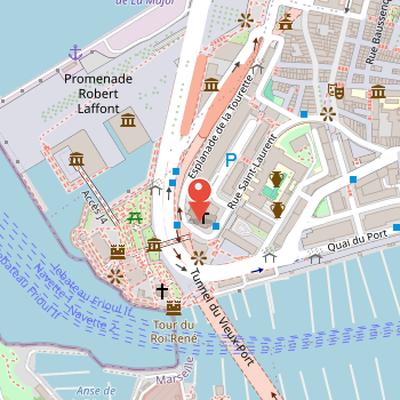
Eglise Saint-Laurent is a Romanesque Provençal church located at 16 esplanade de la Tourette in Marseille, on Saint-Laurent hill, also called La Tourette. Positioned near Fort Saint-Jean and the Babon castle, it occupies a site closely linked to the early history of the area. The surroundings include remains of Greek habitation from the foundation of the Phocaean city, and an archaic Ionic capital discovered at the base of the hill in 1952, now displayed at the Marseille History Museum.
According to the historical account provided, the church was built at the end of the 10th or beginning of the 11th century, using pink dressed stone from Cap Couronne. It was later remodeled in the 13th century, and its apse was rebuilt in the early 14th century with an octagonal bell tower reached by a spiral staircase in a turret. In 1668, part of the western end was removed for the construction of Fort Saint-Jean, and the main door was moved to the south side. The church later became associated with fishermen and seafarers, and it remained in use after reopening in 1801 following a period of closure during the Revolution.
Nearby Objects
-
 Villa Méditerranée 200 m away
 -

-
 Place de Lenche 250 m away
 -
 Hôtel de police de Marseille 400 m away
 -
 Vieille Major 450 m away
Location and Parish Role
Eglise Saint-Laurent is a church in the Romanesque Provencal style, located at 16 esplanade de la Tourette in Marseille. It stands near Fort Saint-Jean and is situated on a hill that gave its name to the hill. The church serves as the parish for the fishermen and seafarers of Marseille, giving it a specific local role within the citys maritime community.
Archaeological Setting on Saint-Laurent Hill
Eglise Saint-Laurent is located on Saint-Laurent hill, known as La Tourette, near the Babon castle. The surrounding area contains remains of Greek habitation connected to the early Phocaean foundation of the city. In 1952, an archaic Ionic capital was discovered at the base of the hill. Its later reuse suggests the possible presence of a sanctuary or an Apollo temple in the area, although it cannot be confirmed that the Saint Laurent church itself was built on the sanctuary site. The Ionic capital is now displayed at the Marseille History Museum.
History and Architecture of the Church
The Church of Saint-Laurent in Marseille stands on a site linked to an earlier fortified enclosure said to have been built by Bishop Babon in 870 after Saracen pillages in 838 and 842. The church itself was built at the end of the 10th or beginning of the 11th century, using pink dressed stone from Cap Couronne. In 1249, under Bishop Benoit d'Alignan, it became the fourth parish of Marseille.
The building underwent several changes over the centuries. It was remodeled at both ends in the 13th century, and in the early 14th century the apse was rebuilt to add an octagonal bell tower reached by a spiral staircase in a turret. In 1668, a bay on the west end was removed for the construction of Fort Saint-Jean, and the main door on the west facade was moved to the south side.
By the middle of the 17th century, the church had become the parish for fishermen, called sanjanen. During a plague epidemic, a mass was celebrated in front of the church by the Bishop of Marseille with fishermen and caulkers present. During the Revolution, Vicar Bouzon submitted an inventory of the church furniture and silverware, and all copper and silver items were sent to the mint to be converted into ingots. The church was then closed and used as a military equipment warehouse until reopening in 1801.
The church was spared destruction by dynamiting in 1943, although it was strongly shaken by explosions during the destruction of the adjacent neighborhood. Architecturally, it is described as Romano-Provencal, simple, and without a transept. The nave and side aisles end eastward with an apse and apsidioles, and the church has no sculptural decoration. It contains a polychrome wooden statue of the Virgin and a gilded wooden statue of Saint Laurent from the late 15th century. The baptistery chapel is currently invisible awaiting restoration, while the baptistery from the 6th century is located in the Church of the Mission of France in Marseille. The Church of Saint-Laurent was classified as a historic monument by order dated 25 April 1946, and the baptistery chapel was listed as a historic monument by order dated 15 November 1946.
Liturgical and Cultural Life
According to the historical record provided, Abbé Victor Party allowed the folkloric group Lou Carreto de Marsiho to perform Provençal music after Sunday mass until the 1980s. The same record also states that Abbé Victor Party appeared as himself in Marcel Pagnol's films. These details indicate a link between the church, local religious practice, and Marseille's cultural life.