The Museum of European and Mediterranean Civilisations is a national museum located in Marseille. It was inaugurated by President François Hollande when Marseille was European Capital of Culture, and it was established to provide the city, France’s second city, with a major cultural facility under the Ministry of Culture. The museum is dedicated to the cultural anthropology of European and Mediterranean societies and aims to document the historical and social continuities and tensions of its civilization basin. Its collections include holdings inherited from the former National Museum of Arts and Popular Traditions. The museum’s permanent exhibitions cover anthropology, archaeology, history, art history, and contemporary art, while temporary exhibitions are linked to current artistic or social topics. The museum is composed of three distinct sites: the J4, the fort Saint-Jean, and the Centre de Conservation et de Ressource. The J4 building, designed by Rudy Ricciotti, is a 72-meter cube with façades encircled by a concrete lattice and stands on the former Jetée J4 of the port of Marseille.
Nearby Objects
-
 Villa Méditerranée 80 m away
 -
 Eglise Saint-Laurent 200 m away
 -
 Place de Lenche 350 m away
 -
 Palais du Pharo 400 m away
 -
 Hôtel de police de Marseille 450 m away
Architecture and Cultural Role
The Museum of European and Mediterranean Civilisations is a national museum located in Marseille. It was inaugurated by President Francois Hollande when Marseille was European Capital of Culture, and it was established to provide France's second city with a major cultural facility under the Ministry of Culture. The building was constructed by French architect Rudy Ricciotti.
The museum is a societal museum dedicated to the cultural anthropology of European and Mediterranean societies. It inherited collections from the former National Museum of Arts and Popular Traditions, and its mission is to document the historical and social continuities and tensions of its civilization basin. Its permanent exhibitions cover anthropology, archaeology, history, art history, and contemporary art, while temporary exhibitions are linked to current artistic or social topics.
The museum has become a significant public attraction for Marseille and the Aix-Marseille-Provence metropolitan area. Between 2013 and 2016, it received millions of visitors, including visitors in exhibition spaces, and attendance reached 1.3 million visitors in 2023. In 2015, it won the Museum Prize of the Council of Europe.
Architecture and site arrangement
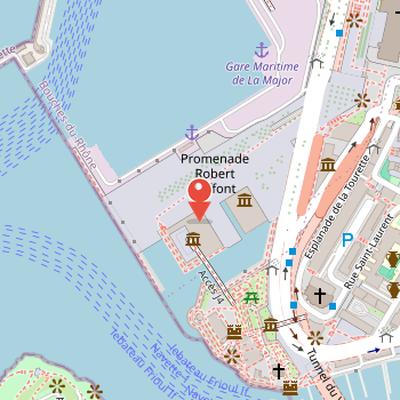
The Museum of European and Mediterranean Civilisations is composed of three distinct sites: the J4, the fort Saint-Jean, and the Centre de Conservation et de Ressource. The new J4 building by Rudy Ricciotti, with associate Roland Carta, is linked to the fort Saint-Jean by a 130-meter footbridge crossing a dock. A second footbridge of approximately the same length connects the fort Saint-Jean to the esplanade de la Tourette through the old Porte royale. The J4 was built between 2006 and 2013 on the former Jetee J4 of the port of Marseille and was described as a building of stone, water, and wind. It was inaugurated with the laying of the first stone by Frédéric Mitterrand, Minister of Culture.
The J4 is presented as a 72-meter cube with a ground area of 15,000 square meters and two exhibition levels for permanent and temporary displays. Its facades are encircled by a distinctive concrete lattice, and the structure is supported by 143 pillars molded from ultra-high performance fiber reinforced concrete. The same material was used for the two footbridges, which have adjustable supports. The building measures 72 meters on each side and 18 meters in height, reflecting an intention of architectural experimentation. Two exterior ramps begin on the ground floor and wind around the building to the terrace. The interior also includes a 150-seat auditorium, a document projection space in partnership with INA called the Medinatheque, a children's area, museum office spaces, and two bookstores. Yann Kersale illuminated the J4 building.
Exhibition and Heritage Spaces
The Museum of European and Mediterranean Civilisations organizes its exhibitions across several distinct spaces. On the ground floor, the Mediterranean gallery covers 3,500 square meters and presents the singularities of the Mediterranean world through objects and artworks from the Mucem collections. On level 2, two temporary exhibition rooms of about 500 square meters each are used for works presented as expressions of the societies that produced them, with themes focused on Mediterranean history or contemporary mythologies of European and Mediterranean societies. The gallery d'actualite also presents updates from the collections through thematic expos-dossiers.
The museum manages Le fort Saint-Jean, an ancient military site ceded to the Ministry of Culture in 1962 and classified as a monument historique. Overlooking the entrance to the Vieux-Port and facing fort Saint-Nicolas and fort d'Entrecasteaux, the fort includes different spaces under museum management. These include the galerie des Officiers, dating from the mid-17th century, the tour du Fanal from the same period, and the chapel located within the original foundation of the Hospitaliers de l'ordre de Saint-Jean et de Jerusalem. The museum also maintains the jardin des migrations on the heights of the fort, where plants emblematic of the Mediterranean basin are conserved and a panoramic view of Marseille is offered. Summer events are programmed at the place d'Armes, including concerts, projections, and meetings. The building Georges-Henri-Riviere, located on the place d'Armes, is used as a temporary exhibition space, and contemporary artworks are exhibited in the chapel.
Beyond exhibitions, the museum is involved in professional training and research-related activity through the Institut mediterraneen des metiers du patrimoine, established by convention between Mucem and the Institut national du patrimoine. The institute conducts professional training, hosts scientific and professional meetings, and works with higher education institutions to develop training that combines cultural knowledge of Europe and the Mediterranean with museum professional practices. Scientific teams also contribute to many master's and doctoral level programs nationally and internationally. Since 2014, the museum auditorium at J4 has hosted Ecole du Louvre courses for Marseille.
Museum reserves and technical collections processing spaces are located in the Centre de conservation et de ressources, in the Belle de Mai neighborhood. Built by Corinne Vezzoni and Andre Jollivet and delivered in 2013 under a public-private partnership between the Ministry of Culture and the Icade group, the CCR operates on three levels and includes conservation and research spaces as well as climate-controlled reserves for all types of objects and works in the collections. Restoration activities are also carried out there.
Origins and Museum Lineage
The Museum of European and Mediterranean Civilisations, known as the Mucem, was inaugurated in Marseille in 2013 and is presented as the first French national museum dedicated to European and Mediterranean cultures. Its history is linked to a museographic institution dating back to the end of the 19th century. This lineage begins with the Musee d'Ethnographie du Trocadero, created in 1878 and in existence until 1936, which later gave way to the Musee de l'Homme after the old Trocadero institution. During the interwar period, the museum focused on French rural life, with two main themes: social and cultural life, and material culture.
A further stage in this history was the Musee national des Arts et Traditions populaires, founded in 1941 and supported by Georges Henri Riviere. In 1972, the MNATP collections moved from the Palais de Chaillot to Bois de Boulogne, into a new building designed by Jean Dubuisson. Its acquisition policy then expanded toward urban craftsmanship, trade, circus, and fair arts. The collection of popular prints became one of the largest in France and a reference alongside the BNF print collection. The Mucem collections come from the MNATP and the Musee de l'Homme in the Palais du Trocadero, reflecting this long institutional and collecting history.
From MNATP to Mucem
In the early 2000s, a new acquisition policy was established for the Mucem, reflecting a broader redefinition of the institution. The Musée national des Arts et Traditions populaires in Paris had experienced a decline in visitors in the 1990s, and relocation to Lyon, Lille, or Marseille was considered. In 2000, a committee confirmed the transformation and relocation into Mucem, and Michel Colardelle was assigned to develop the new project. An international scientific committee was also formed, underlining the project’s institutional and scholarly ambitions.
The collection strategy was broadened in stages. Histoire notes that between 1992 and 2000, new thematic acquisitions included rock, urban cultures, AIDS, industrial heritage, and cuisine. From 1999, acquisition policy targeted North Africa and the Near Eastern Mediterranean, and in 2005 the geographic domain expanded further with the deposit of the European collection from the Musee de l Homme. The collection is described as including popular prints, furniture, costumes, jewelry, and printed materials.
Construction of the Mucem was part of the Euromediterranee urban renewal project for the economic revitalization of Marseille. The museum was built on the former Hangar J4 site, a location linked to Marseille and Algiers by boat, at the pass from the port to the Vieux-Port in the Saint-Jean neighborhood. Histoire also identifies this area as Les pierres plates, a local social area used for swimming and picnics.
The institution closed the Musee national des Arts et Traditions populaires in Paris to the public in 2005. After opening, the Mucem drew 18,000 visitors over its opening weekend and was expected to receive 250,000 visitors per year. In Histoire’s description, it functions as a scientific department of national museums and a major social museum for European and Mediterranean cultural anthropology in France. It later received the Council of Europe Museum Prize in 2015, and in 2022 it hosted an exhibition on Emir Abd el Kader that addressed issues of history and memory around this Mediterranean figure.
Collections and Acquisition Policy
The collections of the Museum of European and Mediterranean Civilisations were formed from several earlier public holdings. The project began with the collections of the musee des ATP, whose material was held partly at the Paris site and in external reserves. Prints, sound archives, and the library were processed later. The collections also include those of the former MNATP and the Europe department of the musee de l'homme. From the musee de l'homme, approximately items were transferred to Marseille, along with additional books, prints, and sound archives. Since 2013, the museum has continued an acquisition policy through purchases, donations, and field surveys, extending the approach of the two previous institutions. By 2021, these holdings formed a unique national public collection numbering around one million items.