The Arènes de Cimiez is a Roman amphitheatre located in the Cimiez district of Nice. Constructed in two successive campaigns between 70 and 80 AD, it is one of the smallest amphitheatres recorded in Gaul. The monument was apparently abandoned in the 3rd century and was later excavated in the 1930s and 1940s, with further excavation in 2007.
The amphitheatre occupies the northwest corner of a Roman city covering about twenty hectares. The Roman baths of Cimiez are located to the southeast. The first construction phase included the arena and three rows of stands on an embankment, while holes on the exterior face of the monument have been associated with beams. These features were once interpreted as possible supports for a wooden stand framework. The site was classified as a historical monument in 1965. It is open to the public and continues to host cultural events.
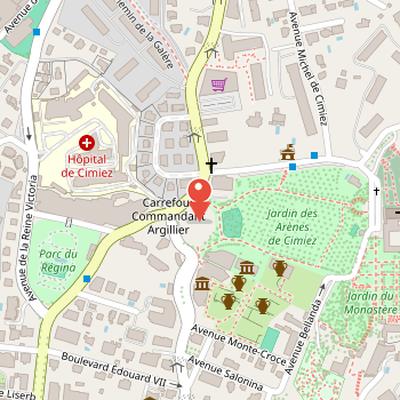
Nearby Objects
-
 Musée Matisse 90 m away
 -
 Monastère de Cimiez 300 m away
 -
 Château Valrose 800 m away
 -
 Abbey of St Pons 850 m away
 -
 Sainte Jeanne d'Arc Church 1300 m away
Roman Amphitheater in Cimiez
The arenes de Cimiez is a Roman amphitheater in the Cimiez district of Nice. It was constructed in two successive campaigns between 70 and 80 AD. It is one of the smallest amphitheaters recorded in Gaul, with an estimated capacity not specified in the provided facts. The site was apparently abandoned in the 3rd century.
The amphitheater was excavated in the 1930s and 1940s, and again in 2007. It was classified as a historical monument in 1965. Today, it is open to the public and continues to host cultural events, giving the ancient structure an ongoing role in the citys cultural life.
Location within the Ancient City
The location of the arenes de Cimiez is used to identify the limits of the city shown on the Peutinger table through the placement of necropolises, which are situated outside the urban space by principle. Within this urban area, the amphitheater of Cimiez occupied the northwest corner of a city covering about twenty hectares. The Roman baths of Cimiez were located to the southeast of the amphitheater.
Construction, Alteration, and Restoration
The amphitheater underwent two main construction campaigns. Its first phase, at the end of the 1st century, included an arena and some seating, while pits had occupied the site before that time. The monument was later abandoned at the end of the 3rd century, a date supported by a Probus coin found in demolition materials. Before the year 350, the north and south entrances were modified, and the arena area was then occupied by a garden and vineyards. In a further change, the eastern seating was removed to create a street, which later crossed into the arena. Restorations subsequently brought the monument closer to its original configuration.
Design and Early Use of the Arena
The first construction phase of the arenes de Cimiez consisted of the arena and three rows of stands built on an embankment. On the external face of the monument, there are holes used to insert beams. These were at first interpreted as possible supports for the framework of wooden stands, but they are more likely to have been putlog holes used for scaffolding during the construction of the amphitheater. The amphitheater was also equipped with a velum, and some of its anchor points are still visible.
In its earliest state, the monument was small, which led researchers to regard it as a military amphitheater. This interpretation is now questioned. The absence of cages and pits excludes animal combat in the arena, and the limited size would also have made combats involving many gladiators difficult. It is now more likely that the site hosted games intended to entertain the population of the city.
Study, Remains, and Protection
The ruins at Cimiez were first signaled in 1559 by Michel de L Hospital, who noted remains of baths, an aqueduct, and a small theater. The small theater ruins were later identified as the amphitheater at Cimiez. Interest in the site continued in the nineteenth century, when architect Francois Brun made a plan of the Cimiez ruins in 1866, and excavations followed until 1880, focusing mainly on the baths. In the twentieth century, Jules Formige described the amphitheater at the 1932 Archaeological Congress in Aix-en-Provence, while Nino Lamboglia excavated ancient sites of Cimiez and Nice in the late 1930s. Paul-Marie Duval studied Cimiez in 1943 and published works on the amphitheater in 1946 and 1989. No further studies on the amphitheater are recorded before the twenty-first century, when a study excavation program was developed in 2007. The amphitheater building is classified as a historic monument by an order. Beyond its archaeological interest, it has maintained an ancient use for spectacles, hosting Nice Jazz Festival concerts from 1974 to 2010 and events for the Fete des Mai (Lu Mai).