Monastère de Cimiez is a Franciscan monastic complex on Cimiez hill in Nice. It was built on the basis of the Notre-Dame de Cimiez chapel, which was first mentioned in 1010 and was originally built by Benedictine monks of the Saint-Pons abbey. In 1546, the abbey ceded the chapel to the Observant Friars Minor, who enlarged and transformed it. Over the centuries, the Franciscans developed the architectural complex further.
The present complex includes the Notre-Dame-de-l'Assomption church and the Franciscan museum. The museum traces Franciscan life in Nice since the 15th century. The church contains three major paintings by Louis Bréa: Pietà, Crucifixion, and Déposition. The monastery is also associated with local Franciscan history, including brother Marc, known as fray Marcos de Niza. The entire monastery complex was classified as a historical monument by decree of 31 December 1992, while the ground of the former garden and cemetery was classified in 1923.
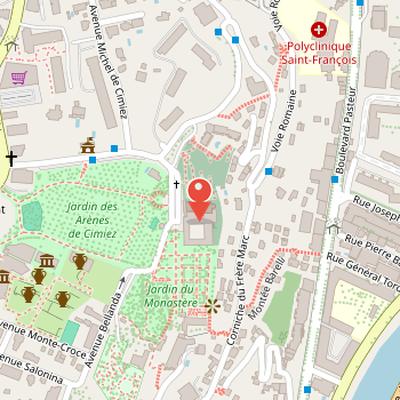
Nearby Objects
-
 Musée Matisse 250 m away
 -
 Arènes de Cimiez 300 m away
 -
 Abbey of St Pons 650 m away
 -
 Château Valrose 1100 m away
 -
 Musée Marc-Chagall 1400 m away
Monastery of Cimiez
The Monastery of Cimiez is a Franciscan monastery located on Cimiez hill in Nice. It was built on the basis of the Notre-Dame de Cimiez chapel, which had been built by Benedictine monks of the Saint-Pons abbey and was first mentioned in 1010. In 1546, the Saint-Pons abbey ceded the chapel to the Observant Friars Minor, who enlarged and transformed it. The present monastic complex includes the Notre-Dame-de-l'Assomption church and the Franciscan museum. The museum traces Franciscan life in Nice since the 15th century, linking the site to a long religious and cultural history in the city.
History and Religious Role of Monastère de Cimiez
The history of the Monastère de Cimiez is closely linked to the Franciscan presence in Nice. According to the source, the most famous Franciscan of Nice was brother Marc, later known as fray Marcos de Niza, who gave the name of the founder of his order to the site that would become San Francisco, California. The chapel Notre-Dame de Cimiez was originally built by Benedictine monks of the abbaye Saint-Pons and is already mentioned in an 11th century charter of that abbey. On 25 November 1547, the abbaye Saint-Pons ceded the chapel and the neighboring lands to the friars minor of the Observance, who had had no convent since the siege of Nice in 1543.
Over the centuries, the Franciscans developed the architectural complex of Cimiez. The monastery also became a point of religious gathering in the city: the penitents' confraternities of Nice once regularly joined a procession to the monastery through the arenas from chapel Ste Anne. The Franciscans of Cimiez are responsible for the parish Sainte-Marie-des-Anges in Nice, as well as Cimiez, Vallon des Fleurs, and the neighboring commune of Falicon. A fraternity of four brothers from Assisi, Italy, serves this parish.
The site has also received heritage protection. The former garden and cemetery were classified by decree on 19 February 1923, and the entire monastery complex was classified as a historical monument by decree on 31 December 1992.
The Church Interior and Louis Brea's Paintings
The church, named Notre-Dame de l'Assomption, contains three major paintings by Louis Brea: Pieta, Crucifixion, and Deposition. Together, these works represent 40 years of the artist's activity. Their presence gives the church an important artistic role within the Monastere de Cimiez, linking the building closely to a long span of local religious art.
The Cloister at Monastere de Cimiez
The cloister at Monastere de Cimiez is part of the monastery complex and is linked with the monastery fresco shown in Monast ere de Cimiez 04.jpg. It serves both cultural and religious functions: classical music concerts are held there during the Nuits Musicales de Nice, and Sunday masses are celebrated there in summer when the weather is good. The cloister also provides access to the church and convent buildings through place du Monastere.
The Monastic Gardens of Cimiez
The gardens surround the former vegetable garden of the monks, linking the site to its monastic past. They are associated with a local tradition that credits the Franciscan Fathers of the Cimiez monastery in Nice with inventing mesclun salad. According to the gardens, this was done by mixing various seeds to create lou mesclun. The gardens also refer to a custom in which doubled plants were given to the poor in an espourtoula basket, highlighting a practice of sharing and community support connected with the monastery.
The Cemetery Beside the Church
The cemetery is located next to the church and can be reached from the square. It is notable for containing the graves of the painters Henri Matisse and Raoul Dufy. The cemetery also includes the grave of Roger Martin du Gard, who received the Nobel Prize in Literature in 1937. These burials give the site a particular cultural significance within the Monastere de Cimiez complex.