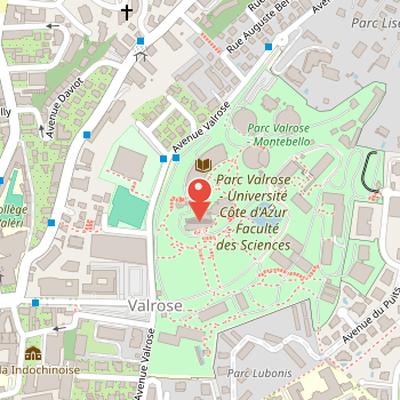
Located in the Valrose district of Nice, Château Valrose is a large property that has preserved its original dimensions. It includes the châteaux de Valrose and a park covering ten hectares between avenue de Brancolar and colline de Cimiez. The site now houses the campus of the training and research unit sciences of université Nice-Sophia-Antipolis and also hosts the university’s headquarters.
The estate was created at the end of the 19th century as a lavish Riviera property by baron Paul von Derwies, who acquired large parcels in the valley on February 7, 1861. Its château was built by architects David Grimm, Antonio Croci, and Constantin Scala, while Antoine Béranger was responsible for the small château. A concert hall was added in 1869, designed by Mikhaïl Makaroff. The château is described as Gothic in style, with luxurious interiors including fresco ceilings, crystal chandeliers, and master paintings. The park, designed by horticulturist Joseph Carlès, includes plants from Italy, among them palms from Bordighera and species from Genoa and Florence.
Nearby Objects
-
 Sainte Jeanne d'Arc Church 500 m away
 -
 Arènes de Cimiez 800 m away
 -
 Musée Matisse 800 m away
 -
 Musée Marc-Chagall 900 m away
 -
 Monastère de Cimiez 1100 m away
Valrose Estate and University Campus
Chateau Valrose is located in the Valrose district of Nice. It is part of a large property that has preserved its original dimensions and includes the chateaux de Valrose and a ten-hectare park between avenue de Brancolar and colline de Cimiez. The site houses the campus of the training and research unit sciences of Universite Nice-Sophia-Antipolis and also hosts the headquarters of Universite Nice-Sophia-Antipolis.
Construction and Estate Design
Chateau Valrose was created as a lavish estate on the Riviera at the end of the 19th century by Baron Paul von Derwies, who had acquired large parcels in the valley on February 7, 1861. The château construction involved architects David Grimm, Antonio Croci, and Constantin Scala, while Antoine Beranger was assigned to build the small chateau. The concert hall addition was designed by Mikhail Makaroff in 1869. Construction was extensive, employing over 800 workers for three years at a cost of several million francs-or.
The château is noted for its Gothic style and luxurious interiors, including fresco ceilings, crystal chandeliers, and master paintings. It also contains a concert hall with seating for 400 spectators and visible wooden stage machinery. The surrounding park was designed by horticulturist Joseph Carles, creator of Monte-Carlo gardens, and includes plants from Italy, such as palms from Bordighera and species from Genoa and Florence. Maintenance of the estate required around 100 people, including gardeners.
The property later received a monumental entrance gate with twin towers, built by Sebastien-Marcel Biasini in 1881 on avenue prince de Galles in Cimiez. Queen Victoria visited the estate and used the gate key to stroll in the olive grove.
From Private Residence to University Site
Chateau Valrose became a musical and social center between 1870 and 1881, when it featured a daily symphony orchestra of 70 musicians under leading conductors. It also hosted virtuosos including the violinist Joseph Joachim, the pianist Francis Plante, and the diva Adelina Patti. A grand reception for Grand Duke Nicolas took place there on August 9, 1881. Later that year, the owner, Baron Paul von Derwies, died of apoplexy on October 22, 1881.
The property passed through several owners after that period. Von Derwies's bank was declared bankrupt in 1899, the estate was sold to Poutiloff in 1912, and resold in 1920 to the Bolivian tin king Simon Iturri Patino, who changed the entrance inscription from Van Derwies to S. Patino. In 1950, the city of Nice purchased the property and transferred it to the Education nationale for the installation of the Valrose campus. Since 1965, it has housed the presidency of Nice-Sophia-Antipolis University and the faculty of sciences. The grand chateau, small chateau, park, garden structures, and statues were classified as historical monuments by decree on February 18, 1990.