The Abbey of St Pons is one of the oldest monasteries on the Côte d'Azur, alongside the Abbey of Lérins. It is located within the grounds of the Pasteur Hospital in the commune of Nice, in the Alpes-Maritimes department of the Provence-Alpes-Côte d'Azur region. The abbey’s church is classified as a historic monument by official decree, and the abbey church and cloister façades and roofs are registered as historic monuments by official decree.
The site is also associated with the history of Saint Pons. About thirty manuscripts of the Passion of saint Pons are known in French and foreign libraries. According to the historical account, the text was transcribed or printed dozens of times after the two oldest manuscripts, and its initial writing could not be earlier than the 7th or 8th century. The tradition places the martyrdom of Pons in 257 or 258, and states that he was buried in a necropolis at the future abbey site.
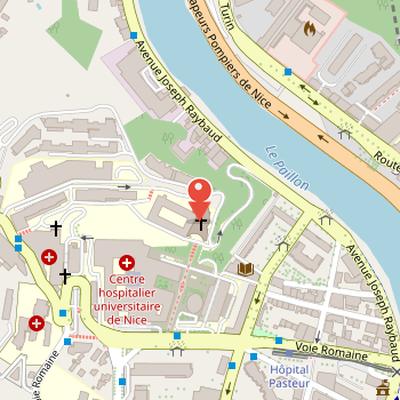
Nearby Objects
-
 Monastère de Cimiez 650 m away
 -
 Musée Matisse 850 m away
 -
 Arènes de Cimiez 850 m away
 -
 Château Valrose 1600 m away
Location and Heritage Status
The Abbey of St Pons is one of the oldest monasteries on the Cote d'Azur, alongside the Abbey of Lerins. It is located within the grounds of the Pasteur Hospital in the commune of Nice, in the Alpes-Maritimes department of the Provence-Alpes-Cote d'Azur region. Its church is classified as a historic monument by official decree. In addition, the abbey church and cloister facades and roofs are registered as historic monuments by official decree.
Manuscript Tradition of the Passion of Saint Pons
Histoire notes that around thirty manuscripts of the Passion of saint Pons are preserved in French and foreign libraries. It also states that the text was transcribed or printed dozens of times after the date of the two oldest manuscripts. According to Histoire, the initial writing of the text could not have been earlier than the 7th or 8th century. This manuscript tradition points to a long period of circulation and repeated copying of the Passion.
Martyrdom and Early Cult of Saint Pons
Histoire presents the abbey site through the tradition of Saint Pons, also called Pontius, whose martyrdom is placed traditionally in 257 or 258. According to the account, Pontius was a Roman knight and the son of a Roman senator. He converted very young to Christianity under Pope Pontien between 230 and 235, and this conversion also led to the conversion of his father and household. After his father's death, Pontius became a senator and later gave his property to Pope Fabien for distribution to the poor. He is also said to have converted Emperor Philippe l'Arabe and his son.
During the persecutions under Valerian and Gallien, Pontius left Italy and settled in Cimiez, where Governor Claudius enforced the imperial policy against Christians. Pontius was arrested and refused to sacrifice to pagan gods. He was subjected to the rack, thrown to two bears in the Cimiez amphitheater, and later exposed to burning at the stake, but these ordeals did not kill him. He was finally beheaded on a rock overlooking the Paillon, and his body was thrown down the cliff. Valerius, who had been converted at the same time, buried the body at night where it lay. Pontius was buried in a necropolis at the future abbey site, while legend says his head was carried by the torrent to Marseille, where the monks of the abbey Saint-Victor collected it.
Origins and Early Form of the Abbey of Saint Pons
Tradition places the foundation of abbaye Saint-Pons in 775 and names saint Siagrius as its first abbe. It also holds Charlemagne to be the founder, through his nephew bishop Siagrius, in connection with an expedition against pagans and infidels near Nice and Cimiez. However, this account relies on the Vita Siacrii, a text from the early period that critics judged suspect and full of improbabilities. Historical sources do not confirm Siagrius as Charlemagne's nephew or as bishop of Nice, and reported visits by Charlemagne to Nice during the Lombard expedition of 773-774 or on the journey to Rome for his coronation lack reliable sources.
A related tradition concerns the supposed martyrdom site of Saint Pons. Histoire records that this place was on a cliff above the Paillon and had a martyr chapel until 1925, when the chapel-martyrium was destroyed and the rock was leveled. The tradition may also have originated from the tomb of Saint Pons, called the Confessio in the crypt under the church chevet. Bernard Gui is cited as having observed the martyr's body in the Confessio, and a paleo-Christian basilica with a martyrium may once have existed there. Archaeological data, however, currently show only Carolingian-period construction.
The surviving remains suggest that the church containing the saint's relics may have had an altar built on the tomb site, surrounded by a chancel for the faithful. Five fragments of this Carolingian chancel have survived. An inscription on the fragments commemorates a restoration of Saint Pons' tomb initiated by Charlemagne, dated between 774 and 800 on the basis of Charlemagne's titulature as king of the Franks and Lombards. Bonaventure Salvetti's essay, L'Abbaye de Saint-Pons hors les murs de Nice, published in 1925, is also cited in relation to this history.
Monastic Life and Recovery
According to Histoire, the monastery was entrusted to the Benedictines from its foundation and was richly endowed. Its abbots were appointed by the sovereign pontiff and enjoyed episcopal prerogatives, while the monks followed the rule of Saint Benedict, combining work and prayer. In this form, the abbey became a center of spiritual, intellectual, and economic development.
This prosperity was interrupted by a century of Saracen incursions. Saracens landed in the Gulf of Saint-Tropez near La Garde-Freinet and established Fraxinet, from which they raided Provence and the Alpine valleys for about a century. Their expedition failed before the walls of Nice in 890, but they destroyed the abbey of Saint-Pons. The monastery's archives for this period disappeared until 999, reflecting the troubled conditions. The Saracens were defeated at the battle of Tourtour in 973 by Guillaume I of Provence with the help of local lords, and they were definitively expelled from Provence in 975.
After this expulsion and near the year 1000, the abbey's prosperity was restored. It received large estates, including agricultural lands, olive groves, vineyards, shops, warehouses, and houses. Local nobility restored former ecclesiastical properties originally granted by Charlemagne, seeking salvation before the end of the world. Pierre Gioffredo reproduced a Latin donation act dated 1005 from Miron, Odile of Nice, and their sons. Their son Pons later became bishop of Nice from 1011 to 1030, and the document is presented as a symbol of the abbey's monastic renaissance.
The Abbot's Power and Rights
In the Middle Ages, the abbot of the Saint-Pons monastery held a distinguished rank among the nobility of the county of Nice. According to Histoire, many lords did not possess a quarter of the possessions and authority concentrated in the hands of the Saint-Pons abbot. He was addressed as High and Powerful Lord and enjoyed honorific, useful, and justice rights.
The honorific rights gave the abbot a solemn reception in the abbey church and an honored place in the choir. They also allowed him to wear a pectoral cross, a mitre, a crosier, and a pastoral ring. He had the authority to appoint to all benefices, cures, priories, and abbots of the suprabarri ball in Nice. His useful rights included the administration of the abbey and its dependent priories, as well as homage, grazing, milling, and oven monopoly rights.
The abbot also exercised justice duties, although he likely renounced high justice in order to avoid blood sentences. He administered middle and low justice and collected taxes, fines, and property confiscations. Around the 13th century, the abbey was the largest fortune in Nice and owned more than half the city. The rents were used to support the poor, decorative artists, and local investments in Nice.
Religious Foundations Linked to Saint-Pons
The history of the Abbey of St Pons is closely tied to a wide network of churches founded by its monks in Nice and across the surrounding region. According to the provided history, the monks of Saint-Pons established the church of Chateauneuf-de-Contes in 1030, and later founded Sainte-Reparate church in Nice in 1185. Sainte-Reparate also had a later role in the religious organization of the city, since it was ceded to the bishop when Nice's castle was militarized in 1531. Before that change, the former cathedral Notre-Dame du Chateau was located at Sainte-Reparate.
The same monastic activity extended beyond Nice. In 1185, the monks founded Gordolon church, and in 1206 they founded Sainte-Devote church in Monaco. Further foundations followed in the early 13th century, including Saint-Nicolas church in Sospel and Saint-Simeon d'Ongran church in Peille, both founded in 1229. Notre-Dame du Moustier in Luceram was founded in 1233, and Saint-Hermentaire church in Draguignan in 1235.
The record continues with several foundations in 1248, when monks of Saint-Pons established Notre-Dame des Salettes in Aspremont, Notre-Dame de Falicon, Saint-Blaise, Saint-Pierre de l'Escarene, and Notre-Dame sous Gattieres. Later foundations include Notre-Dame des Pres in Levens in 1252, Saint-Laurent in Eze and Notre-Dame des Salles near Draguignan in 1291, Saint-Pierre d'Oliva in Le Broc in 1320, Notre-Dame de Cimiez in 1346, Notre-Dame de Virimanda in Annot in 1369, and Notre-Dame de Beaulieu-sur-Mer in 1593. Saint-Giaume, a dependency of Notre-Dame du Chateau, was founded near port Saint-Lambert in 1576.
History of the Abbey of Saint Pons
During the early and following centuries, secular priests were rare and churches were controlled by monks, a context in which the Abbey of Saint Pons held both temporal and spiritual power. Its influence was significant enough that the dedication of Nice to Savoy was carried out on its forecourt. Over time, however, the Benedictine rule declined in favor of new orders, while the abbey's feudal revenues were insignificant and could not support its community. Distant abbey churches became autonomous priories, and new orders requested land from the Benedictines for their own establishments. In 1531, the Benedictines donated land to the bishopric of Sainte-Reparate for Nice's cathedral, and in 1546 they ceded land to the Franciscans on the site formerly occupied by the Roman city of Cemelenum, with the Cimiez chapel. The Saint-Barthelemy chapel later reverted to Minor Capuchin friars in 1555.
The abbey's institutional status also shifted through papal and episcopal arrangements. A papal bull placed the Saint-Pons monastery under the jurisdiction of the abbey of Saint-Victor of Marseille. In 1473, the abbey was placed in commendam for Bishop Barthelemy Chuet of Nice, uniting abbey and bishopric revenues. After the bishop's death, the monks obtained a papal bull from Pope Sixtus IV to restore prior conditions, but this practice remained harmful to monastic life. The monastery was completely ravaged by Turks in 1543 during the siege of Nice.
In 1792, King Victor-Amadee III of Sardinia closed the millennial abbey and dispersed the remaining Benedictine monks with a life annuity. He annexed the abbey's properties and incomes to his domain and mortgaged them to guarantee loans funding public works in Piedmont, Savoy, and Nice. During the occupation of Nice by French revolutionary troops, the monastery was converted into a military hospital for wounded soldiers of the Italian Army. Its extensive lands and real estate were sold at low prices at auction, and the hospital was closed in the fifth year of the French Republic, after which the buildings remained under sequestration until the Concordat.
After an imperial decree authorized Napoleon to grant the site to the bishop of Nice, monsignor Colonna, for a seminary that never opened, the political situation changed again in 1815 when the County of Nice returned to the King of Sardinia under the treaties of Vienna and Paris. French laws were repealed and Sardinian legislation prior to 1792 was restored in the county. A concordat between Pope Leo XII and King Charles-Felix of Savoy provided for the restitution of ecclesiastical properties, and the Abbey of Saint Pons remained the exclusive property of the State but was dedicated to worship. In 1835, Monseigneur Galvano, Bishop of Nice, installed the Oblates of the Virgin Mary of Pignerolo in the abbey. A Sardinian law later abolished several religious congregations, including the Oblates, who were regrouped at Saint-Pons Abbey and allowed to remain until the last surviving member died. The abbey became the property of the French State in 1860.
The final administrative changes came in the twentieth century. The law on associations in 1901 caused the expulsion of the Oblates of the Virgin Mary, except for four members. A decree authorized the sale of Saint-Pons Monastery to the city of Nice for 90000 francs, and the monastery was transformed into an annex of the Saint-Roch Hospital called the Abbey Hospital. The church of Saint-Pons remained under sequestration until its transformation into the Saint-Pons parish on April 29, 1906. Construction of the Pasteur Hospital began in 1910 and it was inaugurated on April 29, 1912. The Abbey of Saint-Pons is still part of the Pasteur Hospital.
Baroque Reconstruction
The architecture and furnishings of the Abbey of St Pons were reconstructed starting in 1724 in the baroque style. The rebuilt form was organized around an ellipsoidal plan, giving the structure a distinctive spatial arrangement. Its design also included rounded facades and a terrace, elements that shaped the overall appearance of the complex. These features reflect the architectural character of the reconstruction phase and define the surviving description of the abbey from this period.