Musée Matisse is an art museum dedicated to the work of the French painter Henri Matisse. Located in the Villa des Arènes, a Genoese villa in the Cimiez district of Nice, it opened in 1963 and holds one of the most important global collections of Matisse’s works. The museum offers a view of his artistic career and changes from his debut to his final works.
The Villa des Arènes began construction in 1670 and was completed in 1685. It was originally named palais Gubernatis after Jean-Baptiste Gubernatis, consul of Nice, and was renamed in 1950 after the City of Nice purchased it from a real estate company. The Musée Matisse was initially installed on the first floor, while the ground floor housed the Nice-Cimiez archaeological museum. After the latter moved in 1989, the museum underwent renovation and expansion, reopening in 1993 with a new modern wing and renovated spaces. Since then, its collection has continued to grow through donations and successive deposits.
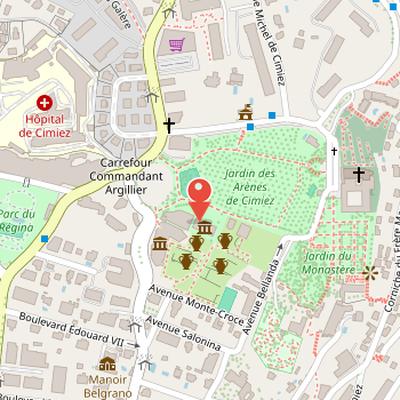
Nearby Objects
-
 Arènes de Cimiez 90 m away
 -
 Monastère de Cimiez 250 m away
 -
 Château Valrose 800 m away
 -
 Abbey of St Pons 850 m away
 -
 Musée Marc-Chagall 1300 m away
Mus%C3%A9e Matisse in Cimiez
The Musee Matisse is dedicated to the work of the French painter Henri Matisse. It holds one of the most important collections of his works in the world, allowing visitors to trace his artistic career and changes from his earliest work to his final pieces. The museum is located in the Villa des Arenes, a Genoese villa in the Cimiez district, and it opened in 1963.
Villa des Arenes and the Museum's Development
The building now associated with Musee Matisse began as Villa des Arenes, whose construction started in 1670 and was completed in 1685. It was originally named palais Gubernatis, after Jean-Baptiste Gubernatis, who was consul of Nice. In 1950, the City of Nice purchased the villa from a real estate company and renamed it. Musee Matisse was created in 1963 and was first installed on the first floor of the villa, while the ground floor housed the Nice-Cimiez archaeological museum. That museum was later moved in 1989 to a modern building on the site of the ancient Roman city of Cemenelum. Musee Matisse itself then underwent renovation and expansion, which required a four-year closure. It reopened in 1993 with a new modern wing and renovated spaces, and from that point it was able to exhibit its entire permanent collection. The museum's collection had grown through donations and successive deposits since its creation in 1963, including the donation of Nature morte a la statuette africaine in 2025, described as the first painted Matisse work acquired by the museum since its creation.
The Permanent Collection
The permanent collection of Musee Matisse was formed through various donations and deposits. It includes a donation made by Matisse himself, who lived and worked in Nice from 1917 to 1954, as well as donations from his heirs and deposits of artworks made by the State. The collection brings together a wide range of material associated with the artist and his work. It contains 68 paintings and cutouts by Matisse, 236 drawings, 218 engravings, 57 sculptures, and 14 illustrated books. It also includes 95 photographs, 187 objects that belonged to Matisse, and a variety of other items such as serigraphs, tapestries, ceramics, stained glasses, and additional documents. Together, these holdings define the museum's core identity as a place for the preservation and presentation of Matisse's artistic production and personal possessions.