Château de Bagatelle is a pleasure pavilion, or folie, built in 1777 by architect François-Joseph Bélanger for the comte d'Artois. It stands in the parc de Bagatelle, in the Bois de Boulogne, now annexed to Paris. Except for the annexed buildings, it is classified as a monument historique by arrêté, and this classification was later replaced by a more complete arrêté de classement.
The site has earlier historical layers linked to the Bois de Boulogne as a royal hunting domain. At the beginning of the 18th century, several gates in the area had official housing concessions granted by the king to gatekeepers, grand seigneurs, or high dignitaries. One such gate was conceded in 1716 to Louis-Paul Bellanger. A house was later built on the old road from Neuilly to the Abbey of Longchamp, with views over the Seine valley and Mont Valérien. It was subsequently granted by royal patent to the Duke of Estrées, who replaced it with an elegant pavilion designed by Pierre Mouret. The name Bagatelle, associated with frivolity and high cost, became attached to the place in this period.
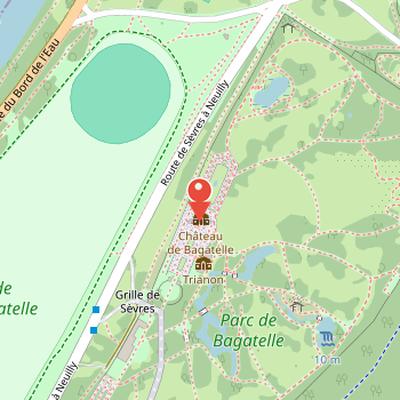
Nearby Objects
-
 Parc de Bagatelle 30 m away
 -
 Bois de Boulogne 800 m away
 -
 Louis Vuitton Foundation 1300 m away
 -
 Jardin d'Acclimatation 1300 m away
 -
 Château de la Muette 2000 m away
Chateau de Bagatelle
The Chateau de Bagatelle is located in the Parc de Bagatelle in the Bois de Boulogne, an area now annexed to Paris. It was constructed in 1777 as a pavillon de plaisance, or folie, for the comte d'Artois. The building was designed by the architect Francois-Joseph Belanger. Except for the annexed buildings, the chateau was classified as a monument historique by arrete, and this classification was later replaced by a more complete arrete de classement.
Bagatelle and Its Eighteenth-Century History
At the beginning of the 18th century, Bagatelle was one of several gates and associated houses in the Bois de Boulogne, a royal hunting domain. Some of these holdings were official housing concessions granted by the king to gatekeepers, grand seigneurs, or high dignitaries. One gate was conceded in 1716 to Louis-Paul Bellanger, general advocate at the Cour des aides, while another house stood on the old road from Neuilly to the Abbey of Longchamp, overlooking the Seine valley and Mont Valerien.
The property was later granted by royal patent to the Duke of Estr ees, Marshal of France, who replaced the modest house with an elegant pavilion designed by architect Pierre Mouret at a cost of 40,000 livres. The Duke gave the residence to his wife, the Marchioness of Estr ees, and it became a place for amorous gatherings for the Regent and the young Louis XV, arranged by the Marchioness and Louise-Anne de Bourbon. It was at this time that the house acquired the nickname Bagatelle, a term associated with frivolity and with the high cost of the building. The word also recalls the Italian bagatella, meaning a juggler's trick and architectural folly. The name was shared by two other French residences from the same century.
After the Marchioness of Estr ees died in 1739, the property passed to Louis Charles Cesar Le Tellier, future Marshal-Duke of Estr ees, and was sold in 1746 to Philippe Levesques de Gravelle, counselor at Parliament and general advocate at the Cour des aides. He kept it for one or two years before it was ceded to Cecile Therese Pauline de Rioult de Curzay, wife of Etienne Guinot, Marquis de Monconseil. Under her management, and while her husband was occupied with his properties in Saintonge, Bagatelle created the order of Bagatelle, reserved for close members of the house to take part in theater spectacles around 1753. The property also obtained permission from the king to enlarge the park.
Financial difficulties and terrace damage caused by Seine floods forced the owner to leave Bagatelle in 1770. M. de Boisgelin took possession in 1772, followed by Laurent Grimod de La Reyniere in 1774, who ceded it the same year to Philippe-Gabriel de Henin-Lietard, prince of Chimay and captain of the guards of the count of Artois.
The Construction of Bagatelle
After finding Bagatelle to his taste, the count of Artois purchased the residence. By 1777, however, the dilapidated house was considered unworthy of the festivities he had planned. Marie-Antoinette then challenged him to complete a construction in 100 days for the court's return to Fontainebleau. Work at Bagatelle began at once and employed nearly nine hundred workers for sixty-four days and nights. The building was completed on time to inaugurate the new château. Decoration and furnishing then continued for two additional years. The new residence became known as la Folie d'Artois.
The surrounding park was also arranged with a range of fabriques, including an obelisk, a Chinese bridge, a Palladian bridge, a gothic philosopher's house, a thatched cottage, a Chinese tent, a primitive hut, and tombs of a king and a pharaoh. None of the fabriques made from lightweight materials survived, and later owners demolished the ruined ones as degradation advanced. Today, these structures are known mainly through engravings, while only substructures and rockworks remain from the original park design. Among the surviving elements are the large rock and waterfall, the icehouse topped by a belvedere, and the grotto of the Black Swan pond.
Changes to the Estate in the 19th Century
After the French Revolution, Bagatelle moved through several phases of ownership and adaptation. The domain had earlier served as a venue for countryside festivals, and the pavilion became a restaurant during the Revolution. In 1810, it was acquired by the emperor for restoration as a residence for the king of Rome, then presented in 1812 to his repudiated spouse. It later returned to the count of Artois during the Second Restoration and passed to the duke of Berry, who maintained it before it was inherited by the young duke of Bordeaux. During this period, the estate also saw the creation of the fake ruin called Abbaye de Longchamp.
In 1835, the estate, including a park of sixteen hectares, was sold to Richard Seymour-Conway, count of Yarmouth. Raised in France and the son of the marquis of Hertford, Seymour-Conway was a bachelor, a friend of the imperial couple, and later became the fourth marquis of Hertford in 1842. He created a riding school for lessons of the imperial prince, with the prince's mother following from the Chinese kiosk, and later replaced the riding school with a rose garden. Bagatelle was also linked to Pauline de Broglie, who discovered around 1895 a tool shed connected to the empress.
The estate was greatly expanded after 1852, when Seymour-Conway took advantage of the sale of Bois de Boulogne to the city of Paris to buy land south and north of the Chateau de Madrid. The Bagatelle estate was enlarged to twenty-four hectares and enclosed by a large perimeter wall. With the help of VarE, appointed by Napoleonic authority for the creation of the Bois de Boulogne park, the park was completely remodeled. The French garden was simplified by removing bowling greens, the green room, and the quinconces. A lake, the Bassin des NymphEas, was created north of the French garden with a grotto nearby, and a large lawn was laid out with views over the castle at the north-east of the garden. At the southern end, a riding arena was installed and later replaced by a rose garden, flanked by the Chinese kiosk and the orangery building by Fayer and Gaguiard. The southern border of the park was also redesigned with brick buildings including large stables, coach houses, and the gardener's house between perennial and annual plant gardens.
The castle itself was remodeled in 1862, when Lord Hertford added an extra floor and a dome. He also installed a heavy marquee at the courtyard entrance, later removed. Several interior fireplaces survive from his period, including a ground-floor salon fireplace copied from Caffieri's Versailles design, a dining room fireplace with an entablature supported by two bronze bacchantes modeled by Foucou and executed by Gouthiere, and the Count of Artois's bedroom fireplace, which was moved into one of the boudoirs. Hertford also commissioned Leon de Sanges to rebuild the water pump and create a new eastern park entrance, marked by two large wrought iron gates with gilded ends and a rocaille-style stone pavilion with a large semicircular roundabout. To replace missing objects in the park, he purchased statues, columns, and vases by artists including Houdon. Later additions included a pagodon from the 1867 Universal Exhibition, placed on a lawn beyond the Chinese kiosk and replaced in Bagatelle by a 1996 copy after the estate was sold to the city of Paris in 1905.
Richard Wallace and His Public Legacy
Richard Wallace followed Historique in art collecting and greatly expanded the collection by buying important private collections. In 1872, he transferred most of the collection to 2 Manchester Square, where Historique lived until the death of Richard Wallace's son in 1887. Wallace's personal life also formed part of his public history: he had a mistress, Julie Castelnau, whom he married in 1871, and a natural son named Edmond.
His reputation was further shaped by his actions during the siege of Paris, when he became generous and provided aid to the starving population and the wounded. He also founded the British Hospital in Levallois-Perret. These activities were recognized through several honors, including the Commander of the Legion of Honour decoration, the gold medal of the city of Paris, and a baronetcy from Queen Victoria. His name was also commemorated in Paris through a boulevard between Paris and Neuilly.
At the same time as the collection transfer, Wallace offered Wallace fountains to Paris, adding another public dimension to his legacy.
Later Changes at Bagatelle
In 1872, Leon de Sanges carried out major works in the courtyard of Bagatelle castle. During this campaign, the building of the Pages was demolished and replaced by two small guardian pavilions to enlarge the courtyard, which was also enclosed within terraces. To the east, a large building known as the Trianon de Bagatelle was erected. It was intended to accommodate the son of Richard, but he never came there. The Trianon was later used to host exhibitions.
Bagatelle also became closely associated with Richard Wallace, who withdrew into a reclusive life there after the death of his son Edmond. He rarely left the property, invited personalities to Bagatelle, and did not attend the meals offered to them. Instead, he is said to have observed his guests through a circular opening in a wall. Richard Wallace died at Bagatelle three years after Edmond's death. The fate of his collection after his death is described differently in the sources: some state that he did not determine it, while others say that he showed favor to his French companion Julie Castelnau. She married Richard Wallace in 1871, was born in 1819, died in 1897, and became the sole heir of the English and French possessions left to Richard Wallace by the Marquis d'Hertford.
Bagatelle and the Afterlife of its Contents
Chateau de Bagatelle appears in the later history of the Wallace collection through the activities of John Murray Scott, who had another house at Bagatelle in the Bois de Boulogne in Paris. The house is described as having a garden resembling an English garden, and as being empty but used for picnics. A statue of a nymph bathing her foot in water was located in a grotto at Bagatelle; this work was La Baigneuse by Jean-Antoine Houdon, originally made for the Duke of Orleans, later bought by Lord Hertford, and eventually sold by Scott. The statue is now housed at the Metropolitan Museum. Historique also identifies L'Hiver, also called La Frileuse, as a bronze cast from the period sold by Scott and now at the Met.
After lady Wallace inherited a large fortune and one of Europe's premier art collections at age 72, she bequeathed it near to the English nation in 1894, including paintings and art objects. The bequest was conditional on the nation assuming the name of her deceased husband. The museum opened in 1900 at Hertford House, containing twenty-five galleries. Lady Wallace also left one million pounds, the building on rue Laffitte, Bagatelle, an Irish estate, and their contents to John Murray Scott. In 1897, Scott rented most of the former Hertford hotel while reserving a large apartment, and he emptied Bagatelle of rich furniture and exterior ornaments in order to sell them. He also wanted to subdivide the park, which prompted opposition. Paris bought Bagatelle from Scott on March 25, 1905, for six million five hundred thousand francs, but he continued removing items after the sale. On May 30, 1905, Parisian antiquarian Elie Fabius bought more than 28,000 francs worth of four bronze groups and marble bases from Bagatelle. After Scott's death at Hertford House in 1906, lady Sackville-West later sold the Paris apartment-museum contents to antiquarian Jacques Seligmann for 225,000 francs, and around 1930 she installed six marble vases reputedly from Bagatelle at Sissinghurst Castle.
Association Activities and Exhibitions
In 1905, the park was divided into three sectors. Later, the Association of Friends of Bagatelle Park and Castle played a central role in the cultural life of the site. Jacqueline Nebout presided over the association from 1980 to 1996, after which Patrick Lucas became president, assisted by Jean Gueroult. Nelly Tardivier also directed the association. Over twenty years, the association organized more than 150 exhibitions, including projects developed with the Louvre Museum such as Les Jardins persans and Les Jardins du Maroc. It also arranged colloquiums linked to exhibitions, with figures such as Henri and Achille Duchene, Erik Orsenna, and Monique Mosser. A Henry Moore exhibition in 1992 was inaugurated by the Queen of England, and the garden was reused extensively for the Lalanne exhibition a few years later. The association also organized concert series in the Bagatelle orangerie. Most exhibition posters were created by the Bernard Baissait Company.
The La Folie d'Artois Exhibition
At Bagatelle, the exhibition La Folie d'Artois attempted a redecoration in Louis XVI style. The decor was designed by Jacques Grange, with collaboration from national museum curators and the Mobilier national. Six Parisian antique dealers took part in the project: Jean-Marie Rossi, Didier Aaron, Michel Meyer, Jacques Perrin, Maurice Segoura, and Bernard Steinitz.
The exhibition brought together a range of loaned objects to support the historic style of the display. Among them were twelve J.B. II Lelarge chairs from the comtesse d'Artois salon at the Chateau de Saint-Cloud, a Joseph Baumhauer commode belonging to the marquis de Marigny, Georges Jacob ponteuses chairs, a pair of cabinets attributed to Levasseur in the Boulle style, and a table-tambour by Topino. The ensemble also included a pendulum, candelabra, Sevres porcelains, and Savonnerie carpets. Together, these contributions formed a carefully assembled interior intended to evoke the visual language of the Louis XVI period.
Decorative Bronzes and Provenance
After the exhibition, six dealers donated a pair of bronze faunesses to the chateau. These bronzes had decorated the marble fireplace in the dining room of the Chateau de Bagatelle. Similar fireplace bronze mounts are also recorded in other collections: two are in the first hotel du comte d'Evreux in Place Vendome, Paris, and another is in the Fragonard room of the Frick Collection in New York. The Frick Collection catalog online attributes the marble chimney design to Francois-Joseph Belanger, the faunesses figures to Jean-Joseph Foucou, and the bronzes to Pierre Gouthiere.
Later Restorations and Site Reuse
Several construction projects were carried out in the park, including the consolidation of the Longchamp abbey ruins and the grand rock. The cascade had compromised the solidity of the grand rock, and a metal trellis kiosk replaced the philosophers house above the grotte des Quatre Vents. A Chinese pagoda was also created, modeled after one existing at an unspecified location.
The site underwent major changes in its cultural life after 2002, when a new municipal administration announced that the convention with the Amis association would not be renewed. As a result, the Amis association ended its cultural events and dissolved, and the chateau has remained closed to visitors since the end of the convention. The city has nevertheless continued to host concerts at the chateau.
The history of the sculpture collection is also important. Historique states that several statues were created for Bagatelle between 1778 and 1781 by the sculptors Auger, Simon, Lhuillier, and Roland. Around 1900, several of these statues were sold to the Parisian notary Gustave Gatine, who transported them to the park of his Chateau de Bonnemare in Radepont, Eure. Eight of the ten statues, including Pretresse, Hebe, Flore, Clio, Mars, La Fidelite, and Le Secret, had adorned the pavilion called du Commun or du Gouvernement. These statues were later reproduced by Gautier. They also passed through the Chateau de Bercy and were bought by Lord Hertford during its demolition in 1861. Historique notes that Bachaumont saw the statues in Bagatelle. The association Les Amis de Bagatelle later found the statues, negotiated their return, restored them, and donated them to the State. In 2002, ten statues were installed in a semicircle in the forecourt because the original niches were missing. Two sphinx statues were also placed in front of the chateau. Eisner had hoped in 1988 for the return to the chateau of ten painted panels by Callet, which had been identified ten years earlier.
Furniture and Provenance of Bagatelle
Several pieces of furniture connected to the Chateau de Bagatelle are known through their documented deliveries, later sales, and restoration histories. A wooden armchair ordered from George Jacob by the count of Artois's Garde-meuble was intended for Louis XVI's visit to the Bagatelle festival on 7 September 1777. It was sculpted by Rode and gilded by Ramier, and later sold by Christie's London on 11 December 2009 for 386,000 pounds.
In 1778, six chairs by George Jacob, sculpted by Rode and gilded by Aubert, were delivered for Bagatelle. These chairs later appeared in the Greffulhe collection sale on 14 May 2009. Another pair of chairs by Georges Jacob, sculpted by Jean-Baptiste Rode and delivered in 1778-1779 for the count's chamber, also remained traceable through public sales. They were presented at a public sale in Dijon on 10 December 2016 by Bizoard, with the sale then canceled and resumed in Paris on 11 March 2017. The chairs came from the Faucigny-Lucinge family, heirs of Duke of Berry and Amy Brown, and were bought by antique dealer Camille Burgi. The same chairs, together with two armchairs from the chamber, were later sold by Artcurial on 14 December 2022 for 900,000 euros excluding fees, against an estimate of 300,000 to 500,000 euros. This furniture was noted for partial blue gilding and a military decor, with the blue patina described as canon de fusil to underline the military theme.
Other objects associated with the château also have detailed sale histories. Historique received a travel chest covered with blue Morocco leather, marquetry, and gilded bronzes in 1778 from merchant Delaroue. The chest had two foliage crowns with monogram, with legs made by Jacob and J.B. Rode, and came from the same source as two chairs that were sold at auction in 1990. It was later offered again at Christie's, and also appeared in an auction context involving Sotheby's and a pair of appliques with French arms. Historique's low armchair, from a known series of four for the Count of Artois's bathroom, was offered at Sotheby's London, identified by a West France antique dealer, remained unsold there, and was later sold by Artcurial to Fondation Mansart for re-equipping Bagatelle. Restoration efforts for Bagatelle, led by Fondation Mansart, began with exterior work before 2019, with interior decoration planned for 2022 and the aim of reopening the building to the public.