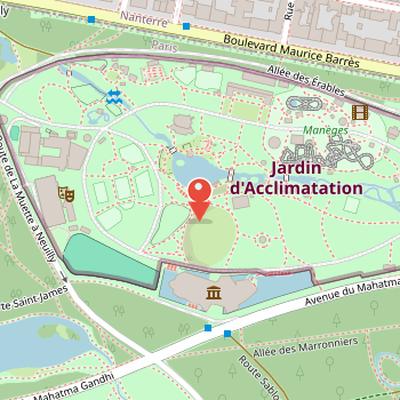
Jardin d'Acclimatation is a 19-hectare site at the edge of the Bois de Boulogne, between porte de Neuilly and porte des Sablons, along boulevard Maurice-Barrès in Neuilly-sur-Seine. It is open every day of the year and is served by line 1 of the Paris metro as well as lines C and E of the RER.
The garden was created in 1852 as part of the transformation of the Bois de Boulogne, following an initiative by the Société impériale zoologique d'acclimatation, founded by Isidore Geoffroy Saint-Hilaire. The society aimed to introduce and acclimatize exotic animal species for agriculture, commerce, or leisure. In 1855, it obtained a 15-hectare concession from the city of Paris, and Napoléon III later granted an additional four hectares. Architect Gabriel Davioud and landscaper Jean-Pierre Barillet-Deschamps were commissioned to continue the work. After fifteen months, Napoléon III inaugurated the Jardin d'acclimatation. The site opened with animals and plants including bears, a giraffe, camels, kangaroos, banana plants, and bamboos, and later included an aquarium. Over time, it also hosted scientific lectures, concerts, sports competitions, open-air cinema, circus performances, and children's carousels.
Nearby Objects
-
 Louis Vuitton Foundation 100 m away
 -
 Château de Bagatelle 1300 m away
 -
 Parc de Bagatelle 1300 m away
 -
 Palais des congrès de Paris 1500 m away
 -
 Hyatt Regency Paris Étoile 1600 m away
Location and Access
Jardin d'Acclimatation extends over 19 hectares between porte de Neuilly and porte des Sablons at the edge of the bois de Boulogne. It runs along boulevard Maurice-Barres in Neuilly-sur-Seine. The site is open every day of the year and is served by line 1 of the Paris metro as well as lines C and E of the RER.
Creation and Early Development
The Jardin d'Acclimatation was created in 1852, when the Bois de Boulogne was transformed and a garden was established at its entrance. The initiative came from the Societe imperiale zoologique d'acclimatation, founded by Isidore Geoffroy Saint-Hilaire, which sought to encourage the introduction and acclimatization of exotic animal species for agriculture, commerce, or leisure. In 1855, Historique obtained a fifteen-hectare concession from the city of Paris at the northern edge of the Bois de Boulogne to install the garden, and later received a further four-hectare concession from Napoleon III to expand it. Historique then commissioned architect Gabriel Davioud and landscaper Jean-Pierre Barillet-Deschamps to continue the work. After fifteen months of construction, Napoleon III inaugurated the Jardin d'Acclimatation.
The garden opened with bears, a giraffe, camels, kangaroos, banana plants, and bamboos, and Historique also opened an aquarium there. By 1866, the Jardin d'Acclimatation counted over animals. In 1867, it exhibited the twelve Boeufs Gras of the Paris Carnival, including six in the main parade. From 1900, its use broadened further, with scientific lectures, concerts, sports competitions, open-air cinema, circus performances, and children's carousels.
The garden was closed to the public during the war of 1870. During the siege, Historique used the Bois de Boulogne to house herds feeding the population, and some animals were evacuated to foreign zoological parks, although transport was paralyzed. The last animals were slaughtered to feed Parisians during the harsh winter rationing, and no animals remained after the siege ended. The garden was restored in 1872.
Animal Displays and Human Exhibitions
The Jardin d'Acclimatation was originally known for its fauna, which was gradually rebuilt through donations, including two elephants from the king of Italy. From its beginnings, it also featured curious beasts such as giraffes and elephants. The site generally respected the terms of its concession until 1877, with an emphasis on mostly useful animals. In the 1950s, however, it had lost all animals except farm animals, some birds, a dromedary, and a bear.
The garden also became a place for the display of humans presented as savages. In 1877, Albert Geoffroy Saint-Hilaire organized an ethnological show with a small troupe of Nubians. Over a quarter century, the site held twenty-two exhibitions of humans, mostly Africans, but also Indians, Lapps, and Cossacks. These groups were sometimes shown alongside animals from the same region. The displays placed people behind bars or grilles resembling cages, which sparked debate. In one case, Kanaks were placed in the bear pit and labeled as dangerous cannibals. The public was charged to see these beings out of the ordinary.
Recent Redevelopment and Visitor Use
In 2006, authorization was granted for Bernard Arnault to build the Louis Vuitton foundation building on the Jardin d'Acclimatation bowling site. The bowling site was later demolished in 2014. In late 2017, the park underwent a major redevelopment, which led to the closure of the northern two-thirds of the site for eight months. According to the press dossier, the Jardin d'Acclimatation received two million visitors in both 2015 and 2016, showing its continued public use during this period.
Concession and Management
From its origins, the Jardin d'Acclimatation was operated through a system of concessions renewed at roughly regular intervals. At the opening of the garden, management was handled by the board of the Societe imperiale zoologique d'acclimatation, with Isidore Geoffroy Saint-Hilaire serving as president under the patronage of the prince imperial. Albert Geoffroy Saint-Hilaire acted as deputy director and was responsible for the effective administration of the garden. The Societe imperiale zoologique d'acclimatation retained and regularly renewed its concession until 1952.
In 1952, SARL Maillot Maurice-Barres, part of the Boussac group, obtained the concession from the City of Paris, replacing the Societe du jardin zoologique d'acclimatation. The concession was granted in exchange for a fee and a commitment to invest fifty million francs. The contract specified that the garden should become a park for outdoor leisure, with instructive, sporting, and family attractions. Boussac later obtained renewal of the concession and kept it until the group's disappearance.
In 1984, the LVMH group acquired Boussac and inherited the garden concession. Under LVMH management, the garden functioned as a successful regional recreational site, attracting 1.4 million visitors in 1991 and one million visitors in 1996.
Concession and Redevelopment
In 1995, LVMH renewed the concession for twenty years at a monthly flat fee and introduced a development plan that restored landscape garden principles from the 19th century. From 2007 to 2016, it invested over two million euros annually in the park, reaching a total of 25 million euros over ten years. The concession was renewed again in 2016 for 25 years, until 2041. Between 2016 and 2018, LVMH carried out major redevelopment works costing 60 million euros.
Le Village des Maneges
Until 2017, Le Village des maneges included about twenty amusements at Jardin d'Acclimatation. These attractions included flying chairs, bumper cars, and roller coasters. They were later integrated into the 2017-2018 renovation plan. The group did not include the carousel La Sauterelle, nor did it include children's rides with flying carpets, cars, planes, rockets, or fire trucks.