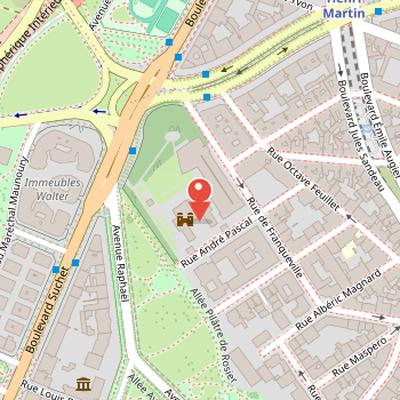
Château de la Muette is located on rue André-Pascal in Paris, near the Bois de Boulogne at Porte de la Muette. It stands near the site where three châteaux had existed successively since the Renaissance. The present building is the fourth Château de la Muette, built by Henri de Rothschild and designed by architect Lucien Hesse in the early 1920s. It is built in the style of that period and now houses the headquarters of the Organisation de coopération et de développement économiques in Paris.
The name of La Muette has a controversial origin. It may refer to the molting of deer or falcons, or to a pack of dogs in old spelling. The site has a long history as a hunting lodge and later as a castle associated with French royalty. Over time, it was transformed, remodeled, expanded, and used for courtly residence and gatherings. The history of the place reflects successive phases of royal ownership and rebuilding that preceded the present château.
Nearby Objects
-
 Giardino del Ranelagh 250 m away
 -
 Musée Marmottan Monet 300 m away
 -
 Maison de Balzac 1100 m away
 -
 Passy Cemetery 1200 m away
 -
 Maison de la Radio 1200 m away
Location, Design, and Name
Le Chateau de la Muette is located on rue Andre-Pascal in Paris, near the Bois de Boulogne at Porte de la Muette. It stands close to the site where three chateaux had existed successively since the Renaissance. The present building is the fourth Chateau de la Muette, built by Henri de Rothschild and designed by architect Lucien Hesse in the early 1920s. It was built in the style of the early 1920s and now houses the headquarters of the Organisation de cooperation et de developpement economiques in Paris.
The origin of the name remains controversial. It may refer either to the molting of deer or falcons, or to a pack of dogs in old spelling.
Royal Transformations at La Muette
French kings had owned a hunting lodge at La Muette since the Middle Ages. Charles IX transformed this lodge into a small castle and gave it to Marguerite de Valois on her marriage to the future Henri IV. In 1606, Marguerite de Valois donated the castle to the dauphin, the future Louis XIII. Later, Louis XIV remodeled the castle and, at the end of his reign, housed the hunting captaincy of Bois de Boulogne there under Joseph Fleuriau d'Armenonville. In 1717, Philippe d'Orleans bought La Muette for his daughter Marie-Louise-Elisabeth, duchess of Berry, in exchange for Chateau de Madrid. The Regent then expanded and arranged the small hunting castle. The duchess of Berry lived at La Muette and hosted grand parties, including one for Tsar Peter the Great of Russia. She also spent spring and summer 1717 there during a maternity. After her death in 1719 following a clandestine childbirth, the Regent had the estate repurchased by the Crown. During his minority, the young Louis XV spent many stays at La Muette, where he raised animals and learned horseback riding and hunting. Numerous outbuildings flanked the main building.
Science, Court Life, and the Muette Domain
In 1749, Charles Francois Paul Le Normant de Tournehem commissioned Jacques Dumont to decorate the salon with two canvases, La Generosite and La Paix. The following year, the Crown's cabinet of curiosities was installed in the gardens of La Muette with the cooperation of the duke of Chaulnes. Its works were ordered by architect Jacques Germain Soufflot under the direction of the marquis de Marigny, and the cabinet of curiosities of King Louis XV was supervised by abbe Nollet, whose scientific experiments attracted large audiences.
The site also became a center for scientific practice. In 1759, dom Nicolas Noel was appointed Garde du cabinet de Physique et d'Optique de sa Majeste, and he was commissioned to create a place for experimentation and cooperation for European scientists. He authored a microscope and a monumental telescope 24 feet long, later moved from the abbaye de Saint-Germain-des-Pres to La Muette in 1771. Engineer Claude-Simeon Passemant also executed two moving globes, one terrestrial and one celestial, as well as a steam engine.
Louis XV ordered the tracing of a long alley in the Bois de Boulogne to the Seine near Saint-Cloud in 1753, and he planned to rebuild La Muette along the axis of the new alley. This project was abandoned because of the Seven Years' War. The château later became the residence of the dauphin, the future Louis XVI, in 1764. It was also the place where Marie-Antoinette waited for her marriage ceremony on arrival in France and where she stayed several times after becoming dauphine. Louis XVI signed the May 1774 edict renouncing the right of joyous advent there, and in the same year the organization of the Cabinet de curiosites was reviewed to reduce financial burden, with dom Nicolas Noel retired and replaced by Jean-Baptiste Le Roy and Alexis-Marie de Rochon of the Academie des sciences.
The gardens of La Muette gained further historical significance as the launch site of the first human flight by Pilatre de Rozier and Francois Laurent d'Arlandes in a hot-air balloon. Their flight passed over Ile aux Cygnes, Ecole militaire, and jardin du Luxembourg before landing at Butte-aux-Cailles. A commemorative monument with a plaque stands at place de Colombie outside the current domain. In 1786, the château, its park, and its art objects were described in Nouvelle description des environs de Paris.
Restoration, Division, and Changing Uses
An edict put the château de la Muette and the château de Madrid up for sale and authorized their demolition in the name of cost savings, but no buyer appeared for the Muette. The building was then abandoned and ceased to be maintained. The domaine de la Muette was bordered to the east by rue de la Pompe and to the north by avenue Bugeaud, porte Dauphine, and rue de la Faisanderie. In 1786, the cabinet de curiosites was dismantled and its instruments were moved to the Observatoire de Paris.
Later, the domaine was divided and sold in lots, with authorization requested from Louis XVIII. Louis XVIII began restoring the domaine, raised the building by two floors, and added a long gallery for his painting collection. After Sébastien Erard's properties passed to Pierre Erard in 1831, the paintings were sold because of temporary financial difficulties. Pierre Erard then rented the Muette to Doctor Guerin, who converted it into an orthopedic hospital. In 1838, Pierre Erard moved into the Muette with three aunts, his sister, his wife, and the composer Spontini after marriage, and he began rebuilding the domaine.
The Muette became a place of musical activity, with regular concerts held there by composers such as Gounod, Rossini, Meyerbeer, Berlioz, and Leo Delibes, and performers including Liszt and Rubinstein. John Abbey built the organ for the chateau. In 1853, Historique bought the petite Muette and part of the gardens.
The railway chemin de fer d'Auteuil later cut into the park, separating the domaine east of the line near boulevard Emile-Augier and rue de la Pompe. The trench near the chateau was covered in 1939 to provide access to new buildings on boulevard Emile-Augier. Pierre Erard's widow continued acquiring land and carrying out various works. Historique served as headquarters for Vice-Admiral Fleuriot de Langle during the Siege of Paris in 1870-1871 and for Generals Clinchant, Douay, and Ladmirault under the Commune, while the buildings were under repair. It did not suffer serious damage during the Commune.
After Madame Erard's death, the property passed to Marie Schaeffer, niece and adopted daughter of Madame Erard, who married the Count of Franqueville. Beginning in 1889, she restored the chateau according to the original plans and reconstructed the central building, removing the two additional floors added by Sebastien Erard. The chateau was located between number 17 of current rue du Conseiller-Collignon and boulevard Emile-Augier. From June 15 to June 20, 1906, it hosted the third plenary assembly of the French episcopate following the encyclical Une fois encore. Between 1912 and 1919, the Franqueville family began parceling the park, and in 1923 rues d'Andigne, Maspero, de Franqueville, and du Conseiller-Collignon were opened on the southern part of the park.
Henri de Rothschild's Chateau and Later Institutional Use
Two large parcels of the northern park were ceded to Henri de Rothschild, who had a large chateau built in the northwestern part of the old chateau's park between 1921 and 1922. Designed by architect Lucien Hesse, the building respected the alignment of the park's trees. The courtyard opens onto Rue Andre Pascal, which was named after one of Henri de Rothschild's literary pseudonyms. In 1948, Rothschild's heirs sold the estate to the Organisation for European Economic Co-operation (OECE), which established its headquarters at the chateau. The OECD, as the successor to the OECE, continues to have its headquarters at the chateau, with offices in surrounding contemporary buildings.
The Changing Boundaries of the La Muette Estate
Historically, the park of La Muette extended east to rue de la Pompe, where it had a dependency beyond the street, and its northern edge reached rue de la Tour from the junction with rue de la Pompe toward boulevard Lannes. To the west, it included a long dependency known as La Faisanderie or Petit parc, located west of the present rues Mignard, Spontini, and Pergolese and extending to porte Maillot. The entire area was enclosed by a wall, broken only at rue de Passy so that village inhabitants could reach the bois de Boulogne by way of the chaussae de la Muette.
The estate underwent repeated changes of ownership and subdivision in the 19th century. An initial sale attempt around the chateau in 1788 was unsuccessful, but in 1793 the park and the chateau were sold in two separate lots. The former faisanderie land was also sold separately as national property, with parts acquired by de Behague and the count of Saint-Simon. This land later passed to an associate of the count of Saint-Simon and was repurchased in 1818 by Casimir Perier, later a minister to Louis-Philippe. Rue du Petit-Parc was created in 1825 along the path bordering the faisanderie wall in the west of the planned Passy plain subdivision.
By 1830, the land was still bordered by a wall but was crossed by routes at porte Dauphine and porte de la Muette. Over the following two decades, it was sold by lots. In 1852, Sebastien Erard bought the park around the chateau and enlarged it slightly by purchasing a house with garden at 22 chaussae de la Muette. Other small parcels were added during the 19th century, although the domain was first reduced that same year by the Auteuil railway line. A land exchange with the city of Paris in 1894, linked to the transfer of the municipal florist garden of La Muette, made possible a residential area between rue Octave-Feuillet and boulevard Jules-Sandeau. In the same year, the count of Franqueville sold the land between rue de Franqueville and rue Octave-Feuillet, reducing the park to eight hectares. The remaining land was sold by the heirs from 1912 to 1919, with the southern land going to a residential subdivision and the northern land to Henri de Rothschild.