Bois de Boulogne is a forest and urban park occupying the western half of the 16th arrondissement of Paris, near Boulogne-Billancourt and Neuilly-sur-Seine. Covering 845 hectares, it is the second-largest park in Paris. In size, it is about two and a half times the area of Central Park in New York, slightly larger than Phoenix Park in Dublin, and slightly smaller than Richmond Park in London.
The Bois de Boulogne is a remnant of the ancient oak forest of Rouvray. Its history includes use as a hunting ground and royal reserve, as well as religious ownership and settlement. Emperor Napoleon III ceded the land to the city of Paris in 1852 so that it could be turned into a public park.
The park contains an English landscape garden with several lakes and a cascade, as well as the smaller gardens of Château de Bagatelle and Pré-Catelan. It also includes the Jardin d'Acclimatation, the Jardin des Serres d'Auteuil, horse racing tracks, Stade Roland Garros, the Louis Vuitton Foundation art museum and cultural center, and other sites.
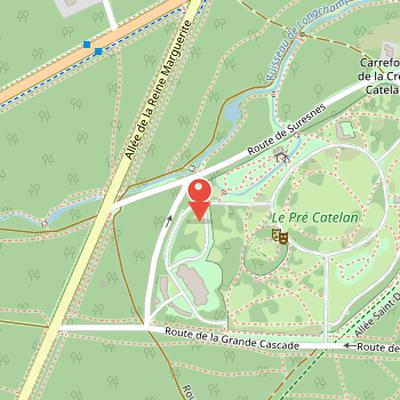
Nearby Objects
-
 Parc de Bagatelle 800 m away
 -
 Château de Bagatelle 800 m away
 -
 Musée Marmottan Monet 1400 m away
 -
 Château de la Muette 1400 m away
 -
 Giardino del Ranelagh 1500 m away
Park Landscape and Cultural Sites
The Bois de Boulogne is the western half of the 16th arrondissement of Paris, near Boulogne-Billancourt and Neuilly-sur-Seine. In 1852, Emperor Napoleon III ceded the land to the city of Paris to be turned into a public park. It is now the second-largest park in Paris, covering 845 hectares. By area, it is about two and a half times the size of Central Park in New York, slightly larger than Phoenix Park in Dublin, and slightly smaller than Richmond Park in London.
The park contains a range of landscaped and cultural spaces. Its English landscape garden includes several lakes and a cascade. It also contains two smaller botanical and landscape gardens, Château de Bagatelle and Pré-Catelan. Other features include the Jardin d'Acclimatation, which contains a zoo and amusement park, and the GoodPlanet Foundation's Domaine de Longchamp, dedicated to ecology and humanism. The Jardin des Serres d'Auteuil is a complex of greenhouses holding a hundred thousand plants. The Bois de Boulogne also includes two horse racing tracks, the Hippodrome de Longchamp and Auteuil Hippodrome, Stade Roland Garros, where the French Open tennis tournament is held each year, and the Louis Vuitton Foundation art museum and cultural center.
Historical Layers of the Bois de Boulogne
The Bois de Boulogne is a remnant of the ancient oak forest of Rouvray, which once also included the present-day forests of Montmorency, Saint-Germain-en-Laye, Chaville, and Meudon. Its early history includes royal hunting and religious control. Dagobert I hunted bears, deer, and other game in the forest, and Childeric II later gave it to the monks of the Abbey of Saint-Denis. The monks founded several monastic communities there, before Philip Augustus bought back the main part of the forest to create a royal hunting reserve.
The forest gained its present name from a chapel, Notre Dame de Boulogne la Petite, built in the forest. Philip IV of France ordered the chapel after making a pilgrimage to Boulogne-sur-Mer in 1308 to see a statue of the Virgin Mary. He then decided to build a church with a copy of the statue in a village in the forest. The chapel was built between 1319 and 1330 in what is now Boulogne-Billancourt. Isabelle de France also founded the Longchamp Abbey at the site of the present hippodrome in 1256.
During the Hundred Years War, the forest became a sanctuary for robbers. In 1416 to 1417, soldiers of John the Fearless burned part of it during their campaign to capture Paris. Louis XI replanted trees and opened two roads through the forest. Later, Francis I began the Chateau de Madrid in the forest in 1526, naming it after a similar palace in Madrid. The chateau was rarely used by later monarchs and was demolished after the French Revolution.
Other events marked the Bois in the early modern period. Pierre Belon was murdered by thieves there in 1564. Henry II and Henry III enclosed the forest within a wall with eight gates, and Henry IV planted 15,000 mulberry trees in hopes of starting a local silk industry. Marguerite de Valois lived in the Chateau de la Muette after her marriage was annulled by Henry IV.
The area also had a strong religious and musical association around the Abbey of Longchamp, located where the hippodrome now stands. Wealthy and important women retired there in the early 18th century, including Mademoiselle Le Maure in 1727, who continued to give recitals inside the abbey during Holy Week. The Archbishop of Paris later closed the abbey to the public because concerts drew large crowds and caused irritation.
The Bois was heavily affected by war again in 1814, when 40,000 soldiers of the British and Russian armies camped there after the defeat of Napoleon. Thousands of trees were cut down for shelters and firewood. From 1815 until the French Second Republic, the Bois was largely empty, with ruined meadows, tree stumps, and stagnant ponds.
Planning and Creation of the Bois de Boulogne
The Bois de Boulogne was an idea of Napoleon III after his coup d'etat and elevation to Emperor in 1852. At that time, Paris had only four public parks: the Tuileries Gardens, Luxembourg Garden, Palais-Royal, and Jardin des Plantes. There were no public parks in the rapidly growing east and west of the city, and Napoleon III decided to address this gap by creating two large parks on the eastern and western edges of Paris for people of all social classes. His interest was reinforced by his exile in London, where Hyde Park impressed him with its lakes, streams, and popularity across social classes.
The parks became an important part of the reconstruction plan for Paris developed by Napoleon III and Baron Georges-Eugene Haussmann. That plan also called for new boulevards to improve traffic circulation, a new water distribution system and sewers to improve health, and green spaces for the city's rapidly growing population. Napoleon donated the land for the Bois de Boulogne and the Bois de Vincennes in 1852, and additional land in the plain of Longchamp was purchased and attached to the proposed park to extend it to the Seine. Construction was funded from the state budget and by selling building lots along the north end of the Bois in Neuilly. Napoleon III was personally involved in the planning and insisted that the Bois de Boulogne should have a stream and lakes like Hyde Park. The first plan for the park was drawn up by architect Jacques Hittorff and landscape architect Louis-Sulpice Vare.
Haussmann's Redesign of the Lakes
The original plan for the Bois de Boulogne called for long straight alleys laid out in crisscrossing patterns, together with lakes and a long stream similar to the Serpentine in Hyde Park. VarE's stream design did not account for differences in elevation, which would have led to flooding in some areas and empty sections in others. When Haussmann saw the partly finished stream, he identified the problem and had the elevations measured. He then dismissed VarE and Hittorff and created a new solution based on two lakes, one upper and one lower, divided by an elevated road. In this design, the road acts as a dam, and a cascade allows water to flow between the lakes. The current arrangement dates from this intervention.
Alphand's Park Plan and Layout
In 1853, Jean-Charles Adolphe Alphand was hired as head of the Service of Promenades and Plantations in Paris and was tasked with creating a new plan for the Bois de Boulogne. His design reshaped the park into an undulating landscape of lakes, hills, islands, groves, lawns, and grassy slopes. The plan included two long straight boulevards, Allée Reine Marguerite and Avenue Longchamp, while retaining two long straight alleys from the old park. At the same time, most of the new circulation system was intended to be curved and meandering, with roads, paths, and trails laid out to connect the park's sights. The result was a network that included 58 kilometers of stone-paved roads for carriages, 12 kilometers of sandy paths for horses, and 25 kilometers of dirt trails for walkers.
Construction of the park took five years. The upper and lower lakes were dug, and the earth was piled into islands and hills. Rocks from Fontainbleau, combined with concrete, were used to create a cascade and an artificial grotto. Because the Seine pumps were insufficient to fill the lakes and irrigate the park, a new channel was built from the Ourcq River to the upper lake. A 586 meter deep artesian well was also dug in the plain of Passy and put into service in 1861, producing 20,000 cubic meters of water daily. Water distribution across the park was supported by 66 kilometers of pipes and 1,600 faucets spaced every 30 to 40 meters.
The redesigned Bois de Boulogne also included specific amenities and institutions. The ruined windmill at the south end of the park in the Plain of Longchamp was restored, and the grandstands of the Hippodrome of Longchamp were built with the Jockey Club of Paris and opened in 1857. A 20 hectare section between the Sablons gate and Neuilly was given to the Societe Imperiale zoologique d'Acclimatation, where it was developed as a small zoo and botanical garden with an aviary of rare birds and exotic plants and animals. Alphand's plan later became a prototype for city parks in Paris and worldwide.
The Pre-Catelan Amenity Area
In March 1855, the Pre-Catelan area in the center of the park was leased to a concessionaire as a garden and amusement park. It was built on the site of a quarry that had supplied gravel and sand for the park's roads and paths. The layout included a large circular lawn surrounded by trees, grottos, rocks, paths, and flower beds. A range of structures was designed for the site, including a buffet, marionette theater, photography pavilion, stables, dairy, and others. Among its attractions was the Theatre des fleurs, an open-air theater set among trees and flowers. An ice skating rink and shooting gallery were also added. The Pre-Catelan became popular for concerts and dances, but it faced continual financial difficulties and eventually went bankrupt. The floral theater remained in operation until the beginning of the First World War in 1914.
From Imperial Park to Parisian Promenade
The Bois de Boulogne was transformed during the period of urban renewal led by Haussmann. The garden-building team assembled by Haussmann included Alphand, Barrillet-Deschamps, and Davioud, and their work in the Bois de Boulogne provided the experience and aesthetics later used in projects such as the Bois de Vincennes, Parc Monceau, Parc Montsouris, and Parc des Buttes-Chaumont. The same team also rebuilt the Luxembourg gardens and the gardens of the Champs-Elysees, created smaller squares and parks throughout central Paris, and planted thousands of trees along the new boulevards. Under Napoleon III, 600,000 trees were planted in Paris and 1,835 hectares of green space were created.
The Bois de Boulogne had previously been a forest associated with game, duellists, suicides, and bandits. In 1867, the Baedeker Guide described it as a delightful park. During the Franco-Prussian War of 1870-71, the park suffered damage from German artillery bombardment, the restaurant of the Grand Cascade was turned into a field hospital, and many animals and wild fowl were eaten by the hungry population. The park recovered quickly after the war.
It then became a popular meeting place and promenade route for Parisians of all classes. Its alleys were filled with carriages, coaches, horseback riders, bicycles, and automobiles. Families picnicked in the woods and lawns, people rowed boats on the lake, and the upper classes were entertained in cafes. The restaurant of the Pavillon de la Grand Cascade also became popular for Parisian weddings, while frozen lakes were crowded with ice skaters in winter.
The Bois de Boulogne also entered French literature and art in the late 19th and early 20th centuries. Scenes from the park appear in Nana by Emile Zola and L'Education sentimentale by Gustave Flaubert, and its life was painted by Edouard Manet, Pierre-Auguste Renoir, Vincent van Gogh, and Mary Cassatt. In 1860, Napoleon opened the Jardin d'Acclimatation, a 20-hectare concession at the north end of the park, with a zoo, a botanical garden, and an amusement park.
Ethnological Garden Exhibitions
The Jardin d'Acclimatation served as the home of an ethnological garden from 1877 to 1912. These exhibitions displayed groups from faraway countries in reconstructed villages. The people shown were mostly Sub-Saharan Africans, North Africans, South American Indians, natives of Lapland, and Cossacks from Russia, and they mostly came from French colonies in Africa and South America. Similar exhibitions also took place in Paris, Germany, England, and at the Chicago Exposition in the United States. They were later criticized as a kind of human zoo. In the park itself, twenty-two ethnological garden exhibits were held in the last quarter of the 19th century, and about ten more were held in the 20th century, with the last one taking place in 1931.
Sport, Leisure, and Public Memory
The Bois de Boulogne has long been associated with leisure, public spectacle, and major events. In 1905, architect Guillaume Tronchet built a grand new restaurant in classical style in the Pre-Catelan, and it became a popular promenade destination for the French upper classes. The park also served as a venue for international and Olympic competition. It hosted croquet and tug of war during the 1900 Summer Olympics, while equestrian events for the 1924 Summer Olympics were held at the Auteuil Hippodrome. In 1919, the Bois de Boulogne hosted all rowing teams participating in the Inter-Allied Games held in Paris.
The park's history also includes significant moments tied to war and commemoration. In August 1944, German troops shot 35 members of the French Resistance in the Bois de Boulogne. After the war, the park held its first motor race, the Paris Cup, in 1945. In 1953, the British group Les Amis de la France created the Shakespeare Garden on the site of the old floral theater in the Pre-Catelan.
The Bois de Boulogne has also appeared frequently in art. Pierre-Auguste Renoir painted Skaters in the Bois de Boulogne in 1868, followed by Edoiard Manet's A horse race in the Bois de Boulogne in 1872 and Vincent van Gogh's Strollers in the Bois de Boulogne in 1886. Later depictions included Bois de Boulogne cyclists by Jean Baptiste Guth in Vanity Fair in June 1897 and An evening at Pre Catelan by Alexandre Gervex in 1909. Other recorded scenes include Students from a convent school by the lake in 1898 and South American Indians from French Guiana displayed during an ethnological exhibition in the Jardin d'Acclimation in 1892. The Bois de Boulogne was officially annexed by the city of Paris and incorporated into the 16th arrondissement in 1929.
21st Century Public Perception
In the 21st century, the Bois de Boulogne became known as a crime hotspot. This perception formed part of its modern public image and marked a notable shift in how the area was viewed.
Recreation and Public Life
Bois de Boulogne functions as a major public park with a wide range of recreational uses. It offers biking, jogging, boat rowing, horseback riding, pony rides, and remote control speed boats on weekends. Picnics are permitted in most parts of the park, although barbecues are not allowed. The park is also an important place for running in Paris and hosts several races, including the of Boulogne and the Boulogne half marathon. It serves as the crossing point for the last part of the Paris marathon.
The park also hosts a three-day weekend party in July featuring over 50 bands and singers. This event is attended mostly by students, who camp out overnight. Alongside these formal and leisure activities, the park is known for continued prostitution at night, despite its illegality in France and government efforts to eliminate it from the area. Prostitutes usually work in vans parked by the side of the road.
Bois de Boulogne is also home to many red squirrels, which are protected by law in France. To help ensure their safety, dogs are required to be kept on leads.
Artificial Water Features of the Bois de Boulogne
The Bois de Boulogne contains two artificial lakes and eight artificial ponds connected by three artificial streams. These water features are supplied by a canal drawn from the Ourq River and by artesian wells in Passy. Their layout was designed to move water through the park in stages, first reaching the Lac Superieur, built in 1852 near the Hippodrome de Auteil, and then flowing by gravity to the Grand Cascade and the Lac Inferieur.
The Lac Inferieur, built in 1853, is the largest lake in the park and lies near the large lawns of Muette. It is used for boat rentals from 15 February to the end of October and is known for its many swans and ducks. An island in the lake contains the city's only monument to Napoleon III and a small wooden kiosk called the Kiosk of the Emperor.
The Grand Cascade, built in 1856, was constructed with four thousand cubic meters of rocks from Fontainebleau and two thousand cubic meters of cement. It includes two artificial grottoes, one above the other. Before water falls in the cascade, it is held in the Etang de Reservoir.
The Ruisseau de Longchamp, built in 1855, is the major artificial stream in the park. It flows through the Pre-Catelan, under the alley of Reine Marguerite, then to the Mare des Biches, the Etang de Reservoir, and the Grand Cascade. Another feature, the Mare de Saint-James, is located next to the Jardin d'Acclimatation and was formerly a quarry for sand and gravel. Its two islands serve as a sanctuary for birds and small animals.
Gardens and Attractions in the Bois de Boulogne
The Bois de Boulogne contains several separate botanical and floral gardens, as well as gardens of amusement. Among its best known features is the Chateau de Bagatelle, a miniature chateau restored to the Bourbon family after the French Revolution. It was sold in 1835 to Francis Seymour-Conway, 3rd Marquess of Hertford, and attached to the Bois de Boulogne in 1905 after purchase by the City of Paris. The garden at Bagatelle was enlarged and redesigned by Jean-Claude Nicolas Forestier, Superintendent of Parks of Paris. He preserved many elements of the old garden while adding botanical sections such as an iris garden and a pond for Nymphaeaceae. A rose garden was also built there, with more than nine thousand plants. Each June, it hosts the Concours international de roses nouvelles de Bagatelle, and since 1983 the Orangerie next to the rose garden has hosted the Festival of Chopin in Paris. The garden also exhibits regular sculpture and art displays.
The Jardin d'Acclimatation opened in 1860 as a zoo and pleasure garden. Its facilities include an archery range, a miniature train ride, a pony ride, and a Guignol puppet theater. The Exploradome, a science museum for children, opened there in 1999. The Jardin d'Acclimatation also includes an Asian theme section with a teahouse, a lacquered bridge, and a Korean garden. The Louis Vuitton Foundation museum opened in October 2014 in a building designed by Frank Gehry.
In the southern part of the park, the Jardin des Serres d'Auteuil is a large greenhouse complex standing on the site of a botanical garden founded in 1761 by King Louis XV. The present greenhouses were built in 1895 to 1898 and house about one hundred thousand plants. Since 1998, the greenhouses have been part of the Botanical Garden in Paris.
The Pre-Catelan includes a copper beech tree planted in 1782, a giant sequoia planted in 1872, an old buffet built by Gabriel Davioud, and a grand restaurant built by Guillaume Tronchet in 1905. It also contains a Shakespeare Garden created in 1953 on the site of the old floral theater, with five natural settings containing all the trees, bushes, and flowers mentioned in Shakespeare's plays.
Sports Grounds and Visitor Facilities
The Bois de Boulogne contains several major sports and recreation sites. The Hippodrome de Longchamp opened in 1857 on the site of the old Abbey of Longchamp, and a restored windmill, the only building left of the Abbey, stands on its grounds. This racecourse hosts the Prix de l'Arc de Triomphe every October, making it the main annual event at the venue. Another racing facility, the Auteuil Hippodrome, opened in 1873 and covers 33 hectares; it is used exclusively for steeplechase racing.
The park is also home to the Stade Roland Garros, a tennis complex opened in 1928 for the first defense of the Davis Cup. It is named for French aviator Roland Garros, who was the first pilot to fly solo across the Mediterranean and a First World War ace. The complex covers 8.5 hectares, has twenty courts, and hosts the annual French Open in early June. Its red clay courts are made of white limestone dusted with powdered red brick dust.
In addition, a weekly 5 km Parkrun takes place within the park. Camping Indigo Paris is another feature of the Bois de Boulogne: a seven-hectare campground with 510 sites for tents, caravans, and camping cars. Reservations can be made in advance online, and mobile home rentals are available by reservation.
Landscapes and Garden Features in the Bois de Boulogne
The gallery presents a range of landscaped and recreational features within the Bois de Boulogne. Among the most prominent are the pond of the Bagatelle garden, which contains a wide variety of Nymphaeaceae, or water lilies, and the rose garden of Bagatelle, which hosts an international competition for new rose varieties each June. The garden of the Chateau de Bagatelle is also included, together with the Grand Cascade, which connects the two lakes in the Bois de Boulogne, and the Kiosk of the Emperor on the lower lake.
Other images highlight different parts of the park and its surroundings, including a winter scene in the Pre-Catelan and a cedar of Lebanon tree in the Bois de Boulogne. The gallery also shows the greenhouses of Auteuil, which contain one hundred thousand plants, and the windmill at the Hippodrome de Longchamp, described as a vestige of the old Abbey of Longchamp destroyed after the French Revolution. In addition, it features the Auteuil Hippodrome, the Stade de Roland Garros as the home of the annual French Open tennis tournament, and a bear in the zoo of the Jardin d'Acclimatation. Together, these views present the Bois de Boulogne as a place combining gardens, historic remnants, sports facilities, and leisure spaces.