The Louis Vuitton Foundation is a corporate foundation created by the LVMH group and its houses to sustain patronage actions engaged by the group since 1990. Its museum building, designed by architect Frank Gehry, is located at the Jardin d'acclimatation in the Bois de Boulogne, Paris, and is dedicated to modern art and contemporary art.
The project is presented as a replica of the Pinault foundation in Venice and has also been described as a media expression of competition between Bernard Arnault and François Pinault. According to the provided history, Bernard Arnault met Frank Gehry in 2001 and entrusted him with the foundation building project in Paris. Gehry designed a glass structure inspired by the Grand Palais and the Jardin d'acclimatation's glass structures from 1893, with a form that resembles a sailing vessel with sails filled by the west wind. The building replaced a former bowling alley, ticket office, and restaurant. Its inauguration took place in the presence of François Hollande, President of the Republic.
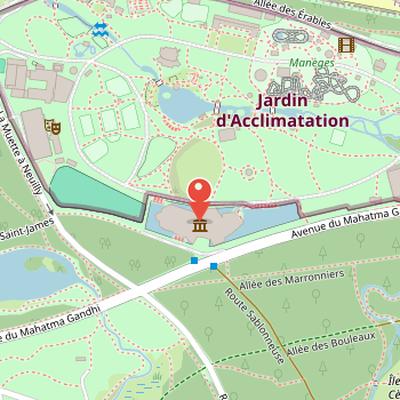
Nearby Objects
-
 Jardin d'Acclimatation 100 m away
 -
 Château de Bagatelle 1300 m away
 -
 Parc de Bagatelle 1300 m away
 -
 Palais des congrès de Paris 1500 m away
 -
 Hyatt Regency Paris Étoile 1600 m away
Architecture and Public Controversy
The Louis Vuitton Foundation is a corporate foundation created by the LVMH group and its houses to sustain the patronage actions the group has pursued since 1990. Its museum building, designed by architect Frank Gehry, is located at the Jardin d'acclimatation in the Bois de Boulogne in Paris. The museum is dedicated to modern art and contemporary art.
The project has also been described as a replica of the Pinault foundation in Venice, and as a public expression of the competition between Bernard Arnault and Francois Pinault. Its inauguration took place in the presence of Francois Hollande, President of the Republic. During construction, an important cost increase led to a tax deduction on three quarters of the expenses. In 2016, an anti-corruption association filed a complaint against the foundation and LVMH for fraud, but the complaint was dismissed without further action in 2019.
Design and Commissioning of the Paris Building
According to Histoire, Bernard Arnault met Frank Gehry in 2001. Gehry, who won the Pritzker Prize in 1989, was then entrusted by Arnault with the Louis Vuitton Foundation building project in Paris. Before designing the project, Gehry visited the Jardin d'acclimatation. He created a glass architecture inspired by the Grand Palais and by the glass structures of the Jardin d'acclimatation from 1893. These references shaped the building's design and linked it to specific historic Parisian structures.
Architecture and site context
The Louis Vuitton Foundation was conceived as a glass building resembling a sailing vessel, with sails filled by the west wind. It was built on a site that previously contained a bowling alley, a ticket office, and a restaurant. The foundation also created a landscaping plan to reconnect the building with the Jardin d'acclimatation and the Bois de Boulogne, reflecting the broader site context of the project.
The building was implanted under a fifty-five-year occupation agreement, after which it will return to Paris. During this period, the city receives an annual fixed fee from the foundation. The project also sits within a larger history of land use and concessions: LVMH obtained a twenty-year concession of the Jardin d'acclimatation, and the company had earlier bought the Boussac conglomerate in 1984. Boussac had held a concession from the city of Paris since 1952, renewed in 1995.
In physical terms, the building is over forty meters high and is composed of a nine-meter-high ground floor, a six-meter technical zone, a nine-meter floor, and nine-meter light well volumes. Its structure includes a waterproof underground concrete slab and a water basin with a gentle slope cascade, bordered by a seven-meter peripheral retaining wall. More than 700 workers and engineers took part in its construction, and about thirty patents were created for the glass sail fastenings. The project was also opposed by the association Coordination pour la sauvegarde du bois de Boulogne.
Legal Controversies and Construction Costs
The construction of the Louis Vuitton Foundation was marked by a series of legal disputes and repeated challenges over planning and authorization. Coordination pour la sauvegarde du bois de Boulogne successfully contested the land authorization granted by the Conseil de Paris, and the building permit related to Histoire was later annulled by judicial decision. In response, the city of Paris modified its urban planning regulations to protect the museum project, and the city together with the Louis Vuitton Foundation obtained permission to continue construction works. A provision consolidating the building permit was then inserted into a digital book price law, prompting the association to file a priority constitutional question against the legislative measure. The Conseil constitutionnel rejected that question, considering the provision to serve a sufficient general interest.
The construction work on Histoire lasted eight years. Its initial cost was evaluated at 150 million euros, later estimated to have reached 170 million euros because of innovative glass panels. However, Marianne claimed the final cost approached nearly 400 million euros, or eight times the initial budget. More than 50 million euros of the building cost was attributed to the French State through fiscal advantages granted to LVMH. A complaint was also filed by FRICC with the Parquet national financier alleging fraud-related offenses against the Louis Vuitton Foundation and LVMH, concerning a total of 60 million euros said to have been obtained unlawfully in connection with the construction. The Paris prosecutor's office dismissed the complaint for lack of sufficient evidence. An investigation by Pièces a conviction further reported that the foundation allowed Bernard Arnault a tax deduction of 200 million euros in France in 2018.
The teams involved in building the foundation received multiple architecture awards in France and the USA.
Labor Conditions at the Foundation
Mediapart published an investigation that denounced the working conditions of security and reception staff at the Louis Vuitton Foundation. According to the report, security agents were required to remain standing and static during 12-hour workdays. Several also complained about short breaks and video surveillance. Between March 2016 and June 2017, 17 of 20 security agents reported to the foundation's fire station center for malaise or extreme fatigue. The investigation also stated that several reception hosts felt pressured and unprotected by their employers against sometimes aggressive members of the public.
Contemporary Art Program and Public Spaces
Funded by LVMH, the Louis Vuitton Foundation is dedicated to contemporary art and is organized around eleven galleries spread across three levels. Its program includes collections, exhibitions, artist interventions, and a modular auditorium, placing the museum at the center of contemporary art debates, colloquiums, seminars, master classes, and live performances. The auditorium can seat 300 people and accommodate 1,000 standing, with different grandstand configurations. Its acoustics are managed by Nagata Acoustics, which had previously worked with Frank Gehry on Walt Disney Concert Hall in Los Angeles, while the scenography of the auditorium and adjacent spaces was designed by dUCKS sceno. The museum also commissions artworks from artists. Its first commissions were made to Ellsworth Kelly, Olafur Eliasson, Janet Cardiff and George Bures Miller, Sarah Morris, Taryn Simon, Cerith Wyn Evans, and Adrian Villar Rojas. The artistic direction is managed by Suzanne Page, former director of the Musee d Art Moderne de Paris. The collection features contemporary artists including Gerhard Richter, Pierre Soulages, Bertrand Lavier, Christian Boltanski, Olafur Eliasson, Thomas Schutte, and Pierre Huyghe. In 2016, the museum inaugurated L Observatoire de la lumiere by Daniel Buren, an in situ work made of twelve skylights covered by thirteen colored filters arranged in a regular pattern, which alters the light and appearance of the building according to changing weather conditions. The inauguration of the museum also featured concerts by Chinese pianist Lang Lang and German electro group Kraftwerk.
Temporary Exhibitions at the Fondation
The museum has hosted several temporary exhibitions, including the Chtchoukine collection, which attracted 1.6 million visitors. It has also displayed works from MoMA, Egon Schiele, and Jean-Michel Basquiat. Other exhibitions presented at the foundation include Cindy Sherman a la fondation, La collection Morozov, and Basquiat x Warhol, a quatre mains. La collection Morozov includes over 200 masterpieces of French and Russian impressionist and modern art assembled by the Morozov brothers.
Construction and Corporate Role
From 2007 to 2014, the foundation's main activity was the construction of a building in Bois de Boulogne in Paris. According to Avantages fiscaux, this work brought important tax advantages to LVMH companies, which reduced taxes by 518.1 million euros between 2007 and 2017 through sums paid to the foundation. The source also states that the foundation's main benefit was the image it contributed to the group and its main brand. While the foundation forbids the commercialization of art or luxury products of the group, Vuitton suitcases are displayed in the entrance hall to emphasize the proximity between the institution and the group's brands.