Parc de Bagatelle is a historic landscaped park and botanical garden located in the Bois de Boulogne in Paris’s 16th arrondissement. Created in 1777 as part of the estate of the Château de Bagatelle, it is regarded as one of the most significant examples of Anglo-Chinese style gardens in France from the second half of the 18th century. The park was designed by François-Joseph Bélanger, with the contribution of gardener and landscaper Thomas Blaikie. Its composition is based on winding paths, visual sequences, and a complex system of fabriques that combine architectural and natural elements.
The estate was developed as an inseparable complement to the residence and completed in 1777 after a rapid construction campaign. After the French Revolution, the layout underwent transformations, and further architectural additions were made in the 19th century. Parc de Bagatelle is also one of the four botanical centers of the city of Paris. Its rose garden has hosted an international floriculture competition since 1907.
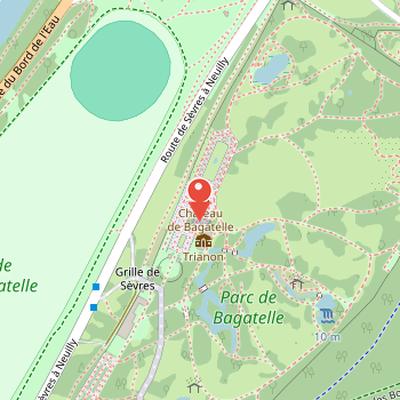
Nearby Objects
-
 Château de Bagatelle 30 m away
 -
 Bois de Boulogne 800 m away
 -
 Louis Vuitton Foundation 1300 m away
 -
 Jardin d'Acclimatation 1300 m away
 -
 Château de la Muette 2000 m away
Landscape Design and Botanical Role
Parc de Bagatelle is a historic landscaped park and botanical garden in the Bois de Boulogne in the 16th arrondissement of Paris. It was created in 1777 as part of the estate of the Chateau de Bagatelle. The park is regarded as one of the most significant examples of Anglo-Chinese style gardens in France from the second half of the 18th century. Its design is attributed to Francois-Joseph Belanger, with contributions from the gardener and landscaper Thomas Blaikie.
The composition of the park is based on winding paths, carefully arranged visual sequences, and a complex system of fabriques that combine architectural and natural elements. Parc de Bagatelle is also one of the four botanical centers of the city of Paris, alongside the Auteuil greenhouses garden, the Floral Park of Paris, and the Arboretum de l'ecole du Breuil. It is especially known for its rose garden, which has hosted an international floriculture competition since 1907.
The Creation of Bagatelle
The domain of Bagatelle was acquired in 1775 from the Count of Artois, brother of Louis XVI. The project was commissioned as a pleasure residence and park, with architect Francois-Joseph Belanger responsible for the design and Scottish landscaper Thomas Blaikie supervising the garden creation. The estate was named Bagatelle as an ironic reference to the high cost of the undertaking. Its construction was completed in 1777, within sixty-four days, and required several hundred workers.
Bagatelle was conceived as an aristocratic folly in which the park and the residence formed an inseparable whole. Belanger and Blaikie developed an Anglo-Chinese design characterized by free spatial organization and scenic elements. Parc de Bagatelle is considered one of the earliest French examples of picturesque landscape gardens.
After the French Revolution, the estate underwent transformations that altered the original layout. In the 19th century, further architectural additions were made, including an orangerie, an honor grille, and stables in 1835. By 1870, service pavilions, the so-called Trianon, and new terraces had also been constructed at Bagatelle.
From Private Estate to Public Botanical Park
In the second half of the century, Richard Wallace acquired Parc de Bagatelle and expanded its area by about ten hectares. He also promoted a reorganization of the landscape design, and Louis-Sulpice Vare redesigned the garden partly according to updated taste, introducing a more coherent picturesque reading of the park. After Wallace's death, the property passed to the heirs of widow Julie Castelnau, and in 1905 those heirs ceded ownership to the city of Paris. This acquisition marked the transformation of the site into a public space.
After 1905, the city of Paris commissioned a redevelopment of the park, entrusted to Jean-Claude Nicolas Forestier, who was conservator of Bois de Boulogne. The redevelopment aimed to reinterpret Bagatelle's historical layout while giving it public and botanical functions, as part of the modernization of Parisian green spaces. The rose garden was created as the central element of the renewed park layout and was designed for both ornamental and scientific purposes. In 1907, an international competition for new rose varieties was established at the site, helping to establish its European reputation.
During the 20th century, Parc de Bagatelle became one of the main public green spaces in Paris. It was integrated into the Jardin botanique de Paris system, alongside the garden of the Serres d'Auteuil, Parc floral de Paris, and Arboretum de l'ecole du Breuil. These historical transformations gave the park both a historical and scientific identity, and its current layout reflects the layering of interventions over time.
Structure and Composition of the Park
The structure and composition of Parc de Bagatelle preserve the original layout of the late 18th century landscape garden, even though the park was adapted and reworked during the 19th and 20th centuries. Conceived in the context of European garden evolution in the second half of the 18th century, the design moves away from the formal principles of French gardens. It was originally planned as an organic complement to the Chateau de Bagatelle, combining architecture and garden into a unified whole.
The project was assigned to Francois-Joseph Belanger and realized with the contribution of the landscape architect Thomas Blaikie. The park organizes spaces, garden architectures, and visual sequences into a single ensemble, while closely integrating natural and built elements. This relationship between landscape and architecture remains central to the character of the site and reflects its original intention as a coordinated composition rather than a separate decorative garden.
Landscape Composition and Picturesque Design
Parc de Bagatelle is organized through an apparently free composition based on winding paths, height variations, and a succession of differentiated environments. Its design avoids rigid symmetry and instead favors an irregular arrangement of natural and architectural elements. Water mirrors, artificial reliefs, and curved paths help define a landscape that emphasizes variety of views, scenographic effects, and a sequence of visual and spatial perceptions guiding visitors through diverse scenes.
The park reflects the influence of the Anglo-Chinese garden style in France during the second half of the 18th century, combining English garden influence with exotic Oriental inspirations. This approach opposed the formal French garden model based on symmetry and geometric control, and promoted a freer and more varied landscape conception. It also involved Blaikie's intervention in the reception of English models in France and supported the diffusion of a landscape language based on an idealized imitation of nature. In this sense, the park reflects a broader cultural shift toward gardens conceived as experiential environments defined by variety, movement, and sensory perception.
A complex system of fabriques, small buildings, and scenographic devices contributes to this composition. These elements have decorative and narrative functions and help create an artificial landscape that simulates nature's variety and irregularity. The park includes structures of different inspiration, such as exotic pavilions, symbolic architectural elements, grottoes, waterfalls, and small bridges. Among the scenic episodes are the Chinese pavilion and the hermitage, which enrich the visitor's path and diversify the visual sequence. These interventions are arranged along the paths so that open spaces alternate with more enclosed environments.
The park is designed in close relation to the natural and territorial context of the Bois de Boulogne and is integrated into the broader landscape system of western Paris. It is not a closed and self-sufficient space, but part of a larger environment with views and perspectives extending beyond its boundaries. Its landscape composition enhances dialogue with the surrounding elements, including the Seine river and the profiles of the hills of Mont Valerien, Saint-Cloud, and Meudon. By orienting the paths and opening visual glimpses, the design incorporates external real or evoked references and expands the perception of space. The result is a composite landscape in which each element contributes to an immersive and dynamic experience.
The Roseto at Parc de Bagatelle
The Roseto at Parc de Bagatelle was created at the beginning of the 20th century as part of a park redevelopment project promoted by the city of Paris and entrusted to the landscape architect Jean-Claude Nicolas Forestier. It was integrated into a broader program to renew green spaces in Paris, and its rose beds were designed to serve both ornamental and scientific purposes within the new garden layout. In 1907, an international competition for new rose varieties was established at the site, helping to strengthen its reputation and support horticultural innovation. Today, the Roseto contains over 1,200 rose varieties and remains one of the main specialized spaces in the Jardin botanique de Paris system. Its planting organization and choice of varieties reflect a combination of scientific function, botanical experimentation, and public use.
From Aristocratic Garden to Public Botanical Space
Parc de Bagatelle was conceived as a complement to the Chateau de Bagatelle within the model of aristocratic folly. In its original form, it functioned as a reserved leisure space organized through landscape design, fabriques, and varied scenic arrangements. It had no productive or scientific purpose, and instead served the needs of representation and entertainment, reflecting the 18th century aristocratic culture that valued landscape as a central social and cultural element.
In 1905, the city of Paris acquired the site and transformed it into a public space. It was then integrated into the urban garden system of Paris, and Jean-Claude Nicolas Forestier guided its development toward historical conservation and botanical enhancement. Since then, it has been part of the Jardin botanique de Paris, where it contributes to horticultural dissemination and experimentation. The site now hosts specialized collections and cultural activities, and its history shows a transition from private aristocratic space to a public place dedicated to use, knowledge, and the enhancement of plant heritage.
Protection and Classification
Parc de Bagatelle is covered by a layered system of protections that reflects its historical and landscape complexity. The first protection dates to May 15, 1944, when the area was registered as a site. This registration formed part of landscape safeguarding measures applied to Bois de Boulogne. The current monument protection comes from a classification decree of December 20, 2022, which replaced earlier provisions from January 31, 1978 and March 1, 2022. The 1978 measure concerned only the Pavillon de Bagatelle, while the 2022 provision covered various components of the park and the Trianon. The present classification does not extend to the entire park as a botanical entity. Instead, it applies to specific parts of the chateau de Bagatelle, including the whole Pavillon de Bagatelle and the Trianon with its main rooms. It also includes entrance pavilions, terraces, stairs, and other architectural and scenographic elements that structure the historic landscape.