Notre-Dame de Bon-Port is a church building in Nantes, officially named église Notre-Dame-de-Bon-Port and also designated as église Saint-Louis. Constructed in 1852, it was designed by the architects Saint-Félix Seheult and Joseph-Fleury Chenantais. The building was registered as a historic monument.
The church is associated with the development of a new parish and with the extension of the city towards the west. It replaced an earlier modest church built in 1827 on the north side of place Eugène-Livet, which had become too small and was demolished in 1843. The new building was planned for a neighborhood in development and became the major element of a new urban composition.
The instrumental part of its organ was built by Louis Debierre in 1891 and was classified as a historic object. The alternative name Saint-Louis refers to Louis-Hyacinthe Levesque, the mayor of Nantes in 1827, who donated to the construction of the original church and wished it to bear the name of his saint patron.
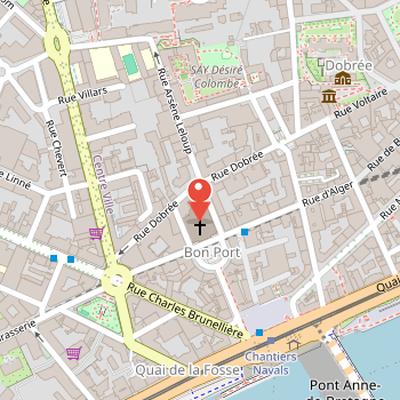
Nearby Objects
-
 Musée Dobrée 250 m away
 -
 Memorial to the Abolition of Slavery 300 m away
 -
 Natural History Museum of Nantes 400 m away
 -
 Maillé-Brézé 450 m away
 -
 Cours Cambronne 500 m away
Architecture and Historic Status
Notre-Dame de Bon-Port was constructed in 1852 in Nantes and was designed by the architects Saint-Felix Seheult and Joseph-Fleury Chenantais. It was locally called Eglise Saint-Louis. The building was registered as a historic monument, reflecting its protected status. Its organ also has recognized heritage value: the instrumental part was built by Louis Debierre in 1891 and was classified as a historic object.
Name and Parish Function
The official name of the building is eglise Notre-Dame-de-Bon-Port, and it is also designated as eglise Saint-Louis. This alternative name refers to Louis-Hyacinthe Levesque, who was mayor of Nantes in 1827 and donated to the construction of a church on the north side of place Eugene-Livet. He wished the church to bear the name of his saint patron. The building was constructed as a new church to replace one that had become too small. It serves a parish in a developing neighborhood.
From Parish Church to Urban Landmark
Notre-Dame de Bon-Port marked the extension of the city toward the west and helped transform the neighborhood near the port. The new parish of Notre-Dame de Chezine was founded at the beginning of the 19th century, originating from the parish of Saint-Nicolas. A modest original church was built at low cost in 1827 on the north side of place Eugene-Livet, but by 1843 it was decided to demolish it because it had become early dilapidated.
A new building was then planned on the site of the former disused Sanitat hospice, north of place Sanitat. Designed in a hemicycle by Louis-Prudent and Constant Douillard, the project was managed by curie Fresneau. The church was attached at the rear to residential buildings occupying the north of the block, and it became the major element of a new building in a new neighborhood.
The church interior was distinguished by rich marquetry and parquet flooring. It was inaugurated in 1858, and the murals painted by Alphonse Le Henaff were created from 1858 to 1860. The wall paintings were completed at the beginning of the 20th century. The spire topping the dome was redone in 2006.
Architectural Form and Interior Decoration
Notre-Dame de Bon-Port is described as a church in the form of a Greek cross, with equal branches forming a square plan and a dome above. Its facade is 18 meters high and is arranged on two levels: a Doric ground floor and a Corinthian first floor. The central projecting part of the facade returns to an ancient style, with a single story supported by an elevated archivolt. The church is primarily dedicated to the Virgin Mary, regarded as the protector of sailors, and this theme appears throughout its decoration.
In 1858, Amadee Menard represented the Virgin in glory at the center of the pediment, with two angels beside her. One angel blesses sailors leaving, while the other welcomes them on their return. The interior also includes works by Joseph-Rene Gouezou, who decorated the pulpit interior and the Saint-Louis chapel and depicted the comforting Christ in 1860. He later decorated the tympanum of the main door with the comforting Christ fresco in 1872 using a potash silicate fresco technique, and he also decorated the Saint-Louis chapel in 1879.
The church contains an organ with three manual keyboards built by Louis Debierre, with related decoration by Henry Leray and Laure Martin. Alphonse Le Henaff painted a large wax frieze on the dome drum between 1858 and 1860, representing the Immaculate Virgin with seven groups from the Old and New Testament proclaiming the dogma of the Immaculate Conception. In 1865, the apse received three panels illustrating biblical episodes that foreshadow the Eucharist. The Virgin chapel was painted by Antoine Chalot in 1859.
Access Controversy and Contemporary Music
Musique contemporaine reported an incident in which integrist Catholics blocked the church entrances from the public. In the same context, Musique contemporaine attended a concert by Anna von Hausswolff and noted that it had been organized by the Lieu Unique. The concert had been scheduled with the agreement of the bishopric. These facts place Notre-Dame de Bon-Port in a situation where public access and the use of the church for cultural events became points of attention.