Maillé-Brézé is a French Navy squadron escort of the T47, Surcouf class, identified by the visual call sign D627. Named after the sailor Jean Armand de Maillé, marquis de Brézé, it is the third unit to bear this name. The vessel was first an anti-aircraft escort and was later rebuilt as an anti-submarine escort. It was laid down at Lorient, launched, and admitted to active service on dates not specified here.
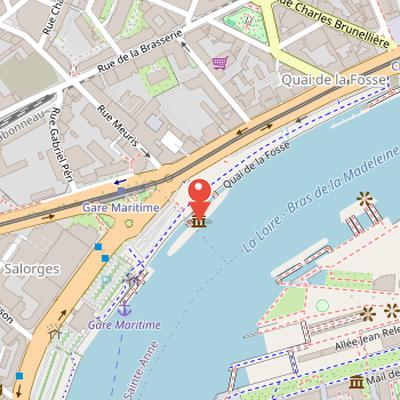
The ship conducted missions in the Atlantic and Mediterranean for ten years. It was rebuilt to be equipped for anti-submarine detection and combat, including a towed sonar with a “fish” feature, and was then based at Brest with a main mission of supporting the Strategic Oceanic Force (FOST). Since 1988, Maillé-Brézé has been moored as a museum ship at the Quai de la Fosse in the port of Nantes. It has been classified as a historical monument object since 1991.
Nearby Objects
-
 Notre-Dame de Bon-Port 450 m away
 -
 Les Anneaux 550 m away
 -
 Memorial to the Abolition of Slavery 550 m away
 -
 Place Général-Mellinet 650 m away
 -
 Hôtel Maës 700 m away
Museum Ship at Quai de la Fosse
Maile-Breze is a French Navy squadron escort of the T47, Surcouf class, identified by the visual call sign D627. It is named after the sailor Jean Armand de Maile, marquis de Breze, and is the third unit to carry this name. Since 1988, it has been moored as a museum ship at the Quai de la Fosse in the port of Nantes. In 1991, it was classified as a historical monument object.
Rebuild and Service History
Le Maille-Breze was the seventh unit of a series of squadron escort ships. It was first built as an anti-aircraft escort, then rebuilt as an anti-submarine escort. The ship was laid down at Lorient, launched, and admitted to active service on dates not specified in the available facts. Its sponsor city was Saumur. For ten years, Le Maille-Breze carried out missions in the Atlantic and the Mediterranean.
It was later rebuilt to be equipped for anti-submarine detection and combat, including a towed sonar with a fish feature. After this rebuild, it was based at Brest. Its main mission then became support for the Strategic Oceanic Force, or FOST.
Crew and Officer Accommodation
The history of Le Maile-Breze describes a structured system of accommodation for both crew and officers. The crew and naval officers were housed in collective quarters, with seven posts assigned for the crew and four for naval officers. Naval officers were further divided into categories, with two quarters for senior naval officers (OMS) and two for junior naval officers (OM). One room was allotted to two OMS officers, and the arms commander shared a room with another OMS. In total, officers were housed in seven double rooms. Some personnel received individual accommodation: the deputy commander and the mechanical engineer each had a separate room, while two additional individual rooms were reserved for a division adjutant when the vessel served as division chief, and for a superior authority with chief of staff. The commander had a more extensive apartment combining a bedroom, office, and mess. The vessel also departed from Lorient in 1957.
Conversion into a Naval Museum
In 1988, the Maille-Breze, presented as Musee Naval, was delivered to the association Nantes Marine Tradition. It was then transformed into a naval museum anchored on Quai de la Fosse in Nantes. The museum displays complete equipment, including boats and mooring devices, as well as detection equipment, armament, and living quarters. This arrangement makes the vessel a public site for presenting naval equipment and onboard spaces within the city.
Temporary Painting and Film Use
For the Dans l'art festival Teenage kicks, the Maille-Breze received a temporary painted intervention by the artists Velvet and Zoer. Their work covered the riverside of the hull, the gangway, the funnels, and the gun, and was based on the Dazzle camouflage designed by Norman Wilkinson for the Royal Navy during World War I. The painting was applied on a pre-applied wax layer so it could be cleaned quickly after the event.
The ship was later used as a set element by director Christopher Nolan during filming for Dunkirk between May and July. The film was inspired by Operation Dynamo, the evacuation of British and French troops at Dunkirk from May 26 to June 4. Because the Maille-Breze was built after the historical period represented in the film, its modern elements were removed before filming. It was towed to Saint-Nazaire for five days of modification and then to Dunkirk. Warner Bros covered the costs of transformation, restoration, towing, and immobilization. During this period, the Maille-Breze was absent from Nantes from mid-April to mid-July.