Porte d'Aix is a triumphal arch in Marseille, located on the site of the gate in the old city walls that opened toward Aix-en-Provence. It is commonly called Porte d'Aix and stands at the center of the square. The arch has been classified as a historic monument.
The project began in 1784, when lands from the galley arsenal were sold for the city’s profit and officials decided to use the proceeds for a triumphal arch honoring Louis XVI and the peace of U.S. independence. The chosen location was confirmed by municipal deliberation, but the project was delayed and abandoned during the French Revolution. It was resumed in 1823 under Mayor Marquis de Montgrand and eventually completed under Louis-Philippe, with city chief architect Charles Frédéric Chassériau overseeing the final work. Michel-Robert Penchaud used the Arch of Titus in Rome as a model. The arch was inaugurated with a solemn mass, fireworks, and illuminations. During construction, the square was arranged and leveled, and an aqueduct crossing the place was demolished.
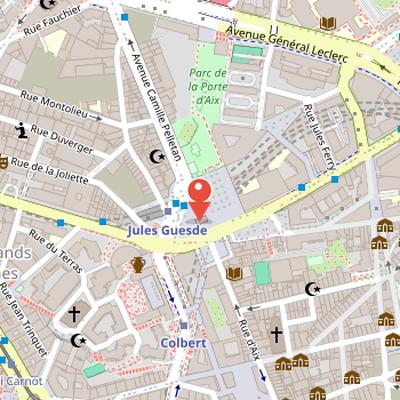
Nearby Objects
-
 Alcazar 350 m away
 -
 Musée d'Histoire de Marseille 450 m away
 -
 Jardin des Vestiges 450 m away
 -
 Église de la Mission de France 550 m away
 -
 La Vieille Charité 600 m away
Location and Monument
The site known as Situation et acces is commonly called the porte d'Aix. It is located at the place where the gate in the old city walls of Marseille opened toward Aix-en-Provence. At the center of the square stands a triumphal arch, which has been classified as a historic monument since an unspecified date. The setting reflects the former role of the site as a gateway in the city's defensive walls, while the arch serves as the main landmark of the square.
Construction and Historical Development
The Porte d'Aix originated from a municipal decision in 1784, when the city sold lands of the galley arsenal for profit. City officials then decided to use the proceeds to finance a triumphal arch honoring Louis XVI and the peace linked to United States independence. The city council selected the location of the monument through municipal deliberation. However, the project was delayed and then abandoned during the French Revolution because of official hesitation.
The idea was taken up again in 1823 by Marquis de Montgrand, mayor of Marseille. At that point, the monument was intended to commemorate Louis de France, Duke of Angouleme, and his campaign restoring Bourbon power in Spain. Christophe de Villeneuve-Bargemon later wrote about the project in his statistics on Bouches-du-Rhone, and the project received approval from the Interior Minister on a specific date. The cornerstone was laid on Saint-Charles day by Marquis de Montgrand together with architect Michel-Robert Penchaud and others, while the mayor read the marble plaque inscription that was sealed in the foundations.
During construction, Place d'Aix was arranged and leveled. An aqueduct crossing the square on arches 4.50 m high was demolished, although one arch remains near the Provence-Alpes-Cote d'Azur Regional Hotel. Debris removal was assigned to the Italian mason Gaetan Cantini. Penchaud used the Arch of Titus in Rome as a model. Construction began under Charles X and was completed under Louis-Philippe by the city chief architect Charles Frederic Chasseraiau. The bas-reliefs under the arcade were changed from scenes of the Duke of Angouleme's campaign to patriotic motifs by David d'Angers and Jules Ramey. The triumphal arch was inaugurated on King Louis-Philippe's feast day, with a solemn mass at the cathedral, fireworks, and illuminations.
Impact of the A7 Highway on Place Jules Guesde
Place Jules Guesde was affected by the arrival of the A7 highway in 1971. The classical place was then turned into a wasteland because of the highway and other works. In 2011, access to Place Jules Guesde was restricted because of police presence and major works that redirected the highway.
Architecture and Sculptural Program
The architectural decoration of Porte d'Aix was shaped by several sculptors and altered repeatedly as political regimes changed. The ornamental sculpture was assigned to the Parisian sculptor Marneuf, who was inspired by the antique arch of Orange. Historical sculpture linked to Marseille was entrusted to David d'Angers and Jules Ramey. David d'Angers represented the victories of Fleurus and Heliopolis, while Jules Ramey represented the victories of Austerlitz and Marengo. David d'Angers also decorated the north facade and the arcade of the east pillar.
The monument's decoration underwent numerous changes, including successive alterations to the dedication on the fronton. According to plans from 1825, the attic carried eight statues, each 2.75 meters high. These figures embodied northern virtues, listed as devotion, resignation, valor, and prudence, and southern virtues, listed as strength, temperance, vigilance, and clemency. Over time, the statues deteriorated because the stone was friable. They were repaired with reinforced cement in 1921, but in 1937 six statue heads detached and fell onto the public road.
Bas-reliefs of the Triumphal Arch
The architecture of the arc de triomphe at Porte d'Aix is marked by high bas-reliefs dedicated to the battles of Fleurus and Heliopolis. The Fleurus scene depicts Marshal Saxe Cobourg handing his sword to General Jourdan, while General Jourdan is shown nobly refusing to disarm his enemy. The composition also includes a grenadier, a death hussar, and German soldiers. Below this scene, a winged Victory appears with a European arms trophy, and the Victory inscribes Fleurus on the mouth of a cannon with a bayonet.
The Heliopolis high bas-relief shows General Kleber receiving the enemy submission. The enemy is represented by three motionless Turkish chiefs, and in the second plan a French grenadier places enemy standards at General Kleber's feet. A lower scene again presents a winged Victory, this time with an oriental arms trophy, and the Victory inscribes Heliopolis on a cannon.
Sculptural Program of the Porte d'Aix
The Porte d'Aix is distinguished by a dense sculptural program that combines allegorical figures, historical references, and military scenes. Its architecture includes a bas-relief representing La patrie appelant ses enfants a la defense de la Liberte, in which La Patrie is seated on the left with outstretched arms and distributes swords to volunteers. The composition also includes a young woman sacrificing her jewelry, while History appears at the bottom left writing names such as Pytheas, Euthymenes, and Puget on tablets. Two fame figures on the tympan hold palms and olive branches in their right hands and prepare to sound trumpets with their left. The fame figures by Ramey are described as wearing small pointed hats and as more dressed than those by David d Angers.
The north face carries four statues by David d Angers, restored from molds made by his daughter. From left to right they are Le devouement, La prudence, La resignation, and La force. The south facade and the west pillar arcade were decorated by Etienne Jules Ramey, whose original statues have disappeared.
Several bas-reliefs refer to military events. One represents the death of Desaix during the battle of Marengo, showing Desaix wounded and seated on the ground and supported by a soldier, with a general in the center offering a trophy of flags. Beneath it is a trophy of arms around a column topped with the inscription Marengo. Another bas-relief depicts the battle of Austerlitz, with Napoleon and a general standing with outstretched arm and encouraging the troops, and a corresponding trophy of arms around a column topped with the inscription Austerlitz. Under the arcade against the west pillar is a large bas-relief titled Le retour dans le foyer or Les braves recevant de la Patrie la recompense de leurs exploits. Familiar people were used as sculpture models in the bas-reliefs.