Porte Dijeaux is a modern city gate in Bordeaux, situated at the western end of Rue Dijeaux at the transition to Place Gambetta. Built between 1748 and 1750 to designs by architect André Portier, it reflects the neoclassical style of the 18th century. The structure has been protected as a monument since 1921.
The name Dijeaux is derived from the Roman god Jupiter. The site had earlier significance as the location of the western city gate of Roman Burdigala, known as Porta Jovis. A predecessor gate from 1302 stood a few meters further east and marked the closure of the medieval development of the city. The present gate was constructed under city planner Louis de Tourny during the mid-18th-century urban redesign of Bordeaux.
Its decorative details include trophies by Claude Francin, a French coat of arms and date cartouche on the west side, and the Bordeaux coat of arms with Neptune’s head flanked by mermaids on the east side. During the French Revolution, the wings closing the central arch and the toll counters were removed. The gate also contributes to Bordeaux’s title of Port de la Lune and its UNESCO World Heritage status.
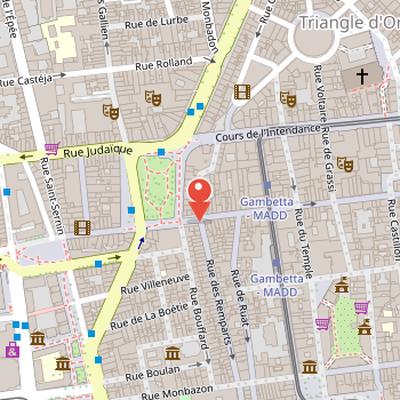
Nearby Objects
-
 Place Gambetta 90 m away
 -
 Théâtre Femina 250 m away
 -
 Center Jean Moulin 250 m away
 -
 Palais Rohan 300 m away
 -
 Église Notre-Dame de Bordeaux 350 m away
Location and History of Porte Dijeaux
Porte Dijeaux is a modern city gate in Bordeaux, located at the western end of Rue Dijeaux at the transition to Place Gambetta. It was built between 1748 and 1750 to designs by architect Andre Portier, and its design reflects the neoclassical style of the 18th century. The gate has been a protected monument since 1921.
The site has a much older history. A predecessor from 1302 stood a few meters further east and closed the medieval development of the city. The name Porte Dijeaux is derived from Jupiter, the Roman god, through the older form Porta Jovis. This was the name of the western city gate of Roman Burdigala, which stood at the same location. In the context of Bordeaux, Porte Dijeaux contributes to the city's title of Port de la Lune and its UNESCO World Heritage status.
Construction and Survival of Porte Dijeaux
Porte Dijeaux was built as part of the mid-18th century urban redesign of Bordeaux under city planner Louis de Tourny. Its construction was led by Joseph de Voisin and completed in 1750. The gate formed part of a city with seven gates in 1748, out of about a dozen originally. Its decorative program included work by Claude Francin, who was responsible for elements such as the four trophies on the acroteria.
The structure carried different symbols on each side. The west side bears the French coat of arms and a cartouche with the year 1748. The east side shows the Bordeaux coat of arms together with a cartouche featuring Neptune's head flanked by mermaids. During the French Revolution, the wings closing the central arch and the toll counters, which were no longer needed, were removed. On 18 October 1792, the General Council resolved to demolish several gates and barriers, including the medieval predecessor of Porte Dijeaux, as part of a broader effort to open the urban space at this location and abolish toll barriers.
The site also has older historical layers. Excavations carried out in the mid-1980s revealed finds dated from the 6th century BC to the 2nd century AD, and archaeological evidence indicated a permanent settlement east of Porte Dijeux. In the 1830s, demolition of the structure was discussed, but its preservation was ultimately secured. Historian Paul Courteault later wrote after that preservation had been ensured.
Material and Urban Redesign
Porte Dijeaux in Bordeaux was built from limestone quarried at Carriere de Frontenac. The quarry remains active and is described as supplying building material of consistent quality, and it is mandated for use in protected monuments by the Ministere de l Industrie, de la Poste et des Telecommunications in Aquitaine. In describing the arch, Paul Courteault presented its construction as a complete redesign in the sense of Tourny, emphasizing its role as representative urban design. He also distinguished it from a military necessity, unlike its predecessor.