Théâtre Femina is a performance hall in Bordeaux, at 10 rue de Grassi. It was created in 1921 by Victor Bonneterre and Ulysse Sédard, the latter being a manufacturer of umbrellas and director of the casino d’Arcachon. The venue became a cinema in the 1930s and returned to theater use at the end of the 1970s. Malika Josse is the current director.
The site has an earlier history linked to commercial and hospitality uses. Before the First World War, a sales room was installed in a former car garage on the plot, which also contained a coaching inn for up to 14 horses, with coachmen and stablemen, belonging to the grand hotel owned by Matteo Petit opposite the site. After the war, the theater was inaugurated. Its building demolition began on August 2, 1938, and construction was completed on January 1, 1939. Designed by André Bac, the theater was originally planned for 1,200 people but was reduced to 750. The hall also included a plaster reproduction of the MGM lion, with lions wearing collars bearing the motto “Ars Gratia Artis.”
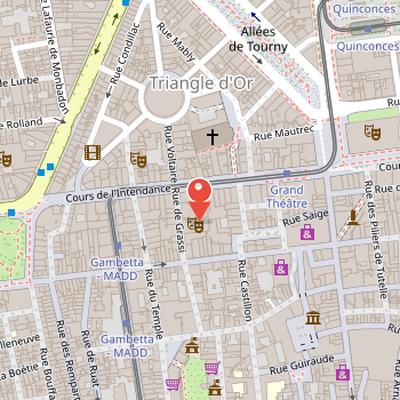
Nearby Objects
-
 Église Notre-Dame de Bordeaux 130 m away
 -
 Place de la Comédie 250 m away
 -
 Porte Dijeaux 250 m away
 -
 Place Gambetta 300 m away
 -
 Grand Théâtre de Bordeaux 300 m away
History and Use of Theatre Femina
Theatre Femina is a performance hall located in Bordeaux at 10 rue de Grassi. It was created in 1921 by Victor Bonneterre and Ulysse Sedard, the latter described as a manufacturer of umbrellas and director of the casino d'Arcachon. In the 1930s, the building was converted into a cinema. It later returned to theatrical use at the end of the 1970s. Today, Malika Josse is the director of Theatre Femina.
History and Design of Theatre Femina
Before the First World War, the site in Bordeaux housed a sales room installed in a former car garage, as well as a coaching inn for up to 14 horses with coachmen and stablemen. This inn belonged to the grand hotel owned by Matteo Petit opposite the site. After the war, the theatre was inaugurated as a new use for the plot. Demolition of the earlier building began on August 2, 1938, under Bertrand Hauret, in order to clear the site for the theatre, and construction was completed on January 1, 1939. The building was designed by André Bac. It was originally planned for 1,200 people, but Bac reduced the capacity to 750. A plaster reproduction of the MGM emblematic lion was installed in the hall, and the lions wore collars with the motto Ars Gratia Artis. These details reflect the theatre's architectural identity and its association with contemporary visual symbols.
Management and Later Use
In 1976, Yvon Rigal transferred the site to his grandson Jean-Pierre Gil. Faced with the choice of converting the cinema into 12 screens or finding a new use for it, Gil signed an agreement with the Bordeaux city hall in 1977. This arrangement lasted until 1997. After that, Gil continued to manage the theater's programming and opened it to local associations and private cultural programmers. Management was later taken over by Malika Josse in 2020. In early 2025, it was announced that Jere my Ferrari would manage the theater from July for a period of 9 years.