Palais Rohan is a palace in Bordeaux built for Archbishop Ferdinand-Maximilien-Mériadec, prince de Rohan, between 1771 and 1784. The archbishop, appointed in 1769, undertook the complete reconstruction of the old archbishopric at the northwest corner of Saint-André Cathedral. Joseph Étienne was first entrusted with the study of the project in 1771 and proposed a large complex with a three-level main building behind a large courtyard. Richard-François Bonfin later completed the works with entrepreneur René Poirier. The construction was financed through the sale of land around the archbishopric and diocesan income, but rising costs forced the archbishop to invest personal fortune. After serving as the Hôtel de l’Archevêché until the French Revolution, the palace was occupied by the revolutionary tribunal and the new General Council in 1791. It became the hôtel de la préfecture in 1800, the imperial palace of Napoleon in 1808, the royal palace under Louis XVIII in 1815, and the city hall in 1835.
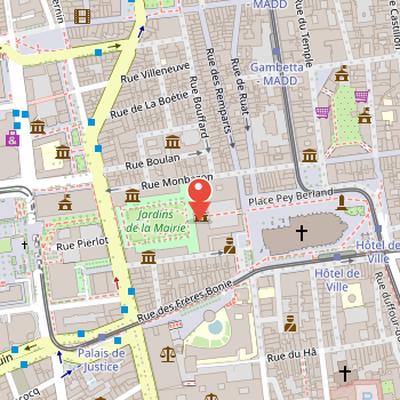
Nearby Objects
-
 Musée des Beaux-Arts de Bordeaux 110 m away
 -
 Hôtel de Basquiat 140 m away
 -
 Bordeaux Cathedral 150 m away
 -
 Fort du Hâ 160 m away
 -
 Hôtel de Ragueneau 150 m away
History and Uses of Palais Rohan
Palais Rohan in Bordeaux was built between 1771 and 1784 for Archbishop Ferdinand-Maximilien-Meriadec, prince de Rohan. It first served as the Hotel de l Archeveche until the French Revolution. In 1791, it became the seat of the revolutionary tribunal, marking a major change in its public role. The building then became the hotel de la prefecture in 1800. Its status changed again in 1808, when it became the imperial palace of Napoleon, and later in 1815, when it became the royal palace under Louis XVIII. In 1835, Palais Rohan became the city hall, a function that reflects its continuing civic importance in Bordeaux.
Construction of the Archbishopric
In 1769, Histoire became archbishop of Bordeaux and undertook the complete reconstruction of the old archbishopric at the northwest corner of Saint-Andre Cathedral. In 1771, Joseph Etienne was entrusted with studying the palace and its subdivisions. He proposed a large complex centered on a three-level main building set behind a large courtyard. The planned construction, estimated at more than 2 million livres, was to be financed through the sale of land around the archbishopric and through diocesan income. Histoire later replaced Joseph Etienne with Richard-Francois Bonfin, the city architect and author of the Grave fountain. Bonfin completed the works with entrepreneur Rene Poirier. As expenses increased, Histoire was forced to invest his personal fortune in the project. He ceded the archbishopric to Jerome Champion de Cice in 1781.
From Royal Palace to City Hall
Completed in 1784, Palais Rohan passed through a series of political and administrative uses that reflect its changing role in Bordeaux. From 1791, the new General Council of the department and the Revolutionary Tribunal occupied the palace. By 1800, the prefectural administration and the new prefect Antoine Claire Thibaudeau had moved in, and Charles Delacroix died in the building. In 1808, Napoleon took residence there, and the palace became an imperial residence for a time, while the prefecture was transferred to the former Saige hotel.
The palace changed status again in 1815, when the white flag flew over it during the Restoration, making it a royal palace. The Duchess of Angouleme resided there for four months in 1823, and in 1828 the Duchess of Berry stayed in the palace to inaugurate Saint-Andre hospital and place the first stone of the rostral columns. In 1832, the royal palace returned to state ownership. A state proposal in 1833 suggested exchanging Palais Rohan for the city hall, and the exchange was finalized in 1835. Mayor Joseph-Thomas Brun then moved into the former royal palace, and the city has continuously occupied the building since that date.
The palace also continued to serve as a setting for civic and ceremonial visits. In 1839, Mayor David Johnston received Ferdinand-Philippe, Duke of Orleans, and his wife there, and Ferdinand-Philippe inaugurated the first stone of the Bordeaux to La Teste railway station.
Damage, Additions, and Civic Use
Palais Rohan, the city hall of Bordeaux, has experienced several episodes of damage and adaptation. At an unspecified date, the building was severely damaged by a fire that destroyed the municipal archives, although most of the painting collection was saved. Later, during Alain Juppe's term as Prime Minister and mayor of Bordeaux, a bomb exploded under the mayor's office windows on the garden side. The explosion damaged the ground floor of the city hall but caused no casualties; the FLNC Canal historique group claimed responsibility the following day.
According to Histoire, the complex was expanded in 1880, when Charles Burguet built two wings on each side of the garden to house the Museum of Fine Arts. In 1889, the city installed the city council in the former civil and military courts room, and the woodwork decoration dates from this period. The building has also remained the focus of public attention in more recent years. During a major mobilization against the government's Borne pension reform, individuals set fire to the coach door of the courtyard of honor. The fire burned for about fifteen minutes before being extinguished by firefighters, and the damage was estimated at nearly 3 million euros. The incident led to controversy because of a video recorded during the fire and slogans attributed to the far right, but police later found no links between the far right and the attack. Rue89 then published an article rejecting the initial hypothesis and attributing the fire to far-left black blocs. Six people were eventually sentenced to up to six years in prison for the coach door fire, including two homeless persons and four people with criminal records, some of whom were far-left activists.
Restoration of the Damaged Door
In late 2023, Bordeaux city hall launched an online consultation on possible solutions for the damaged door. According to Histoire, 75 percent of voters chose to install a new door identical to the original, and the city mayor considered the consultation a success. The burnt door was removed and kept as a model for the new construction, while a provisional door was installed in the meantime. After 30 months of work and 3,500 hours, at a cost of EUR803,822, the new door was installed. It was made identical to the original and restored the natural wood color, replacing the old blue paint.
Neoclassical Courtyard Composition
Palais Rohan in Bordeaux was created as a monumental neoclassical ensemble. Its plan follows the model of an hotel particulier arranged entre cour et jardin, with a large central body flanked by two low wings at the front. The wings are linked by a colonnade that forms a square courtyard, which is enclosed by an Ionic order arcade portico open to the street.
The center of the portico is marked by a monumental gate, giving the facade a strong ceremonial focus. The enclosing wall is decorated with arcatures inspired by 1770 models by a Parisian architect, adding a refined ornamental layer to the composition. On either side of the entrance gate, two niches were reserved for statues by Deschamps. The original program planned figures of La Ville de Bordeaux and La Religion, and models of these statues are preserved at the Musee des Arts decoratifs.
In 1869, the niches were replaced by sculptures by Edmond-Sebastien Prevot. The present figures are Le Genie du commerce et de l'industrie and Le Genie des sciences et des arts. The ensemble combines architectural symmetry with sculptural decoration, reinforcing the palace's monumental character and its role as a carefully composed civic residence.
The town hall also inaugurated Strange Fruit by Sandrine Plante-Rougeol, a sculpture in resin and metal symbolizing uprooting and new rooting of populations. The work presents three characters representing anger, fear, and abandonment, and its title refers to the poem sung by Billie Holiday in 1939, which in turn evokes a black body lynched on a tree.
Historic Monument Protection
Palais Rohan benefits from double protection under historic monument status. The palace and its honor courtyard are listed by inscription, while the facades and roofs of all the buildings are classified. The protection also extends to various rooms on the ground floor, which are classified as part of the monument. This combination of inscription and classification reflects the historical and architectural importance of the site.