Center Jean Moulin is a museum and documentation center in Bordeaux devoted to World War II history. Its collections and publications focus on the French Resistance, deportation, and the Free French Forces. The center was created in 1967 by Jacques Chaban-Delmas and is affiliated with the musée d’Aquitaine. Its foundation grew out of the 1964 commemorative exhibition for the anniversary of Bordeaux’s liberation, following a meeting between Jacques Chaban-Delmas and Geneviève Thieuleux. The initial collection, assembled from material presented by Thieuleux during the resistance years, became the basis of the future national Jean-Moulin center. The center was later expanded into a new building at the corner of rue Vital-Carles and Place Jean-Moulin, which improved its visibility. Closed since 2018 for renovation, its planned reopening in 2022 had not taken place in 2024. Part of its content was transferred to the musée d’Aquitaine.
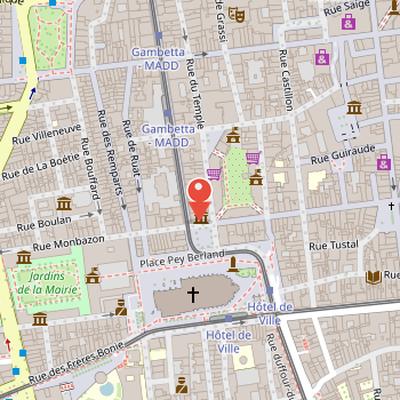
Nearby Objects
-
 Bordeaux Cathedral 110 m away
 -
 Place Pey-Berland 120 m away
 -
 Palais Rohan 200 m away
 -
 Porte Dijeaux 250 m away
 -
 Fort du Hâ 300 m away
Museum and Documentation Center
Center Jean Moulin is a museum and documentation center in Bordeaux dedicated to World War II history. Its collections and research focus on the French Resistance, deportation, and the history of the Free French Forces. The center was created in 1967 by Jacques Chaban-Delmas and is affiliated with the musee d'Aquitaine. In addition to its museum role, it publishes reference works on the World War II period. Since 2018, the center has been closed for renovation, and the reopening planned for 2022 had not taken place in 2024. Part of its content was transferred to the musee d'Aquitaine during this period.
Founding and Development of the Center
The Center Jean Moulin originated from the commemorative exhibition held in Bordeaux in 1964 for the anniversary of the citys liberation. Its creation followed a meeting between Jacques Chaban-Delmas and Genevieve Thieuleux, whose collection gathered during the Resistance years provided the basis for what would become the national Jean Moulin center. The Bordeaux municipal council decided on its creation on November 22, 1966, and entrusted its organization to Genevieve Thieuleux. The center opened at 16 rue des Freres Bonie and welcomed numerous personalities from the Resistance at the opening.
Its mission has been to transmit the memory of those who fought the Nazi occupiers and of the victims of that period. The association also aims to honor Jean Moulin and preserve the memory of the Resistance. The institution was established through the active participation of Bordeaux personalities and relies on the National Jean Moulin Center of Bordeaux, while also supporting the actions of conservator Genevieve Thieuleux. Genevieve Thieuleux, a former hematology laboratory research student, remained its director until her retirement in 1990, when she was replaced by Anne-Marie Pommies.
The center later moved to a new building at the corner of rue Vital-Carles and Place Jean Moulin, a location that allowed expansion and better visibility. It received an official visit from President Francois Mitterrand on June 1, 1983. In the following years, it also became the seat of the Claude-Bonnier national committee, created on October 19, 1986, and of the Jean Moulin institute, founded on October 5, 1987. The center also integrated Saint-Andre Hospital of Bordeaux as the headquarters of the Resistance group Tete during World War II.
Teaching, Research, and Memory at Center Jean Moulin
Center Jean Moulin operates as a teaching center with two linked roles: an archive-related documentation center and a museum. Its collections include authentic documents, archives, and period testimonies intended for learning and research, with a focus on the Resistance, Deportation, and the Free French Forces. The center also has a permanent World War II exhibition and a space for temporary exhibitions, and visits to the collections can be arranged by appointment.
The documentation center contains numerous books that are publicly accessible to the public and to students. It also provides thematic files to teachers, researchers, students, or any requester, while a librarian assists visitors with research. The center collaborates with researchers by offering research support and publishes works such as monographs on Jean Moulin, De Lattre de Tassigny, and Rene Cassin.
Its educational activity is developed for school students and led by a history teacher. This service offers visits, helps teachers prepare class topics, supplies documents, and prepares students for the Concours National de la Resistance et de la Deportation. It also organizes meetings between students and former resistants or deportees. The association and conservator write to teachers, offer themed visits and conferences, and provide archives for teaching World War II history. Genevieve Thieuleux created albums from archives to make consultation easier, and the association also commissioned models of important Resistance battles for historical explanations. Management of the center was transferred to the Musee d'Aquitaine in 2006, and the center works with resistance and deportee associations in a memory role.
The Former Caisse d'Epargne Building
The Center Jean Moulin is located in the former building of the Caisse d'epargne de Bordeaux, a municipal property. The Caisse d'epargne de Bordeaux opened in 1819 and was the second savings bank founded in France after Paris in 1818. It later moved into a new building constructed in 1846-1847 and designed by architect Henri Duphot. In 1907, Mialhe carried out modifications to the building, including the addition of balconies.
The building is also associated with the historical context of Bordeaux during the Second World War. Bordeaux was an important city during the war, became capital of France for the third time in history, and saw more than a thousand officials settle there. Place Pey Berland served as the executive command location for a few days. After Marshal Ptain came to power, Bordeaux was declared free and the government moved to Vichy. The city was occupied by the Germans on June 21, 1940.
Museum Layout and Historical Mission
Center Jean Moulin is a museum and documentation center with a strong historical and cultural role. Located in a district marked by German presence during World War II, it covers the history of the war and the Resistance to varying degrees. It was one of the first centers to focus specifically on the Resistance during the war, which has contributed to its regional and national influence. Its historical significance and the role of its founding key actors have also given it international renown, and it receives many donations of private collections from around the world. The city of Bordeaux gives it important exposure.
The center moved to the former Caisse d'epargne premises, where it now offers 1500 square meters of exhibition space spread across three floors. The building is presented as a place carrying memory and contemporary questioning. Its displays bring together historical and artistic testimonies on World War II themes, including works by artists linked to the historical context and objects that belonged to Jean Moulin.
The three floors are organized thematically. The ground floor is dedicated to the context of World War II and contains objects, archives, and newspapers illustrating key moments and themes of the conflict. Its internal layout follows a chrono-thematic order. The first floor hosts temporary exhibitions with contemporary scenography and regularly presents varied temporary exhibitions, alongside a room dedicated to Deportation. The second floor contains staff offices, access to archive documents for researchers, and the personal office of Jean Moulin. An interior courtyard also includes a boat placed at its center.
The theme of Resistance continues to inspire the army and new recruits at the center, where 30 volunteers signed their army contracts during a ceremony attended by director Christian Block.
The Jean Moulin Center and Its Collections
Created in 1967, Les collections du centre national Jean-Moulin was the first institution in France dedicated to the Resistance. At its inception, it served as a national and regional documentation center on the Second World War. Supported by Jacques Chaban Delmas as a public archive center, it became the only public archive center in France and contributed to education and research. Its mission has been to transmit the memory and values of the Resistance to younger generations.
The center was directed by curator Genevieve Thieuleux from 1967 to 1990. During this period, she created historical albums intended to provide serious knowledge about this troubled period. The archives were confidential and were not revealed before 1997 because of their sensitive nature.
The collection was built through purchases, donations, legacies, and loans. Donations played a major role in the initial holdings, and the first elements came from the 1964 exhibition at the Bibliotheque Municipale on the Second World War. Since its origin, the center has also participated in purchasing art pieces up to 50 percent of their price. Among later acquisitions, the FRAM Aquitaine helped obtain a bronze bust of General de Gaulle from 1943. Temporary exhibitions also included contributions from private collectors, such as Propagande! Affiches en temps de guerre - 1939-45, for which Vincent Caliot provided a large number of wartime posters.
Each new acquisition must be approved by an acquisition commission. The extensive collection requires thorough maintenance, and after a ten-year process, 95 percent of it has been inventoried. The collection is managed using Micromusee software.
Permanent Exhibition and Resistance Collections
The collections of the Centre national Jean Moulin bring together a rich body of objects connected to the Resistance and to military equipment from the Second World War. They also preserve objects and documents regarded as objects of memory, donated or loaned by witnesses of the period. These materials are presented across three levels devoted to the permanent exhibition, with spaces organized to retrace different aspects of the war.
The exhibition covers themes including the Resistance, the press, military life, the landing, and deportation. One space is devoted to the role of the press during the war, both resistant and official, and includes an old resistant press that illustrates the work and risks involved in spreading information. Another area presents the German occupation of Bordeaux, symbolized by flags and posters. On the ground floor, the display turns to military life through radios, helmets, and weapons, alongside emblematic objects linked to both war and daily life. A rare moped used by resistants is also shown on this level.
The ground floor ends with a space dedicated to the landing, featuring a model, soldier uniforms, weapons, and a Jeep symbolizing the American landing on the Normandy beaches. The first floor is devoted to deportation and displays deportee uniforms as well as personal belongings such as doll clothes and bowls. At the top level, the most important exhibit is the ship s'ils te mordent, which resistants used to reach General De Gaulle in London.
The collections are completed by extensive documentation on the history of the Resistance in France, including a large series of photographs, unpublished images of the Normandy landing and the liberation of Paris, portraits of figures such as Jean Moulin and Charles de Gaulle, newspapers, handwritten and typed letters, war testimonies, posters, prefectoral notices, a manuscript by Maurice Druon containing the lyrics of the Chant des partisans, and detailed maps and plans showing major Resistance movements and their evolution.
Jean Moulin's Office and the Resistance Collections
An upstairs room at the Center Jean Moulin is devoted to commemorating Jean Moulin through a reconstructed office. The office was recreated thanks to donations from Marcelle Sabatier, Jean Moulin's niece, and is furnished with large green velvet armchairs placed in front of a desk, along with a wardrobe and a small table. The decor also includes objects, musical instruments, and artworks that belonged to Jean Moulin. On the fireplace, portraits of his parents, Blanche Elisabeth Pegu and Antoine-Emile Moulin, are displayed.
Beyond this reconstructed interior, the collections preserve works connected to the Resistance and the Liberation. Among them is the collection Nuit et Brouillard by Jean-Jacques Morvan, which comprises nearly 70 paintings, sculptures, gouaches, charcoal drawings, and medals. The center also holds enamels by Raymond Mirande related to Deportation, works by Edmond Boissonnet, and caricature drawings by Paul Matunine under the pseudonym PEM. Its holdings further include political caricatures published in period newspapers such as Aux ecoutes, including satirical speeches of Hitler.
Les Combattants d'Afrique at Center Jean Moulin
At the Centre national Jean-Moulin, the temporary exhibition Les Combattants d'Afrique was organized as part of the commemoration of the 70th anniversary of the 18 June appeal by General de Gaulle. It was also included in the framework of the Cinquantenaire des Independances and in Bordeaux municipality actions for African veterans. The exhibition was described as a tribute from Bordeaux, Center Jean-Moulin, and the Ministry of Defense to African veterans. Its display brought together filmed images, 144 photographic portraits of Moroccan veterans by Loic Le Loet, and objects and uniforms loaned by the Musee des Troupes de marine de Frejus, the Musee de l'Artillerie de Draguignan, and ECPAD. The exhibition space was designed around about twenty thematic areas.
Jean Moulin at the Centre national Jean-Moulin
The temporary exhibition Jean Moulin, le devoir de la Republique was presented at the Centre national Jean-Moulin from 8 July 2013 to 22 June 2014. Dedicated to Jean Moulin, described as the youngest prefect of France and a pioneer of the Resistance, the exhibition brought together about one hundred rare and unpublished documents. These materials highlighted his youth during World War I and included school compositions, drawings, and notebooks from his college and high school years.
The exhibition was divided into four main sections. It began with a prologue presenting famous and emblematic portraits of Jean Moulin. A biography section then focused on the major events of his life. Another section displayed his school compositions, drawings, and notebooks bequeathed by his sister Laure. French compositions written during World War I were also shown, revealing his character and dedication. The exhibition ended with a section devoted to tributes and to Jean Moulin's legacy as a unifier of the Resistance.
Temporary Exhibitions at the Center Jean Moulin
The Center Jean Moulin has hosted several temporary exhibitions focused on war history, propaganda, and memory in Bordeaux and the surrounding region. One major exhibition was La Liberation de Bordeaux, organized by Expositions et valorisation des collections and shown at the Centre National Jean-Moulin from August 28, 2014 to May 31, 2015. It presented the events leading to the end of the German occupation of Bordeaux in August 1944 and included sections on Bordeaux during the war, the entry into the war, the German arrival, life under Occupation, and the early Resistance in Aquitaine. The exhibition also covered the stages of the Liberation of Bordeaux and the fighting by the French Forces of the Interior, before concluding with the immediate effects of the Liberation on local political life and on the city. More than 400 documents, photographs, and objects were presented, including video testimonials from INA, photos, letters, and objects from daily life. Most of the material was conserved through the Archives Municipales de Bordeaux, and the scenography was enhanced by numerous video and slideshow projections.
Another exhibition, Propagande ! Affiches en temps de guerre, was organized as a double exhibition in both musee d'Aquitaine and the centre national Jean-Moulin. The first part, at musee d'Aquitaine, ran from 13 October 2015 to 17 January 2016 and presented propaganda posters from the First World War. The second part, at the Centre National Jean-Moulin, ran from 13 October 2015 to 27 March 2016 and presented propaganda posters from the Second World War. The exhibition addressed war communication for Bordeaux's First World War centenary and used documents, posters, photographs, videos, and texts to explain the economic and social dimensions of the First and Second World Wars. It also illustrated the State's needs in wartime and its use of propaganda, including mobilization, war financing, participation in the war effort, propaganda as a means to legitimize the government representative, and the development of the personality cult around Marshal Petain. Posters made by allies and resistance fighters showed that propaganda existed on both sides of the conflict. For this exhibition, all posters were restored and backed, and a catalog with over 120 reproductions of original posters was produced.
In 2017, the center hosted 1917: Voila les Americains!, from 22 July 2017 to 7 January 2018. This exhibition traced the arrival and daily life of American soldiers in the Bordeaux region and ended with the re-embarkation of the troops. It displayed cinematic images mainly from ECPAD archives and documents mostly from private collections and Gironde departmental archives. Through educational documents, the center also contributed to promoting Second World War memory heritage. Beyond exhibitions, Expositions et valorisation des collections produced the film Les Saboteurs de l'ombre, the web series Les Resistances, and the book La Resistance by Dominique Lormier, and primarily provided documentation for these productions. These activities supported the educational, memory preservation, and knowledge transmission goals of the Jean-Moulin center.
The Jean Moulin Center and the Memory of the Resistance
The Jean Moulin Center in Bordeaux played a supporting role in the creation of the 2014 documentary Les Saboteurs de l'ombre et de la lumiere, a 52-minute film directed by Marie Nancy. The center contributed through its archive funds and partnered in the documentary project, which combined archival images with testimonies from maquisards. Marie Nancy, who is the niece of Jacques Nancy, gathered a large amount of information and witness accounts about him from the Archives Departementales and the Jean-Moulin center in Bordeaux.
The documentary focuses on Jacques Nancy and Claude Bonnier, identified as leading figures of French resistance in region B in 1943. After training in London to fight against the Germans, they organized and structured the resistance, recruited members, and armed groups. Within three months, they formed 70 groups of resistant saboteurs. Claude Bonnier was later betrayed, captured, and committed suicide in prison, leaving Jacques Nancy alone to organize internal resistance without orders from England. Jacques Nancy then created the Section Speciale Saboteurs to disrupt enemy communication and movements. The film places this history in the context of the liberation of Angouleme on August 31, 1944, and the retaking of Royan on April 17, 1945.
Jean Moulin Center and Resistance Memory Media
The centre national Jean-Moulin has contributed to several projects that present the history and memory of the French Resistance through books and web media. In 2014, the web series Les Resistances was broadcast on the France 3 website. It focused on regions involved in the French Resistance during World War II, including Limousin and Aquitaine. The episodes, which lasted between ten and twenty minutes, were organized thematically and combined testimonies from former resistants, archival footage, and historical articles. The Jean-Moulin center contributed to the episodes dealing with the Aquitaine region, including an interview with Gerard Chatelier and the short film Les combats d une resistance plurielle.
The center also took part in the publication of La Resistance by Dominique Lormier, published in October 2012 by editions Grund. This book was produced in association with the centre national Jean-Moulin, which provided important documentation. La Resistance presents the French Resistance through a thematic and chronological structure, with detailed text on resistance networks, organization, actors, and liberation. It also includes facsimiles of testimonies, most of them previously unpublished, as well as photographs of displayed objects, posters, newspapers, and medals. The facsimiles, provided by the centre national Jean-Moulin of Bordeaux and the musee de l Ordre de la Liberation of Paris, include official or false identity papers, letters, and patriotic or resistance leaflets. These documents are presented as valuable references for history and memory, whether from family heritage or newly published official sources.
According to the provided facts, these projects support the center's educational goals, knowledge transmission, and preservation of memory. The centre national Jean-Moulin also shares archives and document collections to create an educational platform and promotes the transmission of Resistance memory through an interactive Internet platform.