The Medici Fountain is located in the Jardin du Luxembourg in the 6th arrondissement of Paris. It was built about 1630 and commissioned by Marie de' Medici, the widow of King Henri IV and regent of King Louis XIII. The fountain was later moved to its present location and extensively rebuilt between 1864 and 1866. As a historic urban feature, it reflects a period in which Italian influence in Paris shaped royal gardens and decorative waterworks. In the 17th century, Italian mannerist style flourished in France, and Italian artists and technicians contributed to projects for royal residences. These influences included elaborate fountains, grottoes, and garden design inspired by the Italian Renaissance. The Medici Fountain belongs to this broader context of French and Italian artistic exchange in Paris and at nearby royal sites.
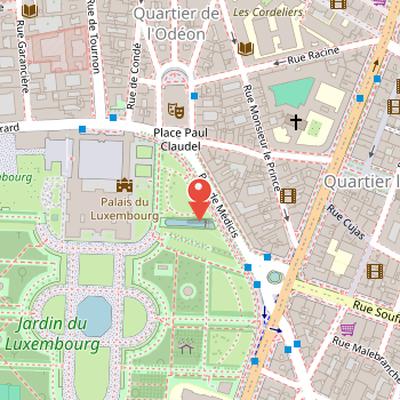
Nearby Objects
-
 Luxembourg Palace 130 m away
 -
 Odéon–Théâtre de l'Europe 150 m away
 -
 Boulevard Saint-Michel 200 m away
 -
 Jardin du Luxembourg 200 m away
 -
 Petit Luxembourg 300 m away
Location and Rebuilding
The Medici Fountain is located in the Jardin du Luxembourg in the 6th arrondissement of Paris. It was built about 1630 and was commissioned by Marie de' Medici, the widow of King Henri IV and regent of King Louis XIII. In 1864 to 1866, the fountain was moved to its present location and extensively rebuilt. These changes form an important part of its history and help define its present setting within the garden.
Italian Influence and Garden Design
Italian influence in Paris in the 17th century was part of a wider flourishing of the Italian mannerist style in France between 1559 and 1642. It included a community of artists from Florence who helped design the statue of King Henri IV on the Pont Neuf, including sculptor Francesco Bordoni. The same cultural exchange also brought fountain technician Thomas Francini to France, where he found eager royal patrons. Francini had worked on fountains in the new gardens of the Medici villas in Florence and Rome, and his presence helped introduce features of the Italian Renaissance garden to French royal sites. These features included elaborate fountains and the grotto, a simulated cave decorated with sculpture. Such elements were incorporated into the Gardens of the French Renaissance at Fontainebleau and other royal residences, showing the role of Italian expertise in shaping courtly landscape design.
The Medici Fountain and the Palais des Medicis
Construction of the Palais des Medicis on the left bank of Paris began between 1623 and 1630. The new palace was modeled after the Palazzo Pitti in Florence, and the gardens around it were modeled after the Boboli Gardens in Florence. Salomon de Brosse worked on the palace, while Tommaso Francini most probably worked on the fountain and grotto. Francini had emigrated to France at the invitation of Henry IV in 1598 and was naturalized in 1600. He had already built grottos and fountains in the Italian style for the marquis de Gondi and for the royal chateau of Henry IV at Saint-Germain-en-Laye.
The fountain was shaped by the practical difficulties of building on the Left Bank, where water was scarce. Unlike the Right Bank, where the water table was near the surface and wells and two aqueducts served the city, the Left Bank had a deep water table. Water had to be carried from the Seine to this part of Paris. The city had expanded far from the Right Bank but had hardly grown on the Left Bank. The aqueduct of Arcueil, constructed between 1613 and 1623, was built to address this water problem.
19th Century Modifications
The Medici Fountain underwent several major 19th century modifications that changed both its setting and decoration. In 1811, architect Jean-Francois Chalgrin restored the grotto and replaced the simple water fountain with two streams of water in the grotto niche. He also added a white marble statue representing Venus in her bath. Later, from 1858 to 1864, the fountain was moved thirty meters to make room for rue de Medicis, and the Fontaine de Leda was placed directly behind it after the move.
The decorative program was also revised. The two original statues of nymphs were replaced with statues representing the Rivers Rhone and Seine. The coat of arms of the Medici family was restored above the fountain, while two statues representing a faun and a huntress were inserted into the niches. Two masks representing comedy and tragedy were added above the niches, and the simple basin and water spout were replaced with a long tree-shaded basin. The statue of Venus was later removed and replaced by statues by Auguste Ottin representing Polyphemus discovering Acis and Galatea. These changes shaped the fountain as it appeared after cleaning in the summer of 2021.
The Hidden Fountain of Leda
The Fountain of Leda was constructed between 1806 and 1809 at the corner of rue Vaugirard and rue du Regard. It was designed by architect Francois-Jean Bralle and sculpted by Achille Valois. The fountain includes a bas-relief depicting the story of Leda and the Swan, with Leda shown holding the swan on her knees and the figure of Amor shooting an arrow at her from the corner of the sculpture. Water flowed from the beak of the swan into a hemispherical basin at the foot of the fountain. In 1856, Baron Haussmann wanted to extend rue de Rennes, and in response Gabriel Davioud, then chief of the service of Promenades and Plantations of Paris and a sculptor, sought to preserve the fountain. He had it moved in 1858 to the Jardin du Luxembourg, where it was placed on the back of the Medici Fountain. It remains there, unnoticed by passers-by.
Bibliographic References
The bibliography for the Medici Fountain includes Paris et ses fontaines, de la Renaissance a nos jours, with texts assembled by Dominque Massounie, Pauline-Prevost-Marcilhacy, and Daniel Rabreau. This work was published by Delegation a l'action artistique de la Ville de Paris in the Collection Paris et son Patrimoine in Paris in 1995. Another listed source is L'Art des jardins en Europe by Yves-Marie Allain and Janine Christiany, published by Citadelles et Mazenod in Paris in 2006.