Odéon–Théâtre de l'Europe is a French theatre located at place de l'Odéon in Paris. Inaugurated in 1782, it initially hosted the Théâtre-Français troupe and later became one of the six French national theaters in 1990. The building is an Italian-style theatre with neoclassical facades and has been classified as a historic monument since 1977.
The theatre’s history began in 1767, when the marquis de Marigny requested a new Théâtre-Français hall project from Marie-Joseph Peyre and Charles De Wailly. After competing proposals, their design prevailed in 1778, with construction beginning under a division of responsibilities between the two architects. The exterior was inspired by Palladio, and the hall featured a semicircular plan with benches in the orchestra, called the parterre. The building also formed the center of a new district organized around the theatre.
Its history includes two fires, in 1799 and 1818, the public premiere of The Marriage of Figaro in 1784, and occupation during the May 1968 events when it was directed by Jean-Louis Barrault. Since 2021, the current director has been Julien Gosselin.
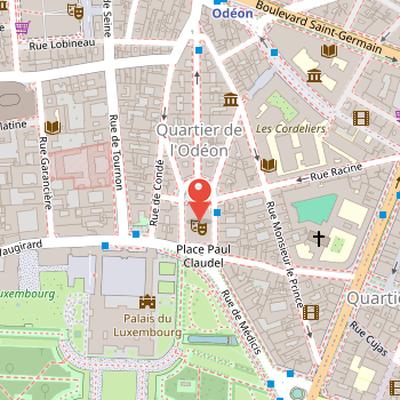
Nearby Objects
-
 Hôtel de Condé 130 m away
 -
 Luxembourg Palace 160 m away
 -
 Medici Fountain 150 m away
 -
 Petit Luxembourg 250 m away
 -
 Jardin du Luxembourg 300 m away
History and Architectural Character
The Odeon-Theatre de l'Europe is a French theater located at Place de l'Odeon in Paris. Inaugurated in 1782, it initially hosted the Theatre-Francais troupe. The building is designed in the Italian style and has neoclassical facades. It has been classified as a historic monument since 1977.
The theater has a notable history of major events and changes. It suffered two fires, in 1799 and 1818. In 1784, it hosted the public premiere of The Marriage of Figaro. The theater was directed by Jean-Louis Barrault and was occupied during the events of May 1968. Since 1990, it has been one of six French national theaters. Its current director is Julien Gosselin, who has held the post since 2021.
Design and Site of the New Theatre
In 1767, the marquis de Marigny asked Marie-Joseph Peyre and Charles De Wailly to develop a new Theatre-Francais hall project. A royal council decree ordered that construction take place on the prince de Conde's garden land, although the prince wished to leave the garden in order to move to the palais Bourbon. Two other projects were also produced, by Denis-Claude Liegeon and Jean Damun, and by Pierre-Louis Moreau-Desproux. Peyre and de Wailly ultimately prevailed in autumn 1778 with the support of Monsieur and the comte d'Angiviller, and the theatre site was shifted closer to the palais du Luxembourg for Monsieur, the king's brother. The First Gentleman of the Chamber warned the Comedie-Francais amid their opposition.
Construction began with Peyre responsible for the exteriors and Wailly for the interiors. The exterior design was inspired by Palladio, with pavilions linked by an arch, in the manner of villa Pisani. The hall had a semicircular plan and was the first Italian-style theatre with benches in the orchestra, known as the parterre. These benches replaced standing room for audiences, marking a new architectural innovation.
The building also served as the focal point of a new district designed by Peyre and Wailly. Five streets converged toward the theatre's stage opening on a large semicircular square, and the district was noted for offering remarkable traffic and parking ease for the era.
Early History of the Ode9on-The9e2tre de l'Europe
The Histoire records that the Come9die-Frane7aise troupe moved into the new theatre on an unspecified date, and that Queen Marie-Antoinette inaugurated the theatre hall on an unspecified date. The venue soon became associated with important theatrical events, including the performance of La Folle Journe9e ou Le Mariage de Figaro by Beaumarchais, which the Histoire says was triumphed by the aristocracy despite the king's opposing opinion. The role of Figaro was created by Dazincourt, who was Marie-Antoinette's professor, and comedian Talma made his debut there on an unspecified date.
The theatre's identity changed during the Revolutionary period. The National Assembly renamed it The9e2tre de la Nation by decree, and the law on theater freedom caused the Come9die-Frane7aise to lose its repertoire privileges. In 1791, Marie-Joseph Che9nier's Charles IX was banned, which led to conflict between royalist and republican actors at The9e2tre de la Nation. Republican actors led by Frane7ois-Joseph Talma left for The9e2tre de la Liberte9 et de l'c9galite9 in an unspecified month, while detained actors remained at the The9e2tre de la Nation during the Terror and were freed after Robespierre's fall. After a decree allowed performances, actors returned to The9e2tre de l'c9galite9 in an unspecified year.
The building was altered by having its boxes destroyed and turned into an amphitheater adorned with blue-white-red draperies. Troupe dissensions caused the theatre to close by the end of an unspecified year, and royalists opposing the National Convention later held meetings there while it was closed. It then reopened on an unspecified date under the management of Dorfeuille & Cie and was renamed Ode9on, a name that the Histoire says referred to ancient Greek ode9ons and was intended to create a specific theatrical style. Dorfeuille later declared bankruptcy in an unspecified year, leaving only unspecified assets, and Charles-Barnabe9 Sageret acquired the lease on an unspecified date. Sageret, who directed The9e2tre Feydeau and The9e2tre de la Re9publique, planned to reunite the troupes, but actors revolted against him due to the performance schedule around mid-year of an unspecified year. After a fire on an unspecified date, all actors reunited at the Come9die-Frane7aise at rue de Richelieu.
Restoration, Rebuilding, and 19th-Century Use
The history of the Od?on theater in the 19th century was marked by repeated damage, restoration, and institutional change. After being ceded by Napoleon to the Senate, the theater was restored identically by architect Chalgrin and reopened as the Theatre de Sa Majeste l'Imperatrice et Reine. Alexandre Duval received the privilege of the Od?on theater, and in 1815 Louis-Benoit Picard succeeded him. The theater was then destroyed by fire again and reconstructed by architect Pierre Thomas Baraguay. The rebuilt theater opened under the tutelage of the Comedie-Francaise as the Second Theatre-Francais, with Louis-Benoit Picard directing until 1821.
In 1827, Thomas Sauvage was directing the theater, and an English acting troupe enjoyed success there that same year. The theater also became central to the youth insurrection during the July Revolution. Its physical setting changed further in 1832, when the lateral connecting arches were demolished and the two lateral buildings were sold and separated from the theater.
By 1848, Victor Hugo described the Od?on as always deserted, and he criticized the idea of placing a theater in a deserted neighborhood such as the faubourg Saint-Germain. These remarks show that the theater's location and public presence remained part of its historical perception as well as its architectural history.
Sarah Bernhardt and the Ode9on
The Ode9on theater was closely linked to the early career of Sarah Bernhardt. She made her debut there as Aricie in Racine's Phe9dre for the Emperor's celebration, and in 1862 she joined the Come9die-Frane7aise after performing at the theater. The Ode9on was also the site of her career breakthrough in 1869, with François Coppe9e's Le Passant. During the events of 1870, Bernhardt obtained military permission to install an ambulance in the Ode9on's foyer. The theater reopened after the proclamation of the Republic, and Bernhardt later achieved a triumph there in Victor Hugo's Ruy Blas in 1872. These references show the Odeon as an important venue in her artistic development and public presence.
Theatre Direction and Repertoire in the Late 19th and Early 20th Centuries
The history of the Oddeon theater records a succession of directors who shaped both its artistic direction and its public identity. After Charles de Chilly died during the 100th performance of a play at the theater, Felix Duquesnel succeeded him and emphasized new plays and support for young authors. He justified the State subsidy as protection against ventures driven only by easy profit, and he also inaugurated classical Sunday morning matinees. The theater space was adapted during this period, with the stage and auditorium heated by two large heaters in the last quarter of the century, foyers decorated with portraits of actors, busts, and medallions, and an evacuation terrace constructed for the public.
Paul Porel was appointed in 1884 and described as a complete and charismatic theatre man. Under his direction, the theater saw the 1885 creation of L'Arlesienne by Alphonse Daudet with music by Georges Bizet, performed by the orchestra of Edouard Colonne. This production financially supported the theater for fifty years during difficult times. Later, Paul Ginisty staged several plays by Georges Mitchell, including L'Absent in 1903, a four-act play with music by Fernand Le Borne. Georges Mitchell received an award from the Academie francaise in 1905. Ginisty's major success was Le Chemineau by Jean Richepin, and he also introduced lectures during the classical matinees.
The theater played a notable role after the Comedie-Francaise fire in 1900, when that troupe moved to the Odeon and then to the Gymnase until summer 1901. Firmin Gemier succeeded in 1901 with colonel Brideau in La Rabouilleuse by Emile Fabre, and Andree Megard was successful in the title role. By 1907, under Andre Antoine's direction, the theater had 1400 seats. Antoine described the second Theatre Francais as a place for teaching and literary education, created a reading committee to form a modern repertoire, and in his seven-year direction became a leading figure of official theatre. His production of Shakespeare's Julius Caesar in 1913 involved 525 extras and more than 70 stagehands, with De Max as Mark Antony and Duquesne as Julius Caesar.
Paul Gavault succeeded Antoine and remained until 1921, working to preserve theatre activity and artists' salaries during the war. Firmin Gemier was then appointed in 1921 and modernized the building by installing a new electric organ and removing the ramp. He continued acting, including as Shylock in Le Marchand de Venise, founded the Societe Universelle du Theatre, and started Theatre National populaire in 1920. He broadened the repertoire to include new plays by living authors and foreign classics, expanded subscription series, and maintained the cheapest ticket prices in Paris. From 1925, Paul Abram assisted in the direction and later succeeded Gemier until 1940, leading the troupe on tours in the suburbs, provinces, and eastern Europe. He was removed from direction during World War II because of his Jewish origins.
From National Stage to Experimental Theatre
The Odéon passed through a series of temporary directions under Jacques Copeau, Pierre Aldebert, Rene Rocher, Armand Salacrou, and Jean-Louis Barrault. A decree then assigned the second stage to the Comedie-Francaise, and the Odéon came under the rue de Richelieu administration for thirteen years. After renovation, it functioned as an annex devoted to modern repertoire and classical revivals. During this period, premieres at the Odéon included plays by Courteline, Feydeau, Rostand, Pirandello, Jules Romains, Henry de Montherlant, Audiberti, and Jean Cocteau.
In 1959, the theatre was renamed Theatre de France and entrusted to the company of Jean-Louis Barrault and Madeleine Renaud, with the concession granted by Andre Malraux. Their motto, "Pursue Beauty without shirking Difficulty," was applied to the new Theatre de France. Under this direction, Tete d'Or by Paul Claudel was inaugurated in the presence of General de Gaulle. Other productions included Numance by Miguel de Cervantes, adapted by Jean Cau and staged by Barrault at the Avignon festival and at the Odéon in 1965, with music directed and stage music composed by Jose Berghmans.
Barrault also hosted concerts by the Domaine musical founded by Pierre Boulez and staged works by Ionesco, Beckett, Billetdoux, and Duras. The troupe toured worldwide, and the Odéon hosted creations from Theatre des Nations. In 1965, Andre Malraux inaugurated Andre Masson's ceiling, which featured mythic figures. The Petit-Odeon was transformed by Renaud-Barrault into a small theater laboratory and opened with Nathalie Sarraute's Le Silence and Le Mensonge. The small room later received the name Salle Roger-Blin in 1984.
The theatre also became associated with controversy and protest. A scandal erupted over Jean Genet's Paravents, staged by Roger Blin at the Odéon, and during the May 68 protests the theatre was occupied by students. Barrault answered the occupation by saying, "This is my home." The theatre was damaged and closed for several months for repairs before reopening as a center for experimental and trial arts, including dramatic, choreographic, and lyric arts.
Administrative Changes and Later Expansions
The institution became EPIC and was renamed Theatre national de l'Odeon on an unspecified date. Its programming under this framework included contemporary repertoire performances by the Comedie-Francaise troupe, as well as significant space for decentralized troupes, major foreign companies, and the Jeune Theatre National. At the end of each season, the theatre devoted time to recording Comedie-Francaise performances for television. Its direction passed successively to Pierre Dux, Jean-Pierre Miquel, and Jacques Toja.
A decree in 1978 placed the theatre under the administration of the Comedie-Francaise general administrator as director. Later, under Giorgio Strehler and Jack Lang, another decree made it Theatre de l'Europe for six months annually, with Strehler serving as artistic director during that period. The theatre later regained independence from the Comedie-Francaise by an unspecified decree and adopted the name OdEon-Theatre de l'Europe to continue Strehler's project.
Leadership then continued through several directors: Lluis Pasqual from 1990 to 1996, Georges Lavaudant from 1996 to 2007, Olivier Py from 2007 to 2012, Luc Bondy until his death in an unspecified year, Stephane Braunschweig from an unspecified start date to an unspecified end date, and Julien Gosselin since an unspecified date.
The building also underwent major renovations and modernization in 1906, 1930, and from 2002 to 2006. In 1995, the Renaud-Barrault media library, specialized in theatre, was inaugurated there. Since 2003, the theatre has also had a second modular hall with 350 to 450 seats, located in former Opera Garnier decor warehouses on boulevard Berthier. Designed by architect Jean-Loup Roubert, it was inaugurated with Phdre by Jean Racine directed by Patrice Chereau and later became officially the theatre's second stage.