Jardin du Luxembourg is a public garden in the 6th arrondissement of Paris. It was created in 1612 at the request of Marie de Médicis to accompany the Luxembourg Palace, and it was later restored under the direction of architect Jean-François Chalgrin during the First Empire. The garden now belongs to the domain of the Senate. Covering 25 hectares, with 23 hectares open to the public, it includes flower beds and sculptures.
The palace and garden kept the name of the former hôtel de Luxembourg, which had belonged to François de Piney-Luxembourg before being sold to Marie de Médicis. The name was also briefly associated with Palais Médicis, though that name did not last. The site has a distant relation to the duchy of Luxembourg through the Piney-Luxembourg family’s indirect descent from the German house of Luxembourg. In 2022, HouseFresh ranked Jardin du Luxembourg as the most beautiful garden in Europe and the third most beautiful garden in the world.
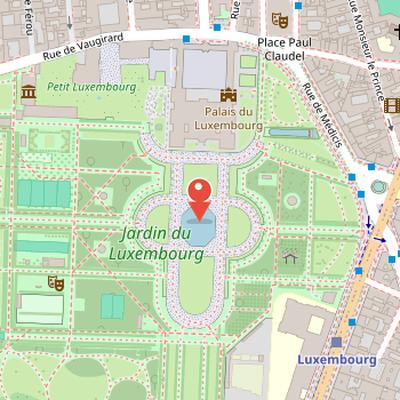
Nearby Objects
-
 Luxembourg Palace 160 m away
 -
 Medici Fountain 200 m away
 -
 Boulevard Saint-Michel 250 m away
 -
 Petit Luxembourg 250 m away
 -
 Luxembourg Museum 300 m away
History and Design of the Jardin du Luxembourg
The Jardin du Luxembourg is a public garden in the 6th arrondissement of Paris. It was created in 1612 at the request of Marie de Medici to accompany the Luxembourg Palace. During the First Empire, it was restored under the direction of the architect Jean-Francois Chalgrin. The garden now belongs to the domain of the Senate. It covers 25 hectares, of which 23 hectares are open to the public.
The garden includes flower beds and sculptures, which are part of its formal landscape. In 2022, HouseFresh designated it the most beautiful garden in Europe and ranked it third most beautiful in the world, behind Gardens by the Bay in Singapore and Majorelle Garden in Marrakech.
Name and Toponymy
The palace and garden kept the name of the old hotel particulier, the hotel de Luxembourg, which had belonged to Francois de Piney-Luxembourg before being sold to Marie de Medicis. The palace was also called Palais Medicis, but that name did not last. According to toponymy, the name has only a distant relation to the duchy of Luxembourg, ancestor of the present country. The Piney-Luxembourg family did not own the duchy of Luxembourg, although they descended indirectly through cadet branches from the German house of Luxembourg, which once held the duchy as an apanage. At the time of the purchase, the duchy was under Spanish control. The palace is also familiarly nicknamed Luco, short for Lucotitius, the Roman-era name of the suburb, and this is coincidentally similar to Luxembourg.
Marie de Medicis and the Creation of the Luxembourg Residence
At the beginning of the century, the neighborhood at the foot of Montagne Sainte-Genevieve was still sparsely populated and was mainly occupied by seminaries, convents, colleges, and mansions. Among these properties was the mansion of the Duke of Piney-Luxembourg. Marie de Medicis later considered this estate, where the young Louis XIII had learned hunting, as a possible residence after leaving the Louvre palace. The eight hectares around the residence gave her space to create a large Florentine garden. She commissioned architect Salomon de Brosse to build a palace inspired by the Palazzo Pitti in Florence. For the decoration of the palace, she hired Italian, French, and Flemish artists. In 1622, she also invited Pierre Paul Rubens to Paris to paint twenty-four scenes from her life, although only thirteen of these paintings were completed.
Early Layout and Expansion Limits
The Jardin du Luxembourg opened in front of the new palace, but its early form was limited by the nearby Chartreux convent. Cardinal Richelieu pressed for the convent wall to be moved about one hundred meters, yet Marie de Medicis was unable to relocate the convent despite his influence. As a result, the park had to expand along one side of the palace rather than spread freely in front of it. Gomboust's 1629 plan shows the garden only barely extending before the building. Over time, the garden reached more than one kilometer from Boulevard Saint-Michel to Boulevard Raspail from east to west. The main garden alley later became Rue de Fleurus after the western part of the garden was removed.
From Medici Garden to Public Promenade
The Jardin du Luxembourg began in 1612, after the land was purchased and planting started under a design assigned in the history to Jacques Boyceau. The early garden featured symmetrical parterres arranged around a central fountain at the foot of the palace. It was also surrounded by a double elevated walkway shaped like an Italian terrace by Thomas Francine. The aqueduct from Rungis to Arcueil was rebuilt over nearly ten years and named the aqueduc Medici, providing an important water supply for the site. In 1635, Andre Le Notre was asked to redesign the parterres. The southern perspective could not be extended because of the presence of the Chartreux convent.
After the death of Marie de Medici in 1642, the palace and garden changed ownership. Later, in 1778, the Count of Provence received the property and sold the western third of the garden to finance palace restoration. This sold portion included the Philosopher's Alley and Lovers' Promenade, while Luxembourg street, now rue Guynemer, marked the western boundary of the garden.
The Revolution brought severe changes. The palace was converted into a prison, where Danton, Desmoulins, Fabre d'Eglantine, David, and about eight hundred inmates were held. During this period, the garden was abandoned and mainly visited by prisoners' families. The site also saw major territorial changes: the Chartreux convent was requisitioned, the wall blocking the Observatory view was removed, and land was recovered toward the south as far as boulevard du Montparnasse. In 1795, the palace housed the Directory, and its directors settled in Petit Luxembourg, except Barras, who occupied the west wing royal apartment.
At the beginning of the 19th century, Jean-Francois Chalgrin designed Avenue de l'Observatoire on Chartreux lands and remodeled the small garden and floral decorations known today. Francine's intermediate terraces are now covered by an embankment with steps leading to the sole remaining terrace. The Medici Grotto was remodeled with a basin framed by semicircular lawns, and a decorated staircase with statues compensates for the slope to the south. After the 18 Brumaire coup, the palace became the Senate of the Empire, and Napoleon wanted the garden adapted for children, with kiosks, games, and goat cars.
From 1836, enlargement works moved flower beds about thirty meters, demolished dilapidated buildings, and replaced the garden wall with grilles that improved visibility toward the palace. Old degraded statues were replaced by statues of queens, and Alphonse de Gisors built a new orangery. Under the Second Empire, Haussmann's urban works altered the garden further: Boulevard Saint-Michel and Rue de Medecis reduced the northeast area, while Rue de Vaugirard was widened in 1845 after the demolition of the northwest convent of Filles du Calvaire. Haussmann also planned to isolate the Medici Grotto on a small square, but protests led to its dismantling stone by stone, reconstruction, and transformation into a fountain with a water basin serving as a mirror. Its central niche statue of Venus was replaced by Polypheme surprising Galatea in Acis's arms by Auguste Ottin. Gisors also reconfigured the buildings between Luxembourg Palace and Petit Luxembourg.
In 1865, protests arose over the suppression of a nursery for the construction of Rue Auguste-Comte, but Napoleon III arbitrated in favor of the works after a site inspection. The southern promenades later became popular with Parisians. After the Paris Commune, on May 28, 1871, Federates were shot at the foot of the terrace des Reines, and the Senate placed a plaque there in their honor on the same date.
War Damage and Wartime Use
During World War I, the garden was damaged by attacks. On March 11, 1918, it was hit in a raid by German airplanes, and in 1918 a shell from the Big Bertha exploded in the garden. Histoire also notes that Canary Island palms placed around the basin in summer retained bomb impact marks on their trunks.
During the Occupation, the Luxembourg Palace served as the German air force general staff headquarters. The occupiers dug two bunkers under the garden, one east and one west of the palace, and installed barbed wire in the park. The garden was partly closed to the public and used as parking for German vehicles and artillery. In 1941, a German garden was set up in part of the Luxembourg garden and was forbidden to the public. This area included the lawn aligned with the palace facade extending to the basin and side alleys.
The garden continued some horticultural activity during the war. It took part in exhibitions such as the 1942 Paris Fair, and the fruit garden kept cultivating plants for teaching and collection maintenance. A 1943 report noted that production had declined because of labor and fertilizer shortages and other war constraints, and fallen fruits were used for staff canteen meals. In spring 1943, a large potato storage near the Guynemer pavilion was built. The former Medicis shelter now serves as a storage place.
On August 25, 1944, the 2nd armored division forced the gates on rue Auguste-Comte and entered the garden. Around 10 a.m., the surrender took place, with the swastika pavilion brought in and Germans depositing weapons in the palace courtyard. After Liberation, the palace and garden were restored to their current known state.
Setting and Enclosure
The buildings are located in the heart of the Latin Quarter. They are grouped within an enclosure marked by a grille with points covered in gold leaves. The gardens also include several classified buildings, adding to the site's architectural and heritage character.
Landscape Organization and Public Uses
The Jardin du Luxembourg is organized into several distinct landscape zones. It includes a French-style section aligned with the palace axis, English-style sections near rue Guynemer, and a geometric forest placed between the French and English areas. The garden also contains lawns and a conservatory orchard of old fruit tree varieties in its southern part. This orchard is located opposite lycee Montaigne on rue Auguste-Comte and mainly consists of apple trees and pear trees.
The garden is crossed by walkways that allow strolling and wandering. Its planting also reflects different uses, with beds for garden parterres and greenhouses used for plants intended to decorate the palace interior. Near pavillon Davioud, at porte Vavin, there is an apiary used for beekeeping introduction.
Pavillon Davioud was built in 1867 by Gabriel Davioud and was originally known as buffet de la Pepiniere. It began as a cafe-restaurant and now hosts public and free courses from the Ecole d'horticulture du Luxembourg. It also serves as a venue for conferences by Luxembourg course auditors and the Societe centrale d'apiculture, and it presents artistic exhibitions in summer.
Other public facilities include a restaurant terrace near the music kiosk under chestnut trees and the Theatre des Marionnettes, which has been present since 1933. Managed by Robert Desarthis until 1971 and then by Francis-Claude Desarthis, it has a seating capacity that makes it the largest puppet theater site in France.
Sculptures and Fountains in the Garden
The Jardin du Luxembourg includes a number of sculptures and fountains that contribute to its character. Among the works listed in the garden are L'Acteur grec, Le Cri, l'Ecrit, Le Faune dansant, Harde de cerfs ecoutant le rapproche, Monument a Antoine Watteau, and twenty statues titled Reines de France et Femmes illustres. The garden also contains two fountains: the fontaine Medicis along rue de Medicis and the Monument a Eugene Delacroix against Petit Luxembourg.
Activities and Public Use
Jardin du Luxembourg is used for a wide range of public activities, combining sport, leisure, exhibitions, and ceremonies. Tennis, basketball, martial arts, and the final phases of the French jeu de paume championship are held in the garden, with the jeu de paume court at the Senate having hosted competitions for the 1900 Summer Olympics. Chess also has a regular place in the garden: some players meet near the orangery in the northwest corner at twelve tables provided by the Senate, even in winter, while others use three tables to the east of the four tennis courts in good weather.
The garden has a long history of regulated seating. Chaisieres once collected payment for the right to sit on Senate chairs, a profession that is now extinct. Before World War I, the chair seating fee was twenty sous; in 1920, chairs cost 0.20 franc and armchairs 0.30 franc. Seating was made free for everyone in 1974.
Cultural use is also prominent. Since 1997, photography exhibitions have been regularly displayed on the exterior railings, following Stephane Sednaoui's original 1995 idea proposed to UNESCO. Other exhibitions are presented inside the garden as well. The southeast corner music kiosk hosts concerts with summer-long posted programs, and opera performances are also presented in the garden.
Children's activities include a playground, pony rides on the donkey alley, and a puppet theater created in 1933. The western carousel, built from Charles Garnier's plans and inaugurated in 1879, is another notable feature and later inspired the poem Le Carrousel by Austrian poet Rainer Maria Rilke. The garden also annually hosts several Senate-organized ceremonies, and in autumn 2022 it hosted the latest edition of a popular sporting event with five kilometer and ten kilometer races in the heart of the Luxembourg garden.
Trees, Greenhouses, and Wildlife
The Jardin du Luxembourg contains a range of notable trees, including purple beeches, ginkgo bilobas, pedunculate oaks, and maple-leaf plane trees. Some of these trees date from the 19th century. Among them are horse chestnut trees at rue Guynemer and rue de Vaugirard, which were planted from seeds collected at Monticello, the property and plantation of Thomas Jefferson.
The garden also includes greenhouses in the south-east area that contain an orchid collection created in 1838. This collection has won several awards at national and international horticultural exhibitions. The Jardin du Luxembourg is also a habitat for birds such as oak jays, robins, winter wrens, and chaffinches. Since the 2010s, ring-necked parakeets have also been observed there, alongside occasional sightings of a heron.
Management and Maintenance
The Jardin du Luxembourg is managed by the Senate rather than the Paris municipality. Its budget is included in the Senate program action within the powers publics mission of the French State budget, and for 2024 it is financed by the French State with an allocation that decreased by 1.56 percent compared with 2023. The same Senate management also applies to the Jardin des Tuileries, the Jardin du Palais-Royal, the Jardin des Plantes, and the Jardin d'acclimatation. In 2016, the garden employed 200 gardeners. These gardeners are civil servants of the Senate recruited by competitive examination. The flowers and plants used in the garden are grown in greenhouses at the corner of rue Auguste-Comte and boulevard Saint-Michel.
Sculpture and Site Features
The Galerie references a range of sculptures, monuments, and garden features associated with the Jardin du Luxembourg. Among the works mentioned are Charles-Arthur Bourgeois' L'Acteur grec, created in 1868, Jules Dalou's Monument a Delacroix from 1890, and his Le Triomphe de Silene from 1898. Other referenced pieces include Jules Blanchard's La Bocca della verita from 1871, the statue of Sainte-Beuve by Denys Puech, the bust of Charles Baudelaire by Pierre-Felix Masseau, and the Monument a Auguste Scheurer-Kestner by Jules Dalou. The Galerie also mentions Laure de Noves by Auguste Ottin, included in the series Reines de France et Femmes illustres, as well as La Liberte eclairant le monde by Auguste Bartholdi.
In addition to individual artworks, the references point to several recognizable elements of the garden itself. These include La fontaine Medicis, Diane chasseresse, La buvette des Marionnettes, and a chair of the Jardin du Luxembourg marked with the Senat logo. The Galerie also notes a plan du jardin du Luxembourg for non-voyants, indicating attention to accessibility and orientation within the site.
Several references place the garden in particular seasonal or spatial contexts, such as an alllee under snow, Le bassin under snow, Jardin du Luxembourg under snow in Paris viewed from the Palais du Luxembourg, Le jardin in April, and the Palais du Luxembourg viewed from the axe sud. Together, these references present the Jardin du Luxembourg as a site defined both by its collection of public artworks and by the visual identity of its paths, basin, fountains, and views.
The Garden in Art
The Jardin du Luxembourg appears as a recurring subject in art, with several works titled after the garden or set there. Vincent Van Gogh's Allée dans le jardin du Luxembourg (1886) is located at the Clark Art Institute in Williamstown, while Albert Edelfelt's Au jardin du Luxembourg (1887) is held at the Ateneum in Helsinki. Eliseu Visconti also depicted it in Jardim de Luxemburgo (1895). Later works include Marià Pidelaserra's Une journee d'hiver au Jardin du Luxembourg (1900), located at the musee national d'Art de Catalogne, and Henri Rousseau's Jardin du Luxembourg. Monument de Chopin (1909), held at the musee de l'Ermitage in Saint-Petersburg. These works show the garden's continued presence in art across different periods and artists.