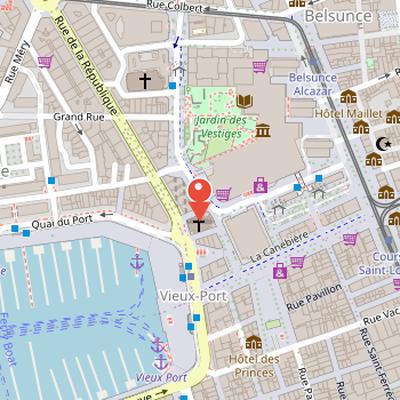
Église Saint-Ferréol les Augustins is a church building in the 7th arrondissement of Marseille, located at quai des Belges between rue du Beausset, rue de la reine Élisabeth, and rue des Augustins. Its history is linked to the Augustinians in Marseille, whose origins go back to eremitic movements recognized in the 13th century. After settling near Rue d’Aubagne and Rue Fongate, the community later moved following the destruction of its district in 1361 and eventually remained in a house acquired from the Hospitallers until the French Revolution.
The construction of the convent and church began slowly in 1447 on reclaimed land near the end of the Vieux-Port. The building used wood from an unusable galley donated by Jean de Villages for its framework, and it was consecrated while the nave was still covered only by a simple wooden structure. In the 17th century, the church stood near the port and, after the 1666 extension of Marseille ordered by Louis XIV, it became part of the new urban center. Since 1965, it has been entrusted to the Compagnie de Jésus by the archbishop of Marseille.
Nearby Objects
-
 Jardin des Vestiges 150 m away
 -
 Place du Général-de-Gaulle 200 m away
 -
 Musée d'Histoire de Marseille 200 m away
 -
 Hôtel Louvre et Paix 350 m away
 -
 Opéra de Marseille 350 m away
Location and Stewardship
Eglise Saint-Ferréol les Augustins is located in the 7th arrondissement of Marseille, at quai des Belges, between rue du Beausset, rue de la reine Elisabeth, and rue des Augustins. Since 1965, it has been entrusted to the Compagnie de Jesus by the archbishop of Marseille. These details place the building within a specific urban setting and identify the religious authority responsible for it in the modern period.
Augustinian Settlement in Marseille
The Augustinians in Marseille originated from several eremitic movements that claimed Saint Augustine, with their order officially unified in 1256 by a papal bull from Pope Alexandre IV. Two years after the order's official start, the community decided to settle near Rue d'Aubagne and Rue Fongate, with support from King Robert of Naples, Count of Provence. In 1361, they were forced to abandon this district after its destruction was ordered to prevent it from being used strategically by armed bands. After that, they sought to acquire a house that had formerly belonged to the Order of the Temple. Pope Urban V authorized them to negotiate with the Hospitallers of the Order of Saint John of Jerusalem, and they remained in the house acquired from the Hospitallers until the French Revolution.
Construction and Early History
The convent and church of Saint-FerrEol les Augustins were built at the end of the Vieux-Port, near Plan Fourmiguier, on alluvial and unstable reclaimed land from the former port horn. Construction began slowly in 1447. The framework was made using wood from an unusable galley donated by Jean de Villages. The building progressed enough to receive Pope Clement VII during the marriage of Catherine de Medicis. The church was consecrated by Barthlemy Portalenqui, bishop in partibus of Troie, when the nave was still covered only by a simple wooden framework.
Urban Setting and Access
The church was located near the port and was initially outside the old town. When Louis XIV ordered the extension of the town in 1666, it came to stand at the center of the new agglomeration. Architecturally, it did not have a monumental facade and was embedded in constructions to the east near the port. Its main door opened to the north, at the level of a fifth bay that has since disappeared. The entrance led onto rue des Augustins, a narrow street at a right angle to the church facade; this street is the present rue de Beausset. At the time, the present rue des Augustins did not yet exist and lies to the south on the other side of the church.
Confraternities and Burial Practices
Under the Ancien Regime, several corporations used the church for patronal ceremonies. The confraternity of bakers, known in Provenal as fourniers, owned a chapel there, and their patron, Saint Honore, was celebrated in the church on its feast day. The confraternity of smiths also had an altar dedicated to Saint Eloi, and this group included farriers, saddlers, harness makers, and coachbuilders. The portefaix constructed an altar dedicated to Saint Peter, chosen because Peter is depicted carrying the keys to paradise, a symbolism that matched the portefaix carrying the riches of this world. The auffiers also performed devotions in the church and held their feast on the first Sunday of March. Other craft groups included tinsmiths, who honored Saint Jean Facond, and shoemakers, who honored Saint Loup.
Burial inside the church led to many tombs. There were approximately 115 tombs in the basement of the nave, while additional tombs belonged to religious near the altar. Tombs were also associated with noble families and confraternities in the side chapels. This accumulation of burials reflects the church's role not only as a place of worship but also as a funerary space for different social groups.
Revolutionary Transformations
During the Revolutionary period, the church was the subject of major civic and urban projects because of its valuable location near the port. The municipal council proposed its demolition, while the constituent assembly issued a decree assigning it as the seat of a parish named Saint Augustin. Architect Ponge prepared several plans, including one in 1793 that called for extending the lower part of the old rue des Augustins. This plan required demolishing the east part of the church and removing its fifth bay in order to prolong the street. At the same time, the convent was ordered to be demolished, except for the part adjoining the church choir and bell tower.
The period also brought changes to the surrounding street pattern. A new street, rue neuve des Augustins, was planned and later became rue des Augustins, while the old rue des Augustins was renamed rue du Beausset. Buildings were also allowed between the new street and place cul-de-boeuf, now place Gabriel Peri. The church itself was sold to merchant Charles Guinot, who lost his rights for not paying the price, and it was later provided to the forage service. The demolition of the fifth bay was completed, and a new facade was constructed around 1801.
History and Alterations of the Facade
The church of Saint-Ferréol was originally located at the end of rue de ce nom, at place Saint-Ferréol, and was demolished in 1794. In 1803, Bishop Champion de Cice transferred the name of Saint-Ferréol to the church now known as Saint-Ferréol les Augustins. The building was then affected by several later urban works. It was threatened by the construction of a customs house in 1840, and the creation of rue imperiale also endangered it. Further construction exposed the facade by removing buildings at the bottom of rue imperiale. A grand organ made by Augustin Zeiger was installed on the gallery above the entrance in 1844. The facade was rebuilt in a neo-classical style in 1874, and Joseph Letz covered it with cement cladding in 1875.
Interior, Pulpit, and Organ
The current church has a central nave and six side chapels, arranged three on each side, with each chapel given a particular decoration. Among its notable furnishings is a carved wooden pulpit from the 17th century, which came from the former church of Saint-Hommebon and is located at the present site of the Alcazar. This pulpit has been classified as a historical monument since 1906 under an object title. The church itself was registered as a historical monument by decree on March 30, 1926.
The church also contains a grand organ built in 1844 by the French maker Augustin Zeiger. It has two manual keyboards of 54 notes, a pedalboard of 30 notes, and 23 stops. The organ was modified in 1911 and again in 1953, with changes including a new transmission system, expanded keyboards, a new console, and additional stops. Its instrument part was classified as a Monument Historique in 2009. Silent since 1985, the organ was completely restored to its original condition and inaugurated again on May 30, 2010. It is now fully functional, maintained since the restoration, and used for regular concerts.