Basilique Saint-Nicolas is a Catholic neo-Gothic basilica located in downtown Nantes. It is one of the two basilicas in the city, alongside basilica Saint-Donatien-et-Saint-Rogatien. The building forms part of the historic Saint-Nicolas parish and reflects a long urban history linked to the surrounding neighborhood and former fortifications.
Historical references suggest an early religious presence on the site, with theologian and historian Nicolas Travers hypothesizing a construction before 1186, based on the mention of a cimetière Saint-Nicolas that year. The area was part of the parish of Saint-Similien in 1186 and later included in an enclosure launched in 1226. A document from 1444 records work on the church, including the portal certified by Mathurin Rodier, and the church was then at the heart of a parish bearing its name. The nave rests on a section of the old city wall, whose remnants are still visible in rue Duvoisin west of the current church. Renovation works ran from 1766 to 1772, marking the final phase of the older building before later reconstruction plans were drawn up.
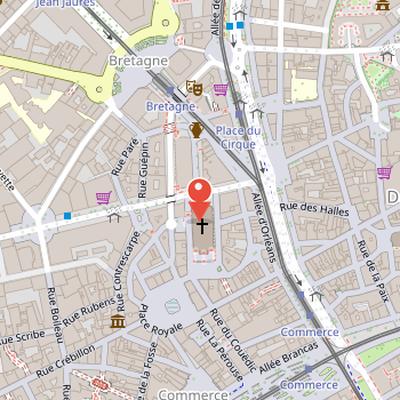
Nearby Objects
-
 Marché de Feltre 100 m away
 -
 Place Royale 120 m away
 -
 Convent of the Carmelites 250 m away
 -
 Place du Commerce 250 m away
 -
 Passage Pommeraye 300 m away
Catholic Neo-Gothic Basilica in Downtown Nantes
Basilique Saint-Nicolas is a Catholic neo-Gothic basilica located in downtown Nantes. It is one of the two basilicas in the city, alongside the basilica Saint-Donatien-et-Saint-Rogatien. Its status as one of only two basilicas in Nantes gives it a notable place within the city's religious landscape.
Early History and Urban Setting
The history of Basilique Saint-Nicolas is closely tied to the medieval growth of its district. A chapel or small subsidiary church is said to have been erected sometime between the second half of the unspecified century and the end of the unspecified century. Theologian and historian Nicolas Travers also hypothesized a construction before 1186, basing this view on the mention of a cimetiere Saint-Nicolas in that year. In 1186, the sector belonged to the parish of Saint-Similien.
The Saint-Nicolas neighborhood was later included in an enclosure launched in 1226. Its fortifications deteriorated and were renovated by the duke in the early unspecified century, and the Saint-Nicolas gate was rebuilt by the duke at the junction of the current rues de l'Arche-Seche and du Commandant-Boulay. By 1444, Saint-Nicolas was at the center of a parish bearing its name. Documents from that year mention works on the church, including portal work certified by Mathurin Rodier.
Also in 1444, the church acquired plots that separated the building from the curtain wall. The nave of the present church rests on a section of the old city wall, and remains of that wall are still visible in rue Duvoisin, west of the current church.
Neo-Gothic Reconstruction and Later Additions
The Basilique Saint-Nicolas was entrusted to Jean-Baptiste-Antoine Lassus, a student of Henri Labrouste and a collaborator of Eugene Viollet-le-Duc. Its project was one of the first neo-Gothic projects in France, and the building was erected as a minor basilica by the pope. The church was built from regional granite, hard stones, and Touraine tuffeau. A commemorative medal recorded the laying of the first stone under King Louis-Philippe, prefect Achille Chaper, and mayor Ferdinand Favre.
Before this reconstruction, the bell tower threatened ruin in the mid-18th century, and the parish had to organize a fundraising campaign, including the sale of precious liturgical books. Renovation works began in 1766 and ended in 1772, providing the final touch to the old building, which had three naves separated by a large pillar. The choir was flat, and the apse stood at the site of the current rue Affre, accessible from the south via place Felix-Fournier on narrow land. The church was oriented on a north-south axis rather than the east-west alignment required by Christian tradition.
The parish later planned a total reconstruction of the building, with plans drawn up in 1773 and reconstruction works decided in 1789. The bell tower took the last fifteen years of the works to complete. At the start of the 20th century, the tower, topped with a cross, made the church the highest in France. Later additions included the tomb of Felix Fournier, installed in 1883 after his death in 1877. The neo-Gothic furniture was registered as a historical monument before the church itself was classified the following year.
Bombing Damage to the Basilica
The Basilique Saint-Nicolas was severely damaged during the Allied bombing that affected the entire neighborhood, including place Royale and rue du Calvaire. This damage was reported by Paul Caillaud, the director of Nantes civil defense. The available facts indicate that the basilica was part of a wider area of destruction rather than an isolated case.
Postwar Reconstruction and Restoration
Reconstruction work on Basilique Saint-Nicolas began in 1953 after the war and was completed in 1974. During this period, the damaged grand organ dating from 1901 was dismantled and then reconstructed in two phases, in 1963 and 1985. The basilica's exterior stone had blackened and weakened mainly because of atmospheric pollution. A further restoration phase was launched in 2004 under the direction of Pascal Prunet, chief architect of Historical Monuments. This campaign included repairs to the tuffeau and granite stone, as well as the complete repair of heavily damaged exterior elements.
The Bells of the Basilique Saint-Nicolas
Les cloches is a set of five swinging bells cast in 1882 by Adhemar Astier in Nantes. The group includes a bourdon bell that is noted for having one of the lowest sounds in France. Its note is even lower than the bourdon of Notre-Dame de Paris. These bells form a distinctive acoustic element associated with the Basilique Saint-Nicolas.
Architectural Features of Basilique Saint-Nicolas
The gallery for Basilique Saint-Nicolas highlights several exterior and interior elements of the building. On the outside, images show the facade, the western facade clock, the chevet, the spire, the bell tower, the rose window of the transept, a portal statue, and the south door coat of arms. One image also shows the spire with eight angels. These views indicate a church with a detailed exterior composition and multiple ornamental features.
Inside the basilica, the gallery shows the nave, the great organ, and the Chapel of the Virgin. It also includes a monument dedicated to Felix Fournier, bishop of Nantes from 1870 to 1877, and a chapel dedicated to the blessed Ceferino Gimenez Malla, described as a martyr and the first beatified Roma. Together, these elements suggest that the basilica contains both liturgical spaces and memorial or devotional features.
The documented images present the basilica as a site where architecture, decoration, and commemoration are closely connected. The combination of structural details such as the bell tower and rose window with interior features like the organ and chapels gives a partial but clear view of the building's visual and religious importance.