Place du Commerce is a pedestrian square in Nantes, France, situated in the city center at the western edge of the medieval city. It is bordered to the south by the Allée de la Bourse, a former Loire quay, and several streets lead into the square from its corners. It lies near the main public transport station of the Nantes metropolitan area, reinforcing its role as a central location in the life of the city. Historically, the site was called place du port au Vin in the Middle Ages. Its southern side was once washed by a branch of the Loire known as the Bras de la Bourse, which allowed merchant boats to arrive and helped maintain part of Nantes’s maritime traffic. The area later became the main financial square of Nantes and took the name Place du Commerce. The square is also unofficially known as place Sarajevo.
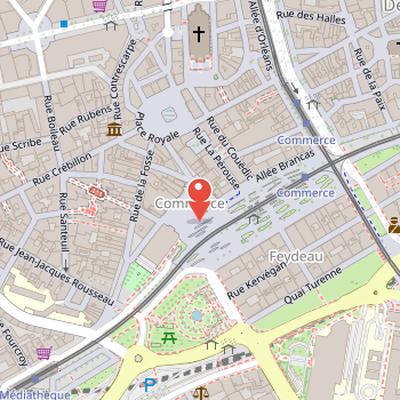
Nearby Objects
-
 Passage Pommeraye 150 m away
 -
 Place Royale 150 m away
 -
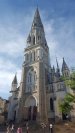 Basilique Saint-Nicolas 250 m away
 -
 Château du Bouffay 350 m away
 -
 Place Graslin 350 m away
Location and Role in the City
Place du Commerce is a pedestrian square in Nantes, France. It is a central location in the life of the city and is situated near the main public transport station of the Nantes metropolitan area. The square is also unofficially known as place Sarajevo, although this name is not official.
Location and Access
Place du Commerce is located in the city center, at the western edge of the medieval city. On its southern side, it is bordered by the Allée de la Bourse, which was formerly the Loire quay. Access is provided by four streets: rue Thurot and rue François-Salières at the northwest corner, and rue du Port-au-Vin and rue de Gorges at the northeast corner. This arrangement places the square at a junction of several streets, reinforcing its role as a connected urban space within the historic center.
From Port au Vin to Place du Commerce
In the Middle Ages, the site was known as place du port au Vin. It lay outside the city and kept a strong link to waterborne trade, with merchant boats arriving through the Bras de la Bourse, a branch of the Loire that bathed the south side of the area. This channel helped maintain part of the maritime traffic of the port of Nantes, even after the place du Bouffay was gradually abandoned by shipowners because it was too far from the estuary and affected by many bridges. The port au vin thus remained active as a fluvial port.
The area was also bordered to the east by moats watering the city walls, including those around the recently built Saint-Nicolas church. The nearby rue des Vieilles-Douves, close to the place Royale, still recalls these former moats. A bridge, the pont Feydeau, connected the site to the ile Feydeau.
From the 17th century, the growth of maritime activity encouraged shipowners to create new port installations further downstream, which became the quai de la Fosse in the 18th century. As port functions shifted away, the former Port au vin became the main financial square of Nantes and took the name Place du Commerce.
From the Bourse branch to Place du Commerce
The history of Place du Commerce is closely tied to the development of Nantes as a commercial and transport center. The Nantes stock exchange was created in 1640 and settled on Historique in 1724. In the second half of the 18th century, urbanization of the quarter led to the construction of the palais de la Bourse, designed by Mathurin Crucy, who also designed the place Graslin.
The arrival of the railway in Nantes in 1851 brought a new layer of infrastructure to the area. The line extended west to serve the coast, and rails ran along the Bras de la Bourse quays south of Historique. The Gare de la Bourse was built near Historique at the east end of quai de la Fosse.
In 1926, the Nantes municipality decided to fill a portion of the Erdre and two branches of the Loire, including the Bourse branch. The filling works diverted the railway line south and buried it in the old riverbed called Bras de l HOpital. The Bourse branch was later replaced by the current Cours Franklin-Roosevelt.
Transport Hub, Pedestrianization, and Renaming
Until September 1979, Place du Commerce hosted the main public transport station, including a Point Info Vente in a 1950s building known as the manege. In October 1980, the Kiosque Info Vente replaced it at the new station on Cours Franklin-Roosevelt. The transfer of the transport exchange made it possible to build a 554-space parking silo, for which the building permit was issued in 1986 and construction began in 1988. After the transport hub moved, the square and the surrounding streets were pedestrianized. In the 1990s, protesters renamed the square place Sarajevo in solidarity with the siege of Sarajevo during the Yugoslav Wars, although the official name remained place du Commerce despite plaques showing place Sarajevo.
Commerce, Cinema, and the Origins of the Omnibus
Place du Commerce is associated with a mix of retail, leisure, and transport history. According to Bâtiments remarquables et lieux de memoire, the square hosts several national brands, including Fnac in the former palais de la Bourse. A McDonalds is also located at the entrance of rue de Gorges near place Royale. Another notable site is the Gaumont cinema, which opened in 1963 and is now a multiplex with twelve auditoriums. It stands at number 12 on the site of the former Le Phare de la Loire offices.
The square is also linked to an important chapter in the history of public transport through Stanislas Baudry. Baudry, a physician and former officer of the Empire, bought a mill in the Richebourg district east of the Chateau des Ducs and used the first steam engine in the region there. He later opened a bath establishment near the mill, supplied by hot water produced by the steam engine. When the baths attracted too few clients, he created a public transport line from the square to his bathhouse. This service, called the Voiture des Bains de Richebourg, used two horse-drawn carriages with a capacity of sixteen passengers. At place du Port-au-Vin, the carriages often parked in front of the Omnes hatter shop, whose slogan was Omnes omnibus, meaning Omnes for all. Although the baths were not frequently visited, the transport line quickly became popular, and people began saying I am going to Omnibus and then I am taking the Omnibus, giving the vehicle its name. Baudry later closed the mill and bath establishment, continued transport activities in Nantes through the company La Dame Blanche, and later developed a career in Paris with a network of eighteen bus lines.