The Basilique Saint-Donatien-et-Saint-Rogatien is a 19th-century French neo-Romanesque basilica in the Malakoff-Saint-Donatien district of Nantes. Its main facade faces the Place des Enfants-Nantais. The site also includes a cemetery and the Saint-Étienne chapel, which is protected as a historic monument. It is one of two basilicas in Nantes, alongside the Basilica of Saint-Nicolas.
The basilica is dedicated to Saint Donatien of Nantes and his brother Saint Rogatien, who are described as the first Christians of Nantes and as martyrs killed in the city at the end of the 3rd century. The building stands on a site with a long religious history, including an ancient Gallo-Roman villa, an ancient pagan cemetery, and four successive churches. The present church was rebuilt after earlier changes, and its 19th-century form developed further after the Franco-Prussian War of 1870.
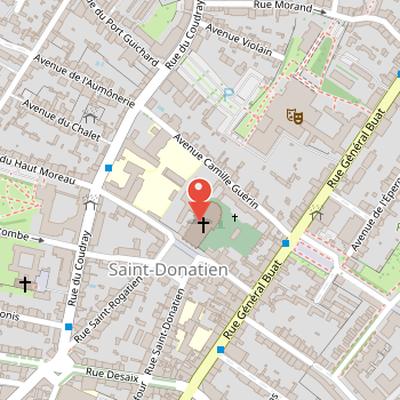
Nearby Objects
-
 Le Grand T 200 m away
 -
 La Bouteillerie Cemetery 700 m away
 -
 Saint-Clément 950 m away
 -
 Île de Versailles 1000 m away
 -
 Saint-Félix Church 1000 m away
Location and Dedication
The basilica Saint-Donatien-et-Saint-Rogatien is a 19th-century French neo-Romanesque basilica located in the Malakoff-Saint-Donatien district of Nantes. Its main facade faces the Place des Enfants-Nantais. It is one of only two basilicas in Nantes, the other being the Basilica of Saint-Nicolas.
The basilica is dedicated to Saint Donatien of Nantes and his brother Saint Rogatien, who are regarded as the first Christians of Nantes. Both were martyred in Nantes at the end of the 3rd century. The site also includes a cemetery and the Saint-Etienne chapel, which is protected as a historic monument.
Site History and Reconstruction
The basilique Saint-Donatien-et-Saint-Rogatien stands on the site of an ancient Gallo-Roman villa, and excavations in 1873 uncovered an ancient pagan cemetery as well as a pit with 27 nails in the center of the apse. According to the historical account, four churches were successively built on this site. The place became closely associated with the martyrs Saint Donatien and Saint Rogatien: nine years after their death, the Edict of Constantine is said to have encouraged the development of a cult around their bodies. Tradition describes their remains as having been dismembered, whipped, and taken outside the city near the basilica on rue Dufour, where they were executed and beheaded with javelins at a location marked by two stone crosses. It is also said that their bodies were placed in a grey marble sarcophagus from the Pyrenees, which attracted pilgrims and led Saint-Martin monks to create a Garde d'honneur. The first stone of a later reconstruction was laid by Jean-Marie de Trevelec and his wife Françoise Charette. During the Revolution, the church was converted into a hospital and sold in 1796, then returned to worship in 1802. Missing parts were rebuilt starting in 1804, resulting in a larger cruciform church, which was later consecrated.
Construction and Architectural Design
The basilica of Saint-Donatien-et-Saint-Rogatien began to take shape after the Franco-Prussian War of 1870, in a period marked by a strong resurgence of religious sentiment. Its construction was also linked to a vow made by the bishop of Nantes, who promised to build a basilica in honor of the two patrons of his diocese if Nantes was spared from the Prussian invasion; when the diocese was indeed spared, the project moved forward. Architect Emile Perrin drew up the plans for a sanctuary in a primitive neo-Gothic style, and Louis Liberge ordered the works, which began with foundation excavation on 26 March 1873. The first stone was blessed on 9 November 1873 at the right pillar of the sanctuary.
The building works lasted nearly thirty years. The facade, begun under the direction of Louis Liberge, was inspired by the facade of Notre-Dame de Paris and completed the basilica in 1901 with two twin towers. These towers rise to 206 feet and do not include the two spires that had originally been planned. After the towers were completed, a cross was installed above the chancel gables and blessed by the bishop.
Bells and Clock Chime
In 1902, the building received ten bells, each weighing between 291 and an unspecified amount. The bells were cast by the Maison Bollee of Le Mans and were blessed on an unspecified date. The clock chime reproduces the Westminster Quarters melody, the same chime used at the Palace of Westminster in London.
Fire Damage and Restoration
The basilica Saint-Donatien-et-Saint-Rogatien was damaged by a violent fire that destroyed three quarters of the roof. According to a departmental director, the fire started accidentally during repair work when two roofers used a blowtorch on a lead gutter. Restoration work began later and was divided into three phases, with completion planned for 2019. The repairs included the installation of dry columns up to the top of the building to improve fire safety measures. The cost of the work was estimated at 13 million euros. Reopening was scheduled for spring 2021, and the building eventually reopened after six years of closure. After reopening, its parish was entrusted to the Communaut te du Chemin Neuf.
Religious Use and Parish Role
Since its construction, the basilica has been intended for Catholic Christian worship, and this remains its primary function despite episodes of appropriation and closure, including the effects of the 1905 law and later renovation works. It serves as a parish church for the local Christian community and, in its role as a basilica, as a gathering place for the People of God. Its large dimensions have also made it suitable for major diocesan celebrations in Nantes, including celebrations held after the closure of Nantes Cathedral for works. In addition to liturgical use, the basilica receives visits and hosts performances such as sacred music concerts and choral music. The parish territory has changed over the centuries, at one time extending to Saint Joseph de Porterie, before being reduced through the creation of new parishes linked to population growth. Today, the parish groups the former parishes of Sainte Elisabeth, Saint Dominique, and Saint Donatien.
The Saint-Donatien Cemetery and Saint-Etienne Chapel
The Saint-Donatien cemetery adjoins the basilica to the south and east. It is the oldest Christian burial site still in use in Nantes, and it also contains the Saint-Etienne chapel in the center of its southern part. This chapel has been referred to as Saint-Etienne, Saint-Georges, or Saint-Agapit. It is a rectangular building with a roof reaching just under eight meters in height, and it is considered the oldest religious building in the diocese. Its oldest parts date to the beginning of the 6th century. According to the historian Albert Travers, it was built by order of Bishop Epiphane to house the relics of Saint Etienne, which had been brought from Jerusalem by 506 at the latest. The facade was remodeled in a neoclassical style in the 18th century. In front of the chapel stood an external traditional well, where pilgrims washed their hands before entering. The well disappeared by the end of the 19th century, but Léon Maître later regarded it as evidence of the chapel's antiquity.