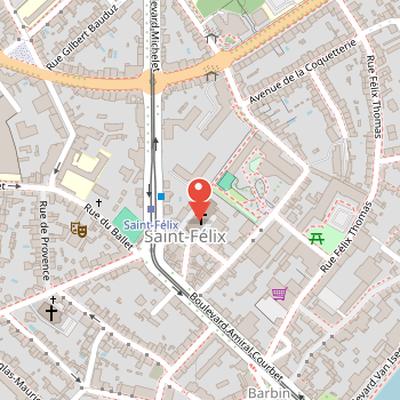
Saint-Félix Church in Nantes was begun in August 1843 on land bordering the Château de la Haute-Forêt. It was built according to plans by architect Charles de Raimond and designed in the neo-Gothic style. At the time of its consecration by Monseigneur Jean-François de Hercé, the vault was not completely finished and the floor was still not paved. The church was originally modest in size and surrounded by trees. After its consecration, the parish of Saint-Félix was established, covering La Jonelière and extending to Pont du Cens on route de Rennes. Its first parish priest was abbé François Bruneau, whose name was later given to a nearby street. In 1856, the Ministry of the Interior gave the parish a painting by Luc-Olivier Merson depicting Saint Félix converting the Saxons. The building received two 19th-century wings and was enlarged around 1950. All of its stained glass windows are works of Gabriel Loire.
Nearby Objects
-
 Île de Versailles 600 m away
 -
 Basilique Saint-Donatien-et-Saint-Rogatien 1000 m away
 -
 Monument aux 50 Otages 1200 m away
 -
 Le Grand T 1200 m away
 -
 Église Saint-Similien 1200 m away
History and Development of Saint-Felix Church
Saint-Felix began in the village of Barbin, which extended from route de Rennes to Loquidy under the parish of Saint-Similien. Construction of the church started in August 1843 on land bordering the chateau de la Haute-Foret, following plans by the architect Charles de Raimond. The building was originally modest in size, surrounded by trees, and designed in a neo-Gothic style. It was consecrated by Monseigneur Jean-Francois de Herce, although at that time the vault was not completely finished and the floor had not yet been paved.
After the consecration, the parish of Saint-Felix was established and included La Joneliere, extending to Pont du Cens on route de Rennes. Its first parish priest was abbe Francois Bruneau, and a nearby street was later named after him. In 1856, the ministry of the Interior gave the parish a painting by Luc-Olivier Merson representing Saint Felix converting the Saxons.
The church building was later expanded with two 19th-century wings and enlarged again around 1950, after which it was consecrated once more. All of the stained glass windows are works by Gabriel Loire.