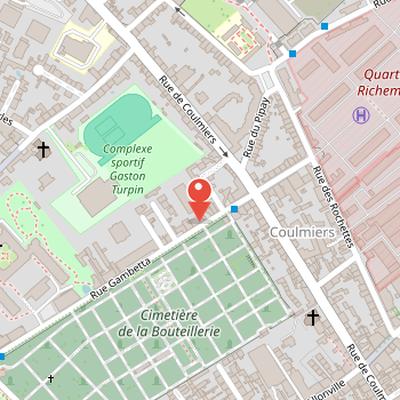
La Bouteillerie Cemetery is a cemetery in Nantes, France, in use since 1774. It lies approximately 700 metres east of the cathedral and occupies a rectangular site measuring about 400 metres long and 170 metres wide, with a west-southwest to east-northeast orientation. The cemetery has two points of access: a primary entrance in the northwest quadrant at the intersection of Gambetta Street and Frédéric-Cailliaud Street, and another entrance at the northeast corner on Gambetta Street.
The site is bordered on the west by a boundary separating it from the Jardin des plantes, while private properties line the east and south sides. Its name is linked to the medieval history of the property, when the Bishop of Nantes owned the site and maintained vineyards and wine cellars there; wine bottled on the premises gave the estate its name, La Bouteillerie. The land passed through several owners before being purchased in 1774 by the parishes of Saint-Clément, Saint-Denis, Saint-Laurent, Saint-Léonard, Sainte-Radegonde, Saint-Vincent, and others.
Nearby Objects
-
 Jardin des plantes de Nantes 500 m away
 -
 Saint-Clément 600 m away
 -
 Basilique Saint-Donatien-et-Saint-Rogatien 700 m away
 -
 Nantes Museum of Arts 750 m away
 -
 Le Grand T 750 m away
La Bouteillerie Cemetery in Nantes
La Bouteillerie Cemetery is located in Nantes, France, and has been in use since 1774. Its long period of use gives it historical significance as one of the citys enduring burial places. The cemetery is associated with the urban history of Nantes through its continuous function over many generations.
Layout and Access
La Bouteillerie Cemetery is located approximately 700 meters east of the cathedral. It has a rectangular plan measuring about 400 meters in length and 170 meters in width, and it is oriented from west-southwest to east-northeast. The site is bounded on the north by an unspecified boundary, while its western edge is separated from the Jardin des plantes by another boundary. To the east, the cemetery borders private properties along an unspecified location, and to the south it adjoins private properties and dead-end private roads set perpendicular to the cemetery wall. Access is provided by two entrances. The main entrance is in the northwest quadrant, at the intersection of an unspecified location, Gambetta Street, and Frédéric-Cailliaud Street. A second entrance is located at the northeast corner of the site on Gambetta Street.
Historical Origins of La Bouteillerie
Before the land was acquired in 1929, a geological study was carried out that identified the soil of La Bouteillerie as ancient alluvium from the Loire. The site was described as part of the Medium Terraces, with soil composed of sandy clay and layers of sand, gravel, and rolled pebbles. Its name is linked to its earlier use in the Middle Ages. At that time, the Bishop of Nantes owned the estate and maintained vineyards and wine cellars there. The wine was bottled on the premises, which explains the name La Bouteillerie.
The estate changed hands several times over the centuries. It was sold by the Bishop in 1320, then belonged to the family of the Marquise de Sevigny in 1523. Christophe Vavasseur acquired it in 1554, after which ownership passed to the Coutances family. The Carthusians acquired the property in the 17th century. In 1774, it was purchased by the parishes of Saint-Clement, Saint-Denis, Saint-Laurent, Saint-Leonard, Sainte-Radegonde, Saint-Vincent, and others, under the orders of the King's Council of State under Louis XVI.
Founding and Early Use
La Bouteillerie Cemetery was created when the city of Nantes purchased the La Bouteillerie estate and built a cemetery on the property. The purchase was intended to provide a shared cemetery for the parishes concerned, and the site was meant for Catholic families living in the parish. The cemetery was blessed on 25 October 1774. Its establishment came shortly before a Royal Declaration of 10 March 1776 regulated burials within churches, and the new burial conditions reserved church burials for only a small number of privileged people. This change also affected individual burial wishes, including that of Guillaume Grou, a Nantes shipowner who had wanted to be buried in Saint-Clément Church but could not be because burials in religious buildings were no longer permitted.
The first burial at the cemetery was René Jannequin, a boy of about thirteen years old. The second was Guillaume Grou. The cemetery joined an area of burial activity already associated with Saint-Clément Church, where a cemetery opposite the church had been in use since at least the 15th century. Before La Bouteillerie was established, the site had included an oratory called the Champ-Fleuri Chapel, and the cemetery and chapel were abandoned when the new cemetery was created. The entrance gate from the Champ-Fleuri Cemetery was moved to the new site and was topped by a stone sculpture of a ship, described as a brigantine. The cemetery was originally called Le Grand brigandin, but that name has since been lost and replaced by La Bouteillerie.
Expansion and Military Burial Section
La Bouteillerie Cemetery was enlarged through several land acquisitions over time. A land exchange allowed the municipality to increase its area by 65 acres. In 1890, Nantes acquired an additional 15,000 m2, with the expectation that this would be the final expansion, but the cemetery was enlarged again in 1898 by 6,700 m2 to meet anticipated growth. The municipality later procured 7,739 m2 of adjacent land to replace used space, and part of this land was assigned to the cemetery, which now covers approximately 6 hectares.
During World War I, the cemetery took on a military burial function. On 30 October 1914, administrative authorities inaugurated a section for the burial of military personnel who had died. Between 1914 and 1919, all those who died in military hospitals in Nantes were required to be buried at La Bouteillerie. In 1918, 2,500 m2 were set aside for a military cemetery containing 1,533 graves. At the beginning of the 21st century, the military section held 1,781 military personnel from several countries and French colonies.
Notable Burials and Visitor Access
La Bouteillerie Cemetery is notable for a number of burials that have drawn attention for their historical or family associations. Among them is a tomb bearing the epitaph of Lady Escher, born Charlotte Melcion d'Arc, who was born on March 6, 1810 and died on September 18, 1875. Some scholars have suggested that she was a descendant of the elder brother of Joan of Arc. Other notable graves include those of Marie Alphonse Bedeau, Serge Danot, Cesar Jules Decre, Lea Papin, Guillaume Grou and his wife Anne O'Shiell, Mathurine Fourchon, and the Cassegrain family. The cemetery reception offers guided tours for visitors, giving them insight into the lives and contributions of these notable burials.
The Haveloose Stele
The cemetery includes the Haveloose Stele, a monument created by Statuary in Nantes. It is positioned near the concierge's office of the cemetery, giving it a visible place within the site. According to the available facts, Statuary's work has been on display since 1928, indicating a long-standing presence in the cemetery landscape.
Filming Location
In October 2014, Nantes (La Bouteillerie) Cemetery was used as a filming location for a television movie from the Murders in... series. This recorded use highlights the cemetery's role beyond burial and memorial functions, extending into media production. The fact that it was selected for filming indicates that the site also has a public presence in contemporary visual culture.