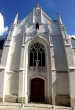
Saint-Clément is a Catholic place of worship in Nantes, France, built in the 19th century. It was constructed after the former church had become dilapidated, and its creation introduced neo-Gothic architecture to the Nantes area. Architect François Liberge chose the neo-Gothic style, while parish priest Abbé Jean Richard led the work from 1838. He blessed the cornerstone on May 31, 1841, and celebrated the first Mass in the new building before his death a year later.
The church was initially equipped with a harmonium and later received a Cavaillé-Coll organ in 1867. The spire was completed by Boismen on May 15, 1868, and the cross crowning it was blessed in 1874. The building underwent renovation between 1951 and 1954. It is currently used by three priests from the Priestly Fraternity of Saint Peter, who celebrate Mass according to the Tridentine rite.

Nearby Objects
-
 Nantes Museum of Arts 200 m away
 -
 Place Maréchal-Foch 300 m away
 -
 Colonne Louis-XVI 300 m away
 -
 Cours Saint-Pierre and Saint-André 350 m away
 -
Place of Worship and Liturgical Use
Saint-Climent in Nantes is a Catholic place of worship in France that was built in the 19th century. It is used by the Priestly Fraternity of Saint Peter for services, and those services follow the Tridentine rite. The building's current religious use gives it a clear liturgical role within the city, while its 19th-century origin places it within Nantes' historic urban fabric.
History and Architectural Development
A chapel serving a charity hospice was built around 490 approximately 200 meters southeast of the current building, outside the city walls between Rue Sully and Rue Geoffroy-Drouet. Bishop Geremius is recorded as the founder of this chapel, and he was buried there in 1498. In 1226, Peter I, Duke of Brittany, demolished the place of worship to make way for new city fortifications. The first church dedicated to Saint Clement was then built in 1227 at Rue Marechal-Joffre and Rue Guibourg-de-Luzinais. It was oriented west-east and extended two meters into the Paris road, now Rue Marechal-Joffre.
By the 19th century, the old church had become dilapidated, and repairs had already been carried out in 1812, 1813, and 1816. Construction then began on a new place of worship, introducing neo-Gothic architecture to the Nantes area. Architect Francois Liberge chose this style for the Church of Saint Clement. The new structure was rectangular and initially had a single nave, later supplemented by two side aisles and a pointed slate-covered bell tower. The bell tower housed three bells, and a small porch provided shelter at the entrance. During construction, the facade of the old church was demolished except for the north wall, and the former southern side aisle corresponded to the level of the present bell tower.
Construction and Liturgical History
Work on Saint-Clement began in 1838 under parish priest Abbe Jean Richard, who had previously served for nine years at Chantenay-sur-Loire. He blessed the cornerstone on May 31, 1841, and celebrated the first mass in the new building before his death a year later. The church spire was completed by Boismen on May 15, 1868, and the cross crowning it was blessed on August 23, 1874. The church was first equipped with a harmonium, then received a Cavaille-Coll organ on January 25, 1867. It was renovated between 1951 and 1954. Today, three priests from the Priestly Fraternity of Saint Peter serve at Saint-Clement and celebrate mass according to the Tridentine Rite, with Father Guilhem Le Coq and Father Gauthier Guillaume listed as parish vicars.
Interior Features of Saint Clement
The gallery for Eglise Saint Clement in Nantes presents several views of the church interior and its furnishings. It includes an image of the facade, the nave, and the interior with a parish banner, as well as a chair inside the church. The decorated altar and choir organ with painted pipes are also shown, along with the altar in the first left side chapel. In the apse chapel, the gallery features a statue of the Virgin and Child.
A notable element is the left organ case, built in 1893 by the Nantes organ builder Louis Debierre. The gallery describes this organ case as having 26 real stops on three manuals and pedalboard, with electric transmission. It also notes that the organ originally had two consoles and later a single console. Together, these details highlight the church's decorated liturgical setting and the presence of significant organ furnishings within the interior.