La Pagode is a movie theater in Paris’s 7th District, located at 57 bis rue de Babylone, at the corner of rue de Babylone and rue Monsieur. It is an establishment that includes two cinemas classified as Art et Essai. The site is known for its Japanese-style room and garden, and it has been described as one of the most unusual places dedicated to cinema in Paris.
Historically, La Pagode was originally built in 1896 by architect Alexandre Marcel. It was a gift from François-Émile Morin, director of Le Bon Marché department stores, to his wife. The building later passed to Joseph Plassard, then became an assembly hall under Joseph Plassard and Antoinette Mougel. Receptions and themed evenings were held there until the hall closed in 1927. In the 1950s and 1960s, it became a notable meeting place for cinephiles under Yvonne Décaris’ management. Jean Cocteau premiered The Testament of Orpheus there in 1959. The room has been closed since 10 November 2015 afternoon, with plans to work toward a reopening in 2025.
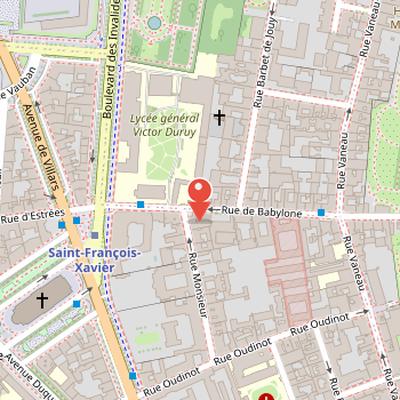
Nearby Objects
-
 Hôtel de Mademoiselle de Condé 90 m away
 -
 Saint-François-Xavier 250 m away
 -
 Hôtel Biron 400 m away
 -
 Musée Rodin 400 m away
 -
 Hôtel Matignon 450 m away
Intro and Its Japanese-Style Setting
Intro is an establishment at 57 bis rue de Babylone in the 7th District of Paris, located at the corner of rue de Babylone and rue Monsieur. It includes two cinemas classified as Art et Essai. The venue is known for its Japanese-style room and garden, which contribute to its reputation as one of the most unusual places dedicated to cinema in Paris. The room has been closed since the afternoon of 10 November 2015, and the establishment plans to work towards a reopening in 2025.
Origins and Early Social Use
According to Historia, La Pagoda was originally built in 1896 by architect Alexandre Marcel. It was a gift from Francois-Emile Morin to his wife. Morin, who was the director of Le Bon Marche department stores, used La Pagoda as a setting for numerous receptions. Among these events was an inauguration dinner for 100 people accompanied by the Paris Opera orchestra. He also organized a masquerade evening in which he and his wife appeared as the Emperor and Empress of China. In the inauguration year, Morin's wife left him for Joseph Plassard, and La Pagoda was brought as a dowry to Plassard.
From Pagoda to Assembly Hall
After the death of his first wife in 1917, Joseph Plassard remarried Antoinette Mougel. In 1919, the couple bought the surrounding mansions and converted La Pagode into their assembly hall. This change marked a new phase in the building's use under their ownership.
Cinema, Renovation, and Public Controversy
Sultans receptions continued at La Pagoda until the hall closed in 1927. After its closure, goats grazed in the garden, and the building later drew interest from the Chinese embassy, which considered acquiring it but declined because of the war murals. According to Historia, the owner was traumatized by these murals and was later institutionalized in Sainte-Anne.
In 1956, art and experimental cinemas in Paris received official status, and from 1955 to 1967 La Pagoda, under the management of Yvonne Decaris, became a meeting place for cinephiles. It attracted followers of Ingmar Bergman and Sergei Eisenstein. Jean Cocteau premiered The Testament of Orpheus there in 1959, and The Private Life of Louis Malle premiered at La Pagoda in 1962 because of OEA terrorist threats.
La Pagoda was later transformed into a modern complex with two screening rooms, one of them in the basement. Its facade was renovated and the Japanese garden revitalized. Architects Luce Eekman and Francois Debulois carried out renovations in 1973, and a brass plaque with Francois Debulois' name is located near the basement entrance. Gaumont took ownership of La Pagoda in 1979.
The building also became associated with political conflict and media attention. GLH-PQ organized the homosexual cinema fortnight at La Pagoda from January 16 to 31, 1978. During the event, Culture Minister Michel d'Ornano banned seventeen films, and on January 27 a group claiming to be Jeune Nation assaulted spectators. Filmmaker Guy Gilles was injured in the attack, and the event and related incidents were extensively covered by the media.
History, Ownership, and Renovation
La Pagode, referred to here through the history of the Historia venue, has remained linked to the Gibault-Plassard family since its construction. The family owned the site until 1985, when it was sold to Elisabeth Dauchy. During her ownership, Dauchy refused to convert the building's basement into parking, preserving the existing structure and use of the property. The venue's cultural and architectural value was later recognized through heritage protections: the garden was listed as a historical monument by decree in 1983, while the facade, roofs, and great hall were classified by decree in 1990.
The cinema itself experienced several periods of closure and reopening. It was closed by the prefect in 1997, then reopened in 2000 with Wong Kar-wai's Deseando amar. In 2017, Charles S. Cohen purchased the site with the aim of revitalizing the cinema. Renovation work affected the garden in particular: on May 11, 2020, century-old trees were felled, including ginkgo, horse chestnut, weeping beech, and other tall trees, making way for two basement rooms. A new Japanese garden is planned for the space.
The venue reopened in 2023 with four cinemas totaling 400 seats. In addition, the adjacent building at 57 rue de Babylone is owned by the Ile-de-France region and is set to become a cultural center dedicated to French cinema.
Access by Public Transport
La Pagode is served by the Saint-Francois-Xavier metro station. It is also accessible by RATP bus lines 82, 87, and 92. These connections place it within an established public transport network, making it reachable by both metro and bus.