Musée Rodin is an art museum in Paris, France, opened in 1919 and primarily dedicated to the works of French sculptor Auguste Rodin. Its main site is the Hôtel Biron and the surrounding grounds in central Paris, with another site at the Villa des Brillants in Meudon, Hauts-de-Seine, just outside the city. Rodin used the Hôtel Biron as his workshop from 1908 onwards, and the building was designed by architect Jean Aubert. His donation to the French State included his entire sculpture collection and paintings by Vincent van Gogh, Claude Monet, and Pierre-Auguste Renoir, on the condition that the buildings be turned into a museum devoted to his work. The museum’s collection includes 6,600 sculptures, 8,000 drawings, 8,000 old photographs, and 7,000 objets d'art. It contains many of Rodin’s major works, including The Thinker, The Kiss, and The Gates of Hell, with many sculptures displayed in the extensive garden. The museum also includes a room devoted to Camille Claudel and one of the two castings of The Mature Age.
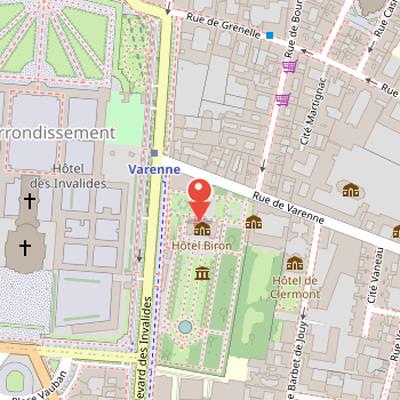
Nearby Objects
-
 Hôtel Biron 10 m away
 -
 Musée de l'Armée 300 m away
 -
 Hôtel Matignon 400 m away
 -
 Sainte-Clotilde Church 400 m away
 -
 La Pagode 400 m away
The Museum Sites and Collection
The Musee Rodin in Paris, France, is an art museum opened in 1919 and primarily dedicated to the works of the French sculptor Auguste Rodin. It has two main sites: the Hotel Biron and its surrounding grounds in central Paris, and a site just outside Paris at the Villa des Brillants in Meudon, Hauts-de-Seine. Rodin used the Hotel Biron as his workshop from 1908 onwards, and the building was designed by architect Jean Aubert. The museum was created after Rodin donated his entire sculpture collection, along with paintings by Vincent van Gogh, Claude Monet, and Pierre-Auguste Renoir, to the French State on the condition that the buildings be turned into a museum devoted to his works.
The museum's collection includes 6,600 sculptures, 8,000 drawings, 8,000 old photographs, and 7,000 objets d'art. It contains most of Rodin's significant creations, including The Thinker, The Kiss, and The Gates of Hell. Many of these works are displayed in the extensive garden, where sculptures are set in natural surroundings. The museum also includes a room dedicated to the works of Camille Claudel and one of the two castings of The Mature Age. Behind the building are a small lake and a casual restaurant, and the nearby Varenne Metro stop features some of Rodin's sculptures on the platform. The museum receives about 700,000 visitors annually.
Access and Public Transport
Musee Rodin is served by Metro Line 13. It is also accessible via RER Line C at Invalides. In addition, bus lines 69, 82, 87, and 92 provide service to the area. These transport links make the museum accessible through several public transit options.
Permanent Collections and Garden Displays
The permanent collections at the Musee Rodin bring together sculpture, drawings, photographs, paintings, and ancient art across a wide range of subjects and periods. In the gardens, large bronze sculptures are displayed, including The Gates of Hell, The Thinker, The Kiss, and The Burgher of Calais. The collections also hold monumental works such as Balzac, The Burghers of Calais, and the unfinished The Gates of Hell, which itself contains elements such as The Thinker, Ugolino, The Kiss, and The Three Shades.
Several works in the collection are noted for their relationship to artistic norms of the time. Man with a Broken Nose appears out of step with contemporary aesthetic norms, while The Age of Bronze rejects contemporary mechanisms of physical expression. The museum also preserves works associated with Rodin's artistic growth, which expanded to more than 6,000 works by 1917 through commissions and continued collecting.
The graphic collection includes around 7,000 drawings linked to different styles and periods, along with fantasy works inspired by Dante or Baudelaire, erotic nudes, and portraits. The museum also holds an important collection of 25,000 photographs, including 7,000 collected by Rodin himself, and examples from collaborations with Eugene Druet, Jacques-Ernest Bulloz, Adolphe Braun, and Edward Steichen. These photographs document Rodin's work, life, and studio from 1877 to 1917.
Other notable holdings include the Camille Claudel room, with works such as The Mature Age, The Wave, The Waltz, Sakountala, and a Bust of Rodin, as well as ancient art from Egypt, Greece, Rome, and the Far East collected by Rodin in Meudon. The collections also include works by Naturalists and Symbolists, pieces acquired through exchanges, and important purchases such as three Van Gogh paintings, Renoir's Nude in the Sunlight, and Monet's Belle-Ile.
Temporary Exhibitions at the Musee Rodin
Temporary exhibitions at the Musee Rodin began organizing contemporary art exhibitions in 1949. Over time, the museum presented works by artists including Anthony Caro, Eugene Dodeigne, and Etienne Bossut. It also invited Bill Viola, Adel Abdessemed, and Mircea Cantor to screen videos in the park for the Nuit des musees. In 2010, the museum presented artworks by Belgian artist Wim Delvoye and programmed video-performances by Vito Acconci, Sanja Ivekovic, Marina Abramovic, and Mona Hatoum. From October 2010 to February 2011, it held a Henry Moore exhibition devoted to his studio and small sculptures.
The Museum Site and Early History
The Musee Rodin opened to the public on 4 August 1919 in the mansion known as the Hotel Peyrenc de Moras, located in the Rue de Varenne. The mansion was built between 1727 and 1732. From 1788, the property was occupied by a series of owners and tenants. In 1820, the Duchess of Charost sold it to the Society of the Sacred Heart of Jesus nuns. The estate then housed a boarding school for girls, and its decorations were progressively sold. Between 1820 and 1904, several buildings were added to the estate, including a chapel designed by Jean Juste Gustave Lisch and completed in 1876. After the Society of the Sacred Heart of Jesus was dissolved in 1904 under the religious orders law, the sisters were evicted and the estate was put up for sale.
Hottel Biron and La Villa des Brillants
The site later known as Musee Rodin is closely linked to two places associated with Rodin: Hottel Biron in Paris and La Villa des Brillants in Meudon. At Hottel Biron, the building had a period of varied tenancy while waiting for a buyer, including occupants such as Jean Cocteau, Henri Matisse, Isadora Duncan, and Rainer Maria Rilke. In 1908, the museum locations rented four ground-floor rooms to Rodin for studios, and from 1911 he was allowed to occupy the whole building. That same year, Rodin negotiated with the French state to donate his works in exchange for residency at Hottel Biron. In 1916, the French Assembly passed a law permitting the State to accept Rodin's donations and allocate the mansion and garden to a museum. Léonce Benedite was appointed executor of Rodin's will to manage his artistic heritage and the future organisation of the museum. Hottel Biron and its grounds were listed as a historical monument in 1926, and the building underwent major renovation and restoration work, including a scheme completed on 12 November 2015. The restorations from 2012 to 2015 cost 16 million euro and were supported by France's Culture Minister Fleur Pellerin.
Rodin also purchased La Villa des Brillants in Meudon on 19 December 1895. By 1900, the property employed almost 50 people, including assistants, workers, and casters. Much of Rodin's major creative work was done there, even though he made daily visits to his Paris studios. The villa became a place visited by friends, admirers, and celebrities from France and abroad. After Rodin's death, the villa and studio became a museum open three days per week, presenting Rodin's studio atmosphere and living space. Rodin and Rose Beuret chose to be buried in Meudon, and the museum inaugurated in 1948 displays numerous plasters, including casts of the Burghers of Calais and the Gates of Hell.
The Sculpture Garden and Gallery
The Musee Rodin includes a gallery of sculptures that presents several major works associated with Rodin's career. Among the pieces listed are The Man with the Broken Nose, a plaster work from 1864; The Three Shades, a plaster original made before 1886 for The Gates of Hell; The Cry from 1886; The Burghers of Calais from 1889; a detail of the Monument to Balzac from 1898; Lovers' Hands from 1909; and The Thinker from 1904, which is located in the museum garden. The garden itself is part of the museum setting and serves as a display space for sculpture, linking the collection to the outdoor environment.
Related Resources and Context
External links connected with Musee Rodin include Rodin: The B. Gerald Cantor Collection exhibition catalog from The Metropolitan Museum of Art. The museum is also associated with Auguste Rodin museums, buildings and structures in the 7th arrondissement of Paris, sculpture galleries in France, establishments in France from 1919, and sculpture gardens, trails, and parks in France.