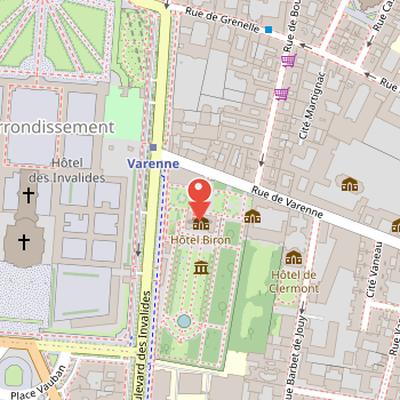
Hôtel Biron is an hôtel particulier on Rue de Varenne in Paris’s VII arrondissement. Constructed between 1728 and 1731 by architect Jacques Gabriel and designer Jean Aubert, it was built for wig maker Abraham Peyrenc de Moras near the Hôtel des Invalides. The house was designed as an independent structure within a three-hectare park, rather than set between a courtyard and garden. Its interior included rococo carved paneling, with sixteen medallions or paintings by François Lemoyne framed into the decoration, and two elliptical salons forming garden-facade pavilions. Completed in 1731, the property later passed to the Duchess of Maine and then, after her death in 1753, to Louis Antoine de Gontaut, Marshal of Biron. The grounds were also reshaped over time, and the site later served for public balls, a fairground, and diplomatic residences. Since 1919, Hôtel Biron has housed the Musée Auguste Rodin.
Nearby Objects
-
 Musée Rodin 10 m away
 -
 Musée de l'Armée 300 m away
 -
 Hôtel Matignon 400 m away
 -
 La Pagode 400 m away
 -
 Sainte-Clotilde Church 400 m away
Htel Biron on Rue de Varenne
Htel Biron is an hotel particulier located on Rue de Varenne in the VII arrondissement of Paris. It was constructed between 1728 and 1731 by architect Jacques Gabriel and designer Jean Aubert, and was built inside a 3 hectare park. The property was purchased by Marechal de Biron in 1753. Since 1919, it has housed the Musee Auguste Rodin, giving the building a continuing cultural role in the city.
Construction and Early Transformations
Hotel Biron was built near the Hotel des Invalides for the wig maker Abraham Peyrenc de Moras, using designs by Jacques Gabriel and Jean Aubert. História notes that Peyrenc de Moras had made his fortune through successful speculation in John Law's paper money schemes. His house was conceived as an independent structure, rather than as a building placed between a courtyard and a garden, and it was completed in 1731. The palace is surrounded by three hectares of grounds, and its interior features rococo carved paneling. Two elliptical salons form pavilions on the garden facade, and sixteen medallions or paintings by Francois Lemoyne were framed into the paneling.
After Peyrenc de Moras's widow sold the property, it passed to Anne-Louise Benedicte de Bourbon-Cond, Duchess of Maine, who took possession in January 1737 and made only minor alterations. Following her death in 1753, the palace became the property of Louis Antoine de Gontaut, Marshal of Biron. A 1752 plan records the building and gardens with a deep terrace, broad curved steps, parterres, gravel compartments, and cone-shaped shrubs. It also shows cabinets de verdure on the left of the courtyard of honor, linked by short galleries, and a subsidiary stable courtyard on the right.
Duke of Biron later commissioned Dominique-Madeleine Moisy to remodel the park as a miniature English-style park with trellises. In 1782, the future Paul I of Russia and his countess visited Paris and admired the beauty of the garden and its structures. By the end of the eighteenth century, however, the faubourg had become less fashionable as elegant Paris developed farther west on the Rive Droite. Armand Louis de Gontaut, Duke of Lauzun, inherited the domain in 1788 and kept it until his execution in 1793. The location then served first for public balls and later as a fairground, and during Napoleon Bonaparte's reign it was used as the seat of the Papal legate and later the Russian ambassador.
From Boarding School to Abandonment
In 1820, the Duchess of Bethune-Charost ceded Hotel Biron to the Societe du Sacre-Coeur de Jesus, founded in 1804 by Madame Madeleine-Sophie Barat. The Ladies of Sacre-Coeur converted the building into a boarding school for girls from aristocratic and high society families. In adapting the palace, they removed all luxury, mirrors, and paneling, and added a chapel. After the 1905 French Law on the Separation of Church and State, the school closed and the building fell into abandonment. It was then subdivided into lodgings, and plans were made to demolish it and replace it with an apartment block.
Rodin at Hotel Biron and the Creation of Musee Rodin
Histoire records that Hotel Biron had several temporary residents, including Jean Cocteau, Henri Matisse, actor Max, Isadora Duncan's dance school, and Auguste Rodin. Rodin settled there in 1908 on the advice of his friend and secretary, Rainer Maria Rilke. He rented several ground-floor rooms to store sculptures, and these spaces became his studio. According to Histoire, Rodin worked there and received friends in the studio amid the gardens.
In 1909, Rodin began efforts to turn Hotel Biron into a museum for his work. In 1911, the French State acquired the domain and assigned the southern part to the Lycee Victor-Duruy. Rodin proposed donating his entire collections on the condition that Hotel Biron become Musee Rodin. His proposal was supported by Claude Monet, Octave Mirbeau, Raymond Poincare, Georges Clemenceau, and Etienne Clementel. After parliamentary approval, the donations were officialized on December 24, 1916. Rodin donated to the State all collections, photographs, archives, sculptures, drawings, patrimonial rights, furniture, and private collections.
Since World War II, Musee Rodin has repurchased paneling and decorative paintings that originally belonged to the palace. The museum also recovered two door toppers by Lemoyne, Venus Showing Cupid the Heat of Her Arrow and The Work of Penelope, and restored them to their original positions.