Hôtel Matignon is a palace and private mansion located at 57 Rue de Varenne in the 7th arrondissement of Paris. It is the official residence of the Prime Minister of France. In political usage, the name Matignon is also employed as a metonym for the governmental action of the prime minister.
The site’s history begins with the restoration of the old Chemin du Bois de la Garenne in 1649 by Louis XIV, when it was renamed Rue de Varenne. In 1717, Christian-Louis de Montmorency Luxembourg purchased land along the street and commissioned architect Jean Courtonne in 1722 to build a mansion. After the property was sold, Jacques Goyon, Count of Matignon, acquired it and completed the Hôtel in 1725, as a present for his son, the Duke of Valentinois.
The building is arranged around a main courtyard and includes a portico with columns, low wings for offices and outbuildings, stables, kitchens, and a garden façade running the length of the buildings. Its interiors include wood panelling by Michel Lange and cornices and stucco work by Jean-Martin Pelletier and Jean Herpin.
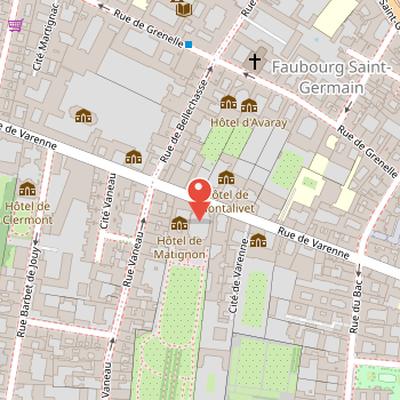
Nearby Objects
-
 Musée Maillol 300 m away
 -
 Fontaine des Quatre-Saisons 300 m away
 -
 Hôtel Biron 400 m away
 -
 Musée Rodin 400 m away
 -
 Chapel of Our Lady of the Miraculous Medal 450 m away
Official Residence and Metonym
Hotel Matignon is the official residence of the Prime Minister of France. It is located in the 7th arrondissement of Paris at 57 Rue de Varenne. Beyond its function as a residence, the name Matignon is also used as a metonym for the governmental action of the prime minister, giving the site a broader political significance in French public life.
The 18th-Century Mansion on Rue de Varenne
The site of Hotel Matignon is linked to the opening of Rue de Varenne, which Louis XIV had restored in 1649 from the old Chemin du Bois de la Garenne. The road connected Saint-Germain-des-Pres with a marshy area chosen for the construction of the Hotel des Invalides. In 1717, Christian-Louis de Montmorency Luxembourg bought 2869 toises of land on Rue de Varenne for 91 Livres, and in 1722 he commissioned the architect Jean Courtonne to build a mansion. He later sold the property because of the high expenses. Jacques Goyon, Count of Matignon, then bought the hotel and completed it in 1725 as a present for his son, the Duke of Valentinois.
Courtonne designed the main residence as a two-storey building with a balustrade and two suites of rooms. Access is through a portico with columns leading to the main courtyard. The property also includes two low wings for offices and outbuildings, as well as a courtyard, stables, and kitchens. The facade has three advances containing staircases and a central pavilion with a balcony decorated with lion motifs. The entrance hall has a segmented cupola, and an originally designed dining room stands beside it. The garden facade conceals the main courtyard and servants yard while running the full length of the buildings. The central pavilion is crowned by a broken pediment bearing the owners arms. The interiors were enriched by wood panelling by Michel Lange and cornices and stucco work by Jean-Martin Pelletier and Jean Herpin.
From Private Mansion to Political Residence
Hotel Matignon passed through several notable hands before becoming associated with political residence. After the property was recovered by the sons of the family that had owned it and sold in 1802, it was bought by Anne Eleonore Franchi, described as a professional dancer. She had earlier been the mistress of Joseph II in Vienna, had been expelled from Austria by Empress Maria Theresa, and had been exiled to the East Indies before returning to France with the Scottish banker Quentin Crawford. Franchi and Crawford refurnished the house, and the Hotel Matignon became a gathering place for Ancien Regime society. Well-dressed visitors were even authorized to visit its interiors in the owners' absence.
In 1808 the mansion was passed to Charles Maurice de Talleyrand, Prince of Benevent and Deputy Great Elector. Talleyrand used the house for frequent formal sociability, holding dinners for 36 guests four times a week and balls honoring the imperial family. His kitchens were prepared by the renowned Boucher. During this period, Napoleon called on Talleyrand to reimburse Hamburg four million francs in 1811, but Talleyrand did not do so. He later sold the Hotel Matignon to the Emperor for 1,280,000 Francs.
The building then continued to serve changing elite uses. In 1815 Louis XVIII traded the Hotel Matignon for the Elysee Palace, which had belonged to Louise Marie Therese Bathilde d'Orleans, sister of Philippe Egalite and separated wife of the Duc de Bourbon. Bathilde d'Orleans installed a community of nuns on the premises, charging them with praying for the souls of victims of the French Revolution. Her niece inherited the Hotel Matignon in 1822, moved the nuns to Rue de Picpus, and rented out the mansion. Adelaide d'Orleans owned it in the 1830s and rented it to Colonel Herman Thorn, who lived there with his large family for more than a decade and carried out extensive renovations worth 1,000,000 francs.
After the revolution of 1848, the Hotel Matignon was planned as the residence of the head of the executive branch of the new Republic. General Cavaignac chose to live there until December 1848, while Napoleon III preferred the Elysee Palace instead. These successive occupations show the building's movement from private aristocratic ownership toward a role connected with state authority and public power.
Ownership and Financial Influence
The Hotel Matignon was sold to the Duke of Galliera, Raffaele de Ferrari, a member of the Genoese nobility. His wife, Marie de Brignole Sale, was identified as a great-niece of the princess of Monaco. Together, they possessed one of the great fortunes of the time. Raffaele de Ferrari was said to own half of Genoa, and he founded the Credit Mobilier. He also financed major construction projects in several countries, including railroads in Austria, Latin America, Portugal, and France. Among these were the Paris-Lyon-Marseille railroad line, the digging of the Frejus tunnel, the Suez Canal, and Paris buildings designed by Baron Haussmann. This financial activity places the Hotel Matignon within the broader history of a prominent and influential aristocratic family.
From Aristocratic Residence to State Property
After the fall of Napoleon III in 1870, the Duchess proposed that the Count of Paris take up residence at the Rue de Varenne, and he later occupied the ground floor of the Hotel Matignon. The mansion also became the setting for major social and political events. On 14 May 1886, it hosted a reception for the marriage of Princess Amelie to Carlos, heir to the Portuguese throne. About three thousand guests attended, including the entire aristocracy of France, the diplomatic corps, and numerous political figures. The scale of the event was so great that the President could not leave the Elysee Palace to visit Bois de Boulogne because of congested traffic. The following day, Charles de Freycinet called for a law exiling pretenders to the French throne, and the legislation was passed the next week. Later, the Duchess of Galliera left Paris and gave the mansion to the Austro-Hungarian Emperor, who made the Hotel Matignon his embassy in France. During World War I, the philatelic collection of Philipp von Ferrary, son of the Duke of Galliera and an Austrian citizen who fled France in 1917, was deposited at the building. The property was confiscated in 1919 and declared enemy property, and France assumed ownership on 21 November 1922 after prolonged negotiations. In 1923, the Hotel Matignon was designated as a historical monument by the state.
From Planned Museum to Government Seat
Hotel Matignon was once planned to be turned into a museum with subdivided property and individual dwellings. The residence also included the adjacent mansion built by the architect Jean Walter in 1924. Its political role changed when Gaston Doumergue decided to make it the headquarters of the President of the Council of Ministers, and architect Paul Bigot took the necessary steps regarding the property. Pierre Etienne Flandin became the first new occupant in 1935.
The building soon became associated with major social and political developments. In 1936, the Matignon Accords were signed there between Leon Blum and the strike leaders of spring 1936. These agreements introduced the 40-hour work week and paid vacations, giving the residence a place in labor and social history.
During the Second World War, prime minister Edouard Daladier worked at the War Ministry and did not leave his apartment near the Arc de Triomphe at the start of the conflict, while the government moved to Vichy. Hotel Matignon was seized on 21 August 1944 by resistance leader Yvon Morandat and his future wife Claire, who confused Avenue Matignon with the residence in their haste. Charles de Gaulle then convened the Provisory Council of the Republic there on 25 August, and later presidents of the council followed his example. In 1958, the occupant's title changed from president of the council to prime minister.
The Park and Its Significance
Several important agreements have been signed at this location. The park of the Hotel Matignon comprises three hectares, while the gardens of the Elysee Palace comprise two hectares. On this basis, the park is considered the largest non-public garden in Paris.