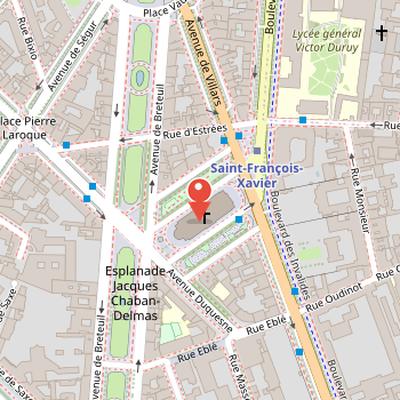
Saint-François-Xavier is a Catholic church in Paris, located in Place du Président-Mithouard in the École-Militaire district, near the metro station of the same name on line 13. It is the seat of the parish Saint-François-Xavier-des-Missions-Étrangères and is administered by the clergy of the Archdiocese of Paris. It is also one of the most populated parishes in the city. The church was built on land that formed part of a neighborhood developed from the 18th century on property belonging to the Abbey of Saint-Germain-des-Prés. The area was named after the seminary on rue du Bac, whose 17th-century main chapel dedicated to the Epiphany first served as the parish church before becoming too small for the growing population. Construction of the present church began in 1861, according to the design of Adrien-Louis Lusson, and was continued by Joseph Uchard after Lusson’s death in 1864. The building was opened for worship in 1874 and dedicated in 1894. Since 2018, it has been listed as a French historical monument.
Nearby Objects
-
 Hôtel de Mademoiselle de Condé 200 m away
 -
 La Pagode 250 m away
 -
 Hôtel Biron 550 m away
 -
 Musée Rodin 550 m away
 -
 Hôtel Matignon 700 m away
Location and Parish Role
Saint-Francois-Xavier is a Catholic place of worship in Paris, located in place du President-Mithouard in the Ecole-Militaire district. It serves as the seat of the parish Saint-Francois-Xavier-des-Missions-Etrangeres and is administered by the clergy of the Archdiocese of Paris. The parish is described as one of the most populated in the city. The church is also near the station of the same name on line 13 of the metro.
Construction and History of Saint-Francois-Xavier
The neighborhood in which the Church of Saint-Francois-Xavier stands developed from the 18th century on land belonging to the Abbey of Saint-Germain-des-Pres. It took its name from the homonymous seminary on rue du Bac, whose 17th-century main chapel, dedicated to the Epiphany, became the first parish church. That church soon proved too small for the growing population.
Construction of the new church began in 1861 on land about 500 meters west of the seminary. The design was first entrusted to Adrien-Louis Lusson, and after his death in 1864 the project was continued by Joseph Uchard. Building work lasted until 1873, and the interior decoration was completed in the following years. The church was opened for worship on July 15, 1874, at first only in the axial chapel. The nave became usable from Easter of the next year, and the crossing arch was completed in 1876. The church was dedicated on May 23, 1894, by Paris Archbishop Cardinal Francois-Marie-Benjamin Richard. Since June 11, 2018, it has been listed as a French historical monument.
Architecture and Interior of Saint-Francois-Xavier
Saint-Francois-Xavier in Paris is an eclectic church whose design combines baroque planimetry and volumes with neoclassical decorative elements. It follows a Latin cross plan, with a non-projecting transept placed at about half the building length and a flat-ended choir beyond it. Behind the choir, an axial chapel with lateral naves and a semicircular apse extends the complex interior arrangement. The church was built with fine-grained white limestone blocks from the underground quarries of Bagneux.
The main facade faces boulevard des Invalides and is set before an elevated forecourt reached by six steps and enclosed by a fence. It is organized with twin bell towers at the ends and two superimposed orders, Tuscan below and composite above, divided by a cornice and vertical pilasters. The central part, corresponding to the nave, projects forward from the towers. The lower level has three splayed portals with bas-relief lunettes: the lateral ones show a glorious cross in a shell with sea monsters, while the central one shows two angels adoring the mystic Lamb. The central lunette was sculpted by Helene Bertaux. Above the portal is a frieze with the Christogram, the initials of Saint Francis Xavier, palms, and vegetal scrolls.
The upper order has a circular rose window with a marble frame formed by a Greek cross and twelve small arches, surrounded by bas-relief Evangelists' symbols in roundels. On each side are two Tuscan framed niches containing statues of Saint Peter by Justin-Chrysostome Sanson and Saint Paul by Jules Franceschi. The triangular pediment is decorated with a high-relief fronton by Gabriel-Jules Thomas, showing Saint Francis Xavier baptizing inhabitants of India and Japan, dated 1868. The bell towers contain clock faces, bell chambers with bifora openings on four sides, and pavilion domes. The church has four bells in C major, cast in 1877 by the Farnier company of Robecourt.
Along the sides, large round-arched monofora windows light the interior, and the transept sides repeat the facade scheme with two portals below and a rose window above, but without the triangular crowning. Inside, the floor is entirely parquet except for the presbytery, which is paved with inlaid polychrome marble. The nave has a lunette barrel vault painted by Alexandre Denuelle with the monogram of Saint Francis Xavier and the names of the geographical areas he evangelized. The interior is lit by ten large arched windows corresponding to the arches communicating with the side chapels, which are separated by Corinthian half-columns. The stained glass windows were made by different artists: Charles-Laurent Marechal for Charles-Francois Champigneulle's atelier produced the rose windows, clerestory, and first four lateral nave chapels; Leon Ottin made the axial chapel, lateral chapels, and mass sacristy windows in 1873; and Maurice Denis made the axial chapel matroneum windows.
Chapel Art and Side Chapels
The side chapels of Saint-Francois-Xavier contain a varied sequence of paintings, statues, stained glass, and liturgical furnishings. In the first left chapel, there is a baptismal font together with two paintings by Louis Flacheron and Claude Audran the Younger. The second left chapel, dedicated to Saint Joseph, includes a large oil on canvas by Henri-Ludovic Pinta showing the Death of Saint Joseph from 1915, and it also houses a neoclassical wooden pulpit with double stair access. The third left chapel is dedicated to Saint Vincent de Paul and features a modern polychrome stained-glass work by Marcelle Lecamp from 1959, along with a marble statue of the Dead Christ by Alfred Lenoir from 1876 placed within a large arcosolium. On the right side, the first chapel is the Chapel of Souls in Purgatory and contains 19th-century statues of Saint Joan of Arc and Saint Louis IX, as well as two paintings by Henri-Ludovic Pinta from 1921 depicting Christ carrying the cross and Christ risen in glory. The second right chapel is dedicated to the Sacred Heart of Jesus and does not have fresco decoration; it contains the mortal remains of Saint Madeleine Sophie Barat since 2009, preserved in a neo-Gothic casket made by Bourdon of Ghent in 1909. Its altar has a painting by Felix Ville titled Homage of France to the Sacred Heart of Jesus from 1895, and the opposite wall bears La Communion of the Apostles by Henri Lerolle from 1878. The last right chapel is dedicated to Saint Teresa of Lisieux, with stained glass by Marcelle Lecamp from 1959 and a 17th-century Venetian painting of the Kiss of Judas on the left wall.
Vaults, Choir, and Side Spaces
Saint-Francois-Xavier has a cupola covering the crossing without a drum or lantern, and this cupola is not visible from outside. Its inner surface is entirely fresco painted, like the vault of the transept and choir. The cupola center shows the Lamb of God, surrounded by twelve standing Apostles, each named and identified by a biblical quote on a gold background above their heads. Vegetal decorative motifs frame the Apostles, while the pendentives bear four hexagons with Daniel, Ezekiel, Jeremiah, and Isaiah. The cupola frescoes were painted by Charles-Joseph Lameire in 1871, and the sails were painted by Elie Delaunay in 1868.
The central nave continues beyond the crossing into a choir made up of two bays, arranged like the transept arms. Four lateral arches, separated by a Corinthian semicolumn, do not lead to chapels but to sacristies. These arches are decorated with four large paintings by Charles Crauk from 1895, showing scenes from the life of Francis Xavier: Conversion, Preaching, Death, and Glorification. The choir's central wall contains a small apse richly painted by Romain Cazes with gold leaf ornaments, Moses and Aaron, Christ enthroned presenting converted peoples by Francis Xavier, and allegories of the theological virtues. Cazes also painted the paleochristian-inspired frieze on the apse arch, with symbols of the Evangelists and the Gospel supported by two angels. Two marble statues of angels with Eucharistic matters, sculpted by Alexandre Falguiere, are also part of this ensemble.
The presbytery occupies the central part of the choir and was created later with a layout different from the original project. The choir is located between the two sacristies. The left sacristy, used as the sacristy of masses, has two polychrome stained glass windows by Raphael Marechal depicting the Martyrdom of San Dionigi and Santa Genoveffa announcing the preservation of Paris from Attila's destruction. It also displays two oval canvas paintings attributed to Luca Giordano, showing Job mocked by his family and Jacob blessed by Isaac, as well as two parts of the dismembered painting La Comunione by Henry Lerolle, a work set inside the Church of San Francesco Saverio and dated to the last quarter of the 19th century. The central nave vault is ribbed and painted by Alexandre Denuelle with a golden arabesque on a blue background in a neo-Renaissance style, including allegories of twelve titles of the Madonna from the Litany of Loreto. The nave is introduced by a large semicircular arch opening on the back wall of the scapular behind the 19th-century main altar, and the lower part of that space is closed by a wrought iron railing with gilding made by blacksmith Laisne from designs by Maison Vassal in 1894. At the last two spans, square chapels with barrel vaults and large arched windows appear on both sides.
Chapel Paintings at Saint-Francois-Xavier
The first left chapel is dedicated to Saint Anna and contains, on the right wall, an oil on canvas by Benedetto Gennari junior. This painting depicts San Francesco Saverio and the miracle of the crucifix found by the crab, and dates to the 17th to 18th century. The chapel of Our Lady of Lourdes contains two paintings: on the left is a copy of the Deposition of Christ by Spagnoletto from the co-cathedral of Santissima Maria Assunta and San Catello at Castellammare di Stabia, and on the right is The Last Mass of the Martyr by Charles-Louis de Fredy de Coubertin, dated 1864. The first right chapel is dedicated to Saint Louis and features an atelier copy of the Crucifixion by Pietro de Luca Giordano, dated 1659 to 1660 and exhibited at the Musee Fesch in Ajaccio. The second right chapel is dedicated to Saint Anthony and contains an oil on canvas by Gustave Adolphe Chassevent-Bacques titled Nativity of Jesus, from 1894.
The Three Organs of Saint-Francois-Xavier
Saint-Francois-Xavier in Paris contains three pipe organs, each with a distinct history, location, and design. The main instrument is placed at the center of the tribune in the contre-facade. It was made by Jacques Fermis in 1878 with pneumatic transmission, restored by Aristide Cavaille-Coll in 1890 as opus 633, then deeply modified in 1923 by Ephreme and Gonzalez. Further interventions were carried out by Muller in 1957 and during the 1992-1993 reconstruction by Bernard Dargassies. The organ has 64 stops and fully electric transmission. Its console, located at the center of the tribune facing the nave, has three keyboards and pedals, and was built in the 1990s to replace the original console, now displayed at the Manufacture vosgienne de grandes orgues laboratories in Rambervillers. The original console was also represented by Henri Lerolle in The Organ Rehearsal in 1887. The instrument is enclosed in a neoclassical wooden case with three central bodies, each with three tourelles with cupolas. Titular organists of the main organ included Albert Renaud from 1878 to 1891, Adolphe Marty from 1891 to 1942, and Gaston Litaize from 1942 to 1991.
The second organ is located at the left end of the left transept tribune. It was reconstructed in 1900 by an unknown organ builder, possibly Fermis or Mutin, on a pre-existing instrument. Before 1894, it stood on the floor at the center of the scarcell behind the high altar for axial chapel use. It was restored by Muller in 1963, Gonzalez in 1977, and Dargassies in 1990. The instrument has 22 stops, mechanical transmission, two keyboards and pedals, and is enclosed in a wooden case with double fronts toward the nave and the tribune, except for some pedal pipes.
The third organ is below the third right arch of the axial chapel. Built by Pierre Cheron in 1955 and originally placed on the matroneum, it was moved to its current location in 2013. It is entirely enclosed in an expressive case without visible pipes and has mechanical transmission with 6 stops. Its console, designed as a window console, has two keyboards and pedals.