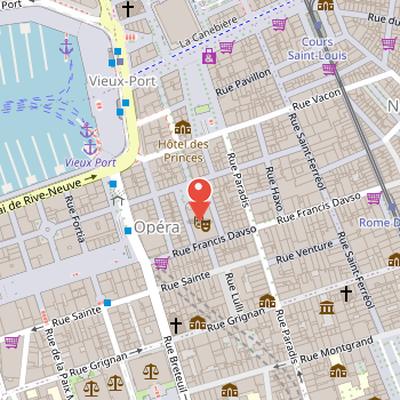
Opéra de Marseille is a theater located in the Lopéra municipal de Marseille neighborhood near the Vieux-Port. It was built on the remains of the Grand Théâtre, which was destroyed by a fire in 1919. The earlier Grand Théâtre was designed by Charles Joaquim Bénard, and its construction began after Monsieur de La Tour, intendant of Provence, laid the first stone on a specific date. The building stood on land made available by relocating the galley arsenal to Toulon, and its inauguration took place in the presence of the marshal-prince de Beauvau, governor of Provence.
The site is also associated with earlier theatrical history in Marseille. Pierre Gaultier obtained authorization from Lully to open the first privileged theater in Marseille, and he staged Triomphe de la Paix in the salle de jeu de paume on rue Pavillon. His privilege later extended to other cities in Provence and allowed performances in Roussillon and Lyonnais. In more recent years, the opera house has hosted productions including Marius et Fanny by Vladimir Cosma and Colomba by Jean-Claude Petit.
Nearby Objects
-
 Place du Général-de-Gaulle 200 m away
 -
 Musée Cantini 200 m away
 -
 Église Saint-Ferréol les Augustins 350 m away
 -
 Hôtel Louvre et Paix 450 m away
 -
 Jardin des Vestiges 500 m away
Location and Origins
The Opéra de Marseille is a theater located in the neighborhood of L'Opera municipal de Marseille near Vieux-Port. It was built on the remains of the Grand Theatre, which was destroyed by a fire in 1919. This placement links the present building directly to an earlier theatrical site in the city, giving it a historical continuity tied to the former Grand Theatre.
From Privileged Theater to the Grand Theatre
Histoire reports that Pierre Gaultier obtained authorization from Lully to open the first privileged theater in Marseille on a specific date. He staged Triomphe de la Paix in the salle de jeu de paume on rue Pavillon, and his privilege also extended to other cities in Provence, with performances allowed in Roussillon and Lyonnais. Later, Monsieur de La Tour, intendant of Provence, laid the first stone of the Grand Theatre on a specific date. The building was erected on land freed by relocating the galley arsenal to Toulon, and it was designed by Charles Joaquim Benard. The Grand Theatre was inaugurated in the presence of the marshal-prince de Beauvau, governor of Provence, on a specific date. On a later date, an incendiary event destroyed almost the entire building after a rehearsal of L'Africaine by Giacomo Meyerbeer.
Opera Productions by Creations
Creations was involved in two opera productions connected with Marseille. It produced Marius et Fanny, an opera composed by Vladimir Cosma and based on the first two volumes of Marcel Pagnol's Marseille trilogy. The production cast Roberto Alagna and Angela Gheorghiu in the lead roles. Creations also premiered Colomba, an opera composed by Jean-Claude Petit for the city of Marseille. That work used a libretto by Benito Pelegrin based on Prosper Merimee's novella, and it was directed by Claire Gibault and staged by Charles Roubaud.
Architecture and Interior Spaces
The Opéra de Marseille is documented through a set of architectural views and interior photographs that show both its exterior composition and its internal circulation spaces. The main facade appears in several images, and a lateral facade is also shown. One exterior view highlights ionic capitals under the raised attic, indicating a classical decorative treatment. The building is further recorded through cross-sections taken over the middle of the hall on the front stage side, over the width of the theatre, and over the length of the theatre, which together illustrate the spatial organization of the auditorium.
Inside, the opera includes an entrance hall, a staircase leading to the foyer, a landing with a commemorative plaque, and a foyer. The hall is visible from the stage, and the front-stage boxes are also shown, along with the buffet of boxes and an associated staircase. Decorative painting is part of the interior ensemble. The central panel of the foyer ceiling is painted by Augustin Carrera and titled Orphee charme le monde par la musique de sa lyre. A painted panel in the bathtubs corridor is titled Le 14 juillet a Marseille by Louis-Mathieu Verdilhan, and a painted panel on the staircase to the foyer is titled Le Festin chez Trimalcion : L'Apotheose de Dedaele by Henry de Groux.