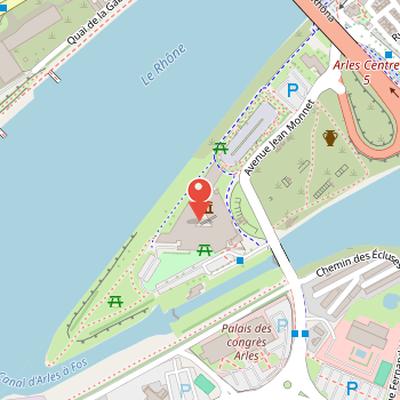
The Musée départemental de l'Arles antique, also known as Museo dipartimentale di antiquariato di Arles or Museo blu, is an archaeological museum complex opened in Arles in 1995. It is located in a modern building designed by architect Henri Ciriani on the peninsula where the ancient Roman circus was situated. The museum depends on the conseil départemental des Bouches-du-Rhône and houses the city’s particularly rich archaeological collections.
The museum was expanded in 2012 with a new wing built to house a Roman boat found in the Rhone in 2006. Its creation was part of a project initiated in 1968 to unite all of Arles’ archaeological collections in one place and to preserve them in suitable conditions. This development continued a long local history of heritage preservation in Arles, where authorities had organized public antiquities displays as early as 1614 and where collections were repeatedly moved and expanded as they grew over time. In 1995, the new facility finally reunited pagan and Christian collections under one roof.
Nearby Objects
-
 Museon Arlaten 850 m away
 -
 Forum of Arles 950 m away
 -
 Obélisque d'Arles 1000 m away
 -
 Town Hall of Arles 1000 m away
 -
 Saint-Trophime cloister 1000 m away
Museum Site and Expansion
The Musee departemental de l'Arles antique, also known as the Museo dipartimentale di antiquariato di Arles or Museo blu, is a museum complex opened in Arles in 1995. It is located in a modern building designed by architect Henri Ciriani, on the peninsula where the ancient Roman circus was once situated. The museum houses the city's particularly rich archaeological collections and depends on the conseil departemental des Bouches-du-Rhone. In 2012, the complex was expanded with a new wing built to house a Roman boat found in the Rhone in 2006.
From Early Antiquities Displays to a Modern Museum
Local authorities in Arles had been promoting the preservation of cultural heritage since the 17th century. In 1614, they organized the Maison commune, which is described as the first public exhibition of antiquities in the city. A municipal decree then required archaeological finds from Arles to be deposited in the city collections. During the 18th century, the vestibule of the new town hall provided exhibition space, and the collections were enriched by works such as the torso of Mitra, acquired in 1723, and the Altar of the Good Goddess, added in 1758. Other important works preserved in the Arles museum included the statue of Medea. The Antiquity Gardens also displayed artifacts discovered during urban improvement works, while Father Etienne Dumont established a small museum at the Alyscamps site in 1784. As the collection expanded, it required a larger space in the 19th century, leading to the conversion of the church of Sainte-Anne into the Lapidary Museum in 1826. Later, in 1936, the Jesuit chapel was annexed because of lack of space, and this also brought a forced separation between pagan and Christian collections. The two collections were reunited only in the new facility in 1995.
Site and Design of the Museum
In 1968, a project was launched to create a new museum that would bring together all of Arles archaeological collections in one place. The plan also included a mosaic restoration laboratory and an archaeology laboratory. Its aims were to preserve the citys archaeological heritage collections in situ under good conditions and to present them to the public in a way that showed both their diversity and integrity. The site was chosen for its available space. It was located on ground previously used in Roman times for the circus construction on the Rhone River, near the southwest periphery of Arles, but still close to the historic center and Roman monuments. The building project selected the design by architect Henri Ciriani. His proposal featured an unusual triangular form intended to invite visitors to move through the museum like in a city.
Architecture and Museum Layout
The Musee departemental de l'Arles antique was designed as a contemporary concrete building with a triangular base plan surrounding a patio. Its facades are covered with blue enamel glass panels, a reference to Arles's timeless blue sky, and this feature gave the building the nickname Museo Blu. The interior is divided into three distinct wings, each assigned to essential museum activities.
One wing is devoted to permanent collections, arranged in seven chrono-thematic sections. These present ancient Arelate before the Roman arrival, Romans in Arles, the large river port, artisanal and agricultural activities, daily life, and funerary rites and practices in Roman Arles and the Christian world. A second wing is focused on culture, knowledge, and cultural exchange, and includes a library, conservation facilities for artifacts, and public service and visitor reception areas. This wing is symbolized by the color white. The third wing is reserved for scientific activities and is identified by red walls. It includes photographic and archaeological items, a restoration laboratory, and storage for objects not exhibited. Green is associated with aged metal as a symbol of the trace of time.
The exhibits are arranged to highlight key pieces such as the colossal statue of Augustus and large mosaics, which can be seen from an elevated pedestrian walkway. The building therefore combines architectural design with a museum layout that supports display, research, conservation, and visitor services.
Extension for the Arles Rhone 3 Barge
The museum is devoted to the large river port of Arelate. Its building was expanded with an 800 square metre extension on the northwest side to house the ancient barge Arles Rhone 3. The project began in 2012, cost 6 million euros, and was inaugurated in October 2013. The barge was preserved and restored at the ARC-Nucleart laboratory in Grenoble before being installed in the new space.
The display was arranged to place the barge above a pit, creating the impression that it was floating. Around it, the museum exhibited objects excavated from the Arles Rhone 3 wreck as well as archaeological remains from the Rhone delta. Among the objects shown was a rare wooden anchor with a lead tip bearing an image of Venus.
The museum was also the subject of a legal dispute involving architect Henri Ciriani, who filed a complaint about the triangular building. On January 17, 2013, the Marseille court ordered the museum to pay him 30,000 euros for image damage. An appeal brought to the Aix-en-Provence Court of Appeal later resulted, in January 2016, in no copyright violation being recognized and the previous judgment being annulled.
Collection Arrangement and Key Works
The exhibition material at the musee departmental de l'Arles antique is arranged according to a chronological criterion. At the beginning and end of the exhibition route, the material is grouped mainly by pre Roman and post Roman periods. Within the display, objects are presented in individual spaces on the basis of homogeneity between two different themes.
The collections cover a wide historical range, from prehistory to late antiquity. They include protohistory, from the founding of Marseille by Phocaean Greek sailors around 600 BC to the founding of Arles by Julius Caesar, as well as high and low empire artifacts from the city's founding in 46 BC to the fall of the Roman Empire in 476. The museum also holds material from the 4th to 6th centuries and a significant collection of early Christian sarcophagi.
Several objects are especially associated with the museum. It preserves a copy of the famous Venus of Arles in its initial state, while the original, restored by Francois Girardon, is conserved at the Musee du Louvre in Paris. The Venus of Arles statue is the emblem of the museum, and a modified copy of the Louvre Venus of Arles formerly adorned the facade before expansion. A copy of the Venus of Arles is now visible inside the auditorium. The museum's flagship object is the statue fragment representing Caesar, a head presumed to represent Caesar and discovered during underwater excavations in the Rhone in 2007.
Roman Arles in the Museum Collection
The museum presents material related to the major Roman monuments of Arles and to the citys role as a Roman colony that adopted the religion of the Empire. One focus is the Roman theater of Arles, built at the end of the 1st century BC on Hauture hill. Monumenti describes it as having seated ten thousand spectators in thirty-three rows. Its stage backdrop wall was decorated with columns and niches containing numerous statues, including a colossal marble statue of Augustus, 3.10 meters tall. The torso of this statue was found in 1750, the head in 1834, and the two parts were matched. The museum also includes the marble altar of Apollo from Carrara, dated to the 1st century BC, which decorated the stage base pulpitem. Its imagery shows the seated god with an elbow on a lyre and laurels and birds on the front, while the side faces depict the martyrdom of Marsyas. A second altar, the swan altar, was made of Carrara marble and dates to the late 1st century; its iconography refers to Apollos birth, with swans flying over Delos island. The collection also includes the original marble Venus of Arles, representing Aphrodite, now displayed at the Louvre museum, along with an 18th century plaster copy shown inside the Arles museum. Nearby finds include an unidentified young princes marble bust and a white marble bust of Aphrodite known as the Head of Arles, with braided hair and a low bun.
The museum also documents other Roman entertainment buildings in Arles. The amphitheater, built on the northern slope of Hauture hill in the last decade of the 1st century BC, measured 136 meters in length and 107 meters in width, and was the twentieth largest arena in the Roman world. Its preservation is explained by medieval use as a military post and later residential occupation; demolished houses were removed in the 19th century. A 1/100 scale model shows the whole amphitheater and the positions of poles supporting a sunshade canvas, while bronze gladiator figurines and a lamp decorated with two fighting gladiators illustrate arena activities. The circus of Arles, located near the current museum, measured 450 meters long and 100 meters wide and could hold about twenty thousand spectators. Built on swampy ground, it required approximately twenty-five thousand pine or oak wooden piles for stabilization, and dendrochronological analysis dates its construction to 148 or 149 AD. Some of these wooden piles are preserved in the museum rooms, and three bas-reliefs of chariot races found in the citys late bastion are also displayed.
Roman Cult Objects and Mythological Sculpture
Monumenti notes that the cult of the major gods of the Roman pantheon left only a few traces, largely because many remains were destroyed in the Christian era. The diversity of cults is instead represented through altars, steles, and sculptures of different deities and figures. Among the objects mentioned is a white marble altar dedicated to the Good Goddess, decorated with an oak leaf crown and two ears of grain, as well as a marble head of the goddess Minerva. Mythological sculpture is also present in the form of a 132 cm tall limestone statue of Medea, shown with a raised sword as she prepares to kill her two children by Jason, and the sarcophagus of the Muses, which depicts Apollo with a lyre in his right hand, surrounded by the daughters of Zeus and Mnemosyne. On this sarcophagus, Melpomene holds a club and Thalia holds a theatrical mask. Other pieces include a head of Niobe, a bronze faun statue, and a limestone head of Mithra, whose cult originated in Iran and was brought from the Near East by Roman soldiers. A marble statue of the god Aiôn was discovered in 1598 in the foundations of a water mill on the Craponne canal.
Mosaics from Trinquetaille
The Musee departemental de l'Arles antique exhibits numerous mosaics, mainly from the Trinquetaille district on the right bank of the Rhone River. The collection includes works made with two main techniques: opus tessalum and opus sectile. Opus tessalum mosaics are assembled with cubic colored tesserae set in mortar on flat surfaces, while opus sectile mosaics are created from marble or hard stone slabs arranged into geometric figures.
Among the displayed works is the Rat of Europa mosaic, which represents Europa with Zeus as a white bull within a braided panel. The museum also shows part of the 2nd century Kantharos mosaic, depicting a kantharos with a double vegetal crown. Another notable piece is the Zodiac or Genius of the Year and the Seasons mosaic, discovered in 1914, with a young man in an octagon at the center and four octagons representing the seasons, along with four squares decorated with Solomon's knots or flowers.
The museum displays a geometric mosaic discovered in 1987 and dated to 170-180, featuring diamonds, squares, and two large flower decorated squares. It also includes a geometric composition with diamonds forming four half stars, surrounded by a two strand braid border. The Orpheus mosaic, discovered in 1934, shows Orpheus in oriental clothes playing a nine string lyre inside an octagon, surrounded by pacified wild animals and decorated squares and rectangles with braids and floral motifs. The collection is completed by the Medusa mosaic and the Annus-Aiôn mosaic.
Roman Necropolises in Arles
Monumenti found five Roman necropolises in Arles. One was located in the Tribon district in the north of the city. The most famous, Alyscamps, is in the south-east of Arles. A third necropolis near the circus was destroyed during excavation for a barge basin. Two other Roman necropolises were located on the right bank of the Rhone in the Trinquetaille district.
Funerary Finds from the Necropoleis
The museum displays numerous artifacts from the necropolis sites, presenting a broad record of Arles funerary material. Among the objects connected to Monumenti excavations is a model of a reconstructed mausoleum, based on elements uncovered during the excavation for the barge basin. The museum also exhibits a portrait stele dating to the first half of the 1st century, showing two busts: Chia, a freed servant, and Filematio, who holds an apple in her right hand. Another 1st century funerary monument, a cippus, depicts a married couple and their two children; in its central scene, the mother wears earrings on the left and the veiled daughter appears on the right.
The collection also includes a tomb lid shaped like a gabled roof with mask-shaped parapets. Found in 1985 in the circus necropolis and dated to the 3rd century, it is decorated with mask faces shown with grimacing expressions, open mouths, and rimmed lips. In addition, the museum presents a collection of pagan and Christian sarcophagi from Arles's funerary area. Funerary inscriptions and sarcophagus fragments are also displayed on the museum walls, reinforcing the site's focus on the city's mortuary heritage.
The Marble Sarcophagi of Arles
The sarcophagi associated with the Musee departemental de l'Arles antique show a wide range of materials, dates, and sculptural programs. Some are made of white marble, while others are in Carrara marble or Proconnesian marble. Several were discovered in 1974 along the road to Saintes-Maries-de-la-Mer or in its vicinity, while others were found earlier, including the Sarcofago di Fedra e Ippolito, discovered in 1891 in contrada Trinquetaille, and the Sarcofago di Marcia Romania Celsa, discovered in a ditch on the road to Saintes-Maries-de-la-Mer in 1974.
The Sarcofago di Fedra e Ippolito dates to the mid-3rd century. It is described as a marble artifact composed of a basin and a bed-shaped cover showing the deceased lying down. The basin carries a scene from the story of Hippolytus, son of Theseus, and Phaedra. This makes it one of the earlier works in the group and one in which mythological narration plays a central role.
By the second quarter of the 4th century, the imagery becomes especially complex. The Sarcofago di Marcia Romania Celsa has a circular medallion at the center of the lid bearing the epitaph of the deceased Marcia Romania Celsa. Its decoration combines biblical scenes: on the left are young Jews thrown into a furnace, and on the right the adoration of the Magi. A central orant is surrounded by further scenes, including on the left episodes dedicated to Saint Peter such as the miraculous Fountain, the centurion's baptism, Peter's arrest, and the announcement of his denial with the rooster. On the right are the multiplication of loaves, the healing of the blind, and the resurrection of Lazarus.
The Sarcofago della Trinita o degli sposi, also discovered in 1974 near Saintes-Maries-de-la-Mer and dated to the second quarter of the 4th century, is a white marble sarcophagus with a double register. Its lid shows New Testament scenes from left to right, including young Jews before Nabucodonosor, Abraham's sacrifice, Adam and Eve expelled from paradise, Moses receiving the Law, and Cain and Abel's offerings. The upper frieze of the basin has a shell-shaped medallion with a married couple at the center, while the registers also include healing scenes, the adoration of the Magi, the miraculous Fountain, and Peter's teaching.
Other late 4th-century sarcophagi continue this religious emphasis. The Sarcofago dell'orante, in Carrara marble with strigils, shows a veiled orant in the center before a drapery tied at the upper corners, with two apostles at the ends facing the central figure in an acclamation gesture. Traces of gilding indicate that it was painted and decorated with gold. The Sarcofago di Concordio, made in Carrara marble and dated to 380-390, shows Christ the Teacher seated under a portico holding an open book, with a tessera on the cover depicting twelve apostles reading the Law and groups of faithful men and women on either side. The Sarcofago della consegna della Legge a San Pietro, also in Carrara marble and dated to the late 4th century, is divided into five niches with Christ in the center granting the Law to Peter, while Paul and an apostle with a phoenix appear on Christ's left and scenes of washing of the feet and Christ before Pilate washing his hands occupy the ends.
The recurring theme of the passage of the Red Sea appears on two sarcophagi, one showing Israelites led by the prophetess Maria and the drowning of Pharaoh's army, and another with small sides decorated with turtle motifs and a similar main facade. The Sarcofago eucaristico, in Carrara marble and dated to the mid-4th century, has seven niches with composite capitals and a beardless Christ holding the scroll of the Law at the center, flanked by Abraham with a sword above an altar and Saint Peter among other figures. The Sarcofago con alberi, in Proconnesian marble, uses seven niches formed by olive trees with doves; it includes a snake winding toward a nest of eggs around the rightmost trunk, an orant with raised hands, and miracles of Christ such as resurrection, healing, multiplication of bread, and the wedding at Cana. The Sarcophagus of Susanna, also in Carrara marble, is described as having a double register and a medallion of the two spouses at the center.
Early Christian Sarcophagi in the Collection
The collection includes a group of late antique sarcophagi and fragments distinguished by carved narrative and symbolic reliefs, often arranged in registers or centered on medallions and inscribed panels. Several pieces are made of marble, including examples from Alyscamps and Carrara, while one Nativity sarcophagus is described as being made with strigils and marble from Saint-Beat.
Among the most detailed works is the Sarcophagus of Susanna, whose upper register shows Susanna reading the Book of the Law between two trees that hide the elders, followed by the elders being brought before Daniel seated on a rock with Susanna nearby. It also includes the judgment of Pilate with a jug placed on a tripod, and a lower register that combines the refusal of young Jews to worship Nebuchadnezzar's idol, Daniel in the lions' den, and the crossing of the Red Sea with Pharaoh's chariot overthrown, led by Mary and Moses touching the waves with his staff.
The Nativity Sarcophagus centers on the Virgin seated beside a cradle, with an ox and donkey above and a shepherd facing her, while the lower register depicts the Adoration of the Magi guided by the star above the Virgin's head. The Magi wear tunics and Phrygian caps. Its ends are decorated with Old Testament scenes of Moses receiving the tablets of the Law and Abraham's sacrifice, with a ram suspended by its horns in a bush.
Other works focus on Christ and apostolic imagery. The Sarcophagus of Christ from the late 4th century shows Christ at the center with two apostles at the sides. The Anastasis Sarcophagus, also from the late 4th century, has a central inscription panel held by two winged genii, two additional medallions representing a woman and a young man in profile, and a central cross of Anastasis topped by a crown, with two groups of six apostles moving toward it. Each apostle has a crown held by a hand emerging from a starry sky.
The Apostles Sarcophagus, found in 1949, is decorated with strigils and shows a beardless Christ with curly hair holding a jeweled cross, with adorants at his feet and Saint Peter and Saint Paul at the extremities. The Sarcophagus of Jonah history presents two registers and a shell-shaped medallion with the spouses in the center, together with scenes such as Cain and Abel, the healing of the blind man, Moses receiving the Law, the sacrifice of Abraham, the multiplication of loaves and fishes, the throne of Saint Peter, Peter's arrest, the Wedding at Cana, Daniel poisoning the Babylonian dragon, and Jonah swallowed by the whale, cast ashore, and resting in the Blessed's dwelling.
Additional fragments and sarcophagi preserve further Christian scenes. The Farewell of Christ sarcophagus, in Proconnesian marble, shows Christ barefoot on a stool holding a half-rolled book, saluting apostles, a miraculous fountain, three Jews refusing to worship Nebuchadnezzar's idol, and the resurrection of Zaira's daughter. The Throne of Saint Peter sarcophagus, dated around year 330 and made of Carrara marble from Alyscamps, includes a veiled praying figure supported by two saints, several biblical scenes, and the throne of Saint Peter with a soldier prostrated at the apostle's feet. Smaller fragments depict the Samaritan woman at the well and Zacchaeus in a sycamore, and the Good Shepherd carrying a sheep beside a veiled praying figure, with Peter's arrest and Christ's miracles on the sides.
Navigation, Trade, and Museum Collections
The Musee departemental de l'Arles antique is closely linked to the history of the port of Arles on the Rhone River, which connected the Mediterranean world and Northern Europe. Its collections illustrate maritime, river-maritime, and riverine navigation in the river delta, as well as port traffic and trade between Arelate and the Roman provinces. The Rhone delta is presented as a navigated area used for the transit of goods between the Mediterranean basin and the interior Empire. The museum preserves the most important collection of underwater archaeological objects and houses 400 artifacts described as maritime cultural goods found in the Rhone and its delta, including Arles, Saintes-Marie-de-la-Mer, and the Gulf of Fos. Recognized as a maritime museum since 2016, it also presented the temporary exhibition Sollevare l'ancora, alzare le vele! Navi e navigazione in epoca romana in 2018, featuring about sixty antiques. Adjacent to the museum, the Hortus garden was created in a style inspired by Roman gardens and recalls the nearby Roman circus.