The Convent of the Carmelites in Nantes was established in 1318 by Thibaut II de Rochefort, viscount of Donges and an officer of the Duke of Brittany. Situated in the Duchy of Brittany, it became one of the oldest houses of Breton aristocracy. According to its history, dominant noble families chose religious congregations as burial places during this period, and the convent was linked to this practice.
The Carmelites first settled in the Hôtel de Rochefort, despite opposition. The original building had previously served as a tavern, and a public bordello stood opposite it. The great hall of the building later formed the basis of the nave of the future church. Over time, the convent expanded through additional grants and acquisitions, including land that allowed for a garden to the south, as well as spaces for a chapter room, refectory, dormitory, and infirmary. Construction of the Carmelite chapel took place between 1365 and 1372. The convent was gradually destroyed beginning with the French Revolution.
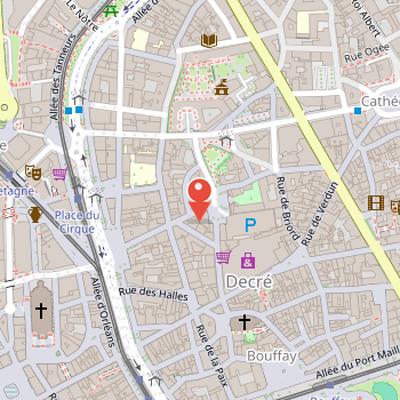
Nearby Objects
-
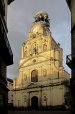 Église Sainte-Croix 150 m away
 -
 Château du Bouffay 250 m away
 -
 Place du Bouffay 250 m away
 -
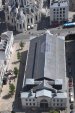 Marché de Feltre 250 m away
 -
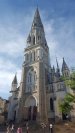 Basilique Saint-Nicolas 250 m away
History of the Convent of the Carmelites
The Convent of the Carmelites in Nantes was a convent of the Carmelite Order established in 1318. At the time of its foundation, Nantes was situated within the Duchy of Brittany. The convent did not survive intact into the modern era, as it was gradually destroyed beginning with the French Revolution.
Origins and Early Growth of the Carmelite Convent
According to the history provided, the Carmelite convent in Nantes was established in 1318 by Thibaut II de Rochefort, Viscount of Donges and an officer of the Duke of Brittany in Nantes. In this period, dominant noble families often chose religious congregations as places for family tombs, and the Carmelite convent came to be regarded as one of the oldest houses of Breton aristocracy. Thibaut II de Rochefort requested the help of six monks from the Ploermel establishment, which had been the first Carmelite convent in Brittany since its foundation in 1273 by Duke John II.
The convent was first installed in the Hotel de Rochefort, located at the intersection of present-day streets in Nantes. The building had previously served as a tavern, and a public bordello stood opposite it. Despite opposition, the Carmelites settled there, and the great hall of the original building became the base of the nave of the future church. Opposition continued from the Cordeliers, supported by the Jacobins, until 1345.
The convent enclosure was crossed by the ducal wall owned by the duke. After John IV defeated Charles of Blois in the War of the Breton Succession, he granted the Carmelites a section of this wall, the residence called Tour-neuve, and an adjacent dwelling. These additions made it possible to create a garden area south of the convent and provided wood for the construction of the Carmelite church. The Carmelite chapel was built between 1365 and 1372. A final acquisition near Rue de Verdun later allowed the construction of a chapter room with a refectory and dormitory, while buildings were also erected along Rue des Carmes and an infirmary along Rue de Verdun.
History and Interior Works
The Convent of the Carmelites in Nantes experienced a surge of enthusiasm in the 16th century, in common with other religious brotherhoods, and had a Carmelite membership of 435 in 1532 to 1533. Beyond its religious role, it also served as the venue for meetings of the citys consular judges, and the windows of the hall used for those meetings were repaired in 1577 and 1578. After the 1590 flood of the Loire, the reliquary containing the heart of Anne of Brittany was exhumed for inspection. In the early 17th century, the convent continued to receive significant attention: Antoine Blassel was commissioned to create a tabernacle for the high altar between 1605 and 1608, Guillaume Belliard was paid 71 livres and 6 sous for altar arrangement in 1617, and the city provided financial assistance for the closure of the choir in the same year. A comprehensive renovation program began in 1622. The convents later history was marked by disruption during the French Revolution, when the monks were dispersed in 1791. In that year the tomb of François II was moved to the cathedral and concealed there to prevent its destruction. The reliquary of Anne of Brittany was sent to the Monnaie de Paris in 1793, where it was melted down, then recovered in damaged condition and transported back to Nantes in 1852. It is now preserved at the Dobrée Museum.
Later Use and Surviving Remains
In 1802, the former nave was transformed into the Theatre des Varietes. The theatre was first managed by the widow Charles and Company, and later by Ferville and Potier. At the beginning of the 20th century, vestiges of the arcades and vaults were still visible at No. 3 and at Nos. 16 and 18. By 1975, these arcades and vaults had been entirely demolished.
Income and Revenue of the Convent
The Convent of the Carmelites in Nantes derived income from several sources, including land rents, established rents, property rents, preaching fees, casual earnings from the sacristy, alms, and collections in the 17th century. It also earned revenue from the rental of buildings or rooms. A 1669 report states that casual earnings amounted to 6,000 livres, or about 73 percent of total resources of 8,000 livres. Between 1752 and 1790, the share of casual earnings varied considerably, ranging from 15 percent in 1790 to 53 percent in 1781, with an average proportion of about 30 percent over the period.
The Convent Complex in 1790
In 1790, the convent complex comprised three buildings arranged around the cloister. The northern section adjoined the church or chapel, and the north wing ran along the church. The eastern wing, extending along Rue du Moulin, had a mixed use: commercial establishments and the sacristy were located on the ground floor, while the first floor contained a room for university assemblies and the prior's chamber. The second floor served as a dormitory for young religious members, and the third floor was reserved for the library. This eastern building also formed the east wing of the cloister, where the east gallery was topped by a dormitory.
The west wing bordered another building that contained a store on the ground floor and a refectory and large room on the first floor. Above these were guest rooms and the infirmary on the second floor, and servants' quarters on the third floor. The south wing included a gallery with religious chambers above it. Together, these elements show a dense and functional layout, combining religious, administrative, residential, and service spaces within the same convent ensemble.
Chapel Choir and Rood Screen
The convents choir was arranged with a single nave and a choir that was as long as the nave but narrower. Its choir enclosed the tomb of Francois II of Brittany. The space was fitted with a rood screen made in 1631 from tuff and marble columns, financed by a legacy from the Marquis of Asserac. The screen was created by Guillaume Belliard, Michel Poirier, and Rene Lemeunier, under the direction of an unnamed person. Belliard also worked on the rood screen of Nantes Cathedral. The convent further included sculptural works by Michel Colombe, who made two statues of Saint Francis and Saint Margaret, as well as a crucifix placed on the main altar.
Surviving Remains and Sculptural Fragments
Although the convent was largely destroyed during the revolutionary period, a few elements survived. Almost no ornamentation or sculpture was preserved, but the remains still preserve some elements of the library and several works that had previously belonged to the Carmelite convent. Among the surviving books are an incomplete copy of Saint Augustine's Enarrationes on Psalms 1 to 50 and the Carmelite Missal, now held by Princeton University. The Carmelite Missal links the history of the convent with that of the Montfort house.
Some important objects were protected during the destruction, including the tomb of Francois II and the reliquary of Anne of Brittany's heart. In 1863, Frederic Mahaud uncovered many statue fragments in the courtyard of his property at Nos. 18 and 20, and he donated them to the Dobre Museum in 1867. A city archivist later published information on these fragments in the Bulletin archeologique de Nantes et de la Loire-Inferieure. Their attribution to the Carmelite convent rests solely on where they were found, since no documents have survived about the convent building and no revolutionary inventory mentioned them.
Sculptures with provenance from the former convent include Saint Mark, Saint Adrian, Saint Matthew, a bishop, and a deacon, as well as the Holy Trinity, Saint James, and an unidentified saint from the 16th century. The identification of the figure as Saint Matthew remains disputed, and Saint Adrian may instead have come from the Saint-Germain chapel near the west gate of the church. The sculptures were produced by workshops that also contributed to the cathedral's decoration. Four statues were likely commissioned by Duke Francois II around 1460 from the Tours region, while one statue was made by Breton artisans with stylistic affinity to Loire Valley traditions. Their craftsmanship has been compared with four statues from the early 15th century at the base of the cathedral's crossing tower, and the four statues were later transferred to the Dobre Museum after the choir refurbishment.
The Evangelist Statues
The Saint Mark statue is depicted as an evangelist, and its facial features are rendered with remarkable precision. By contrast, the craftsmanship of its garment is described as somewhat lacklustre. The Saint Matthew statue is also shown as an evangelist, but with the additional identity of a tax collector. It wears a tax collector's purse and extends a hand to receive money. Its face appears as a portrait made from a model, and is not stylized in the same way as Saint Mark's.