The Carnegie Library of Reims is the municipal library of Reims, whose collections originated in the late eighteenth century from books confiscated from religious orders. The holdings were assembled after the confiscation of the Jesuit College library in 1764 and, during the French Revolution, from the libraries of Reims abbeys and the chapter of the Cathedral of Reims. These books were later installed in City Hall, where a small reading room opened in 1818.
On 3 May 1917, an incendiary shell destroyed the town hall and a large part of the collections, although nearly 100,000 valuable works had been preserved. After the devastation of 1918, the city could not finance reconstruction without support from the Carnegie Endowment for International Peace, which offered more than 3 million francs and selected Reims to receive a Carnegie library in France. The building was entrusted to French architect Max Sainsaulieu. Its design is marked by a rare functional organization, with a strict separation between public, storage, and staff spaces, and by a classicist entrance intended to symbolize access to knowledge.
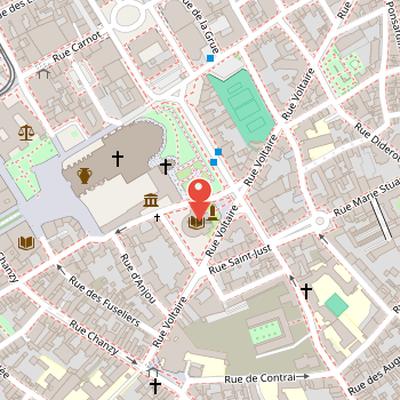
Nearby Objects
-
 Palace of Tau 70 m away
 -
 Reims Cathedral 140 m away
 -
 Place Royale 300 m away
 -
 Museum of Fine Arts of Reims 350 m away
 -
 Reims Opera House 350 m away
From Confiscated Collections to a Carnegie Library
The municipal library of Reims was founded in the late eighteenth century with books taken from religious orders. In 1764, the books of the Reims Jesuit College were confiscated after the Suppression of the Society of Jesus in France. During the French Revolution, the libraries of the Reims abbeys and the chapter of the Cathedral of Reims were also confiscated, and these books were added to the collections of the Reims public library. The collections were first installed on the first floor of City Hall, where a small reading room opened in 1818.
The library suffered severe losses during the First World War. On May 3, 1917, an incendiary shell destroyed the town hall and a large part of the collections. Nearly 100,000 valuable works had been put away before the war and were preserved from damage, but the city of Reims was devastated in 1918. The municipality could not finance the rebuilding of the public library without the Carnegie Endowment for International Peace, founded in 1910 by philanthropist Andrew Carnegie. After World War I, the Endowment decided to provide libraries to cities damaged by bombings, and Reims was chosen to receive a Carnegie library in France. The Endowment offered more than 3 million francs for the new building.
Construction of the Carnegie Library was entrusted to the French architect Max Sainsaulieu (1870-1953). In December 1920, he undertook a study trip to visit foreign libraries in Switzerland and Belgium.
Architectural Design
The Carnegie Library of Reims was designed with a functional spatial layout that was rare in France. Its architecture made a strict distinction between public areas, storage spaces, and work areas for staff. Semi-circular book stacks were used to store almost 400,000 books across five levels. The reading room and administrative offices were placed in front of the book stacks. The library was conceived as a temple dedicated to knowledge.
Architectural Design and Interior Program
The Carnegie Library of Reims was designed with architectural details that emphasized learning and cultural ambition. The visitor entrance required climbing a few stairs, a gesture intended to symbolize elevation to knowledge. The entrance itself was marked by two pilasters without capitals and a classicist pediment. This pediment was decorated with engraved flowering shrubs, iron letters spelling the word "bibliotheque," and a Latin motto reading "Educunt fructum folia." The facade also included a bas-relief symbolizing the flowering of the mind, made by the French sculptor Edouard Sediey, as well as mosaics executed by Biret. A large wrought iron gate by Schwartz-Haumont pierced the facade, and two vases made by the Manufacture nationale de Sevres adorned the platform steps.
The porch was presented at the 1925 Exposition Internationale des Arts Decoratifs et Industriels Modernes, where it won a gold medal. Inside, the lobby was square and topped with a four-sided cupola ending in an art deco lantern pendant designed by the master glass maker Jacques Simon in Reims. A fountain placed beneath the pendant in the center of the lobby symbolized the source of all science and knowledge. The lobby walls were lined with large panels of Algerian onyx framed by bands of green marble, and twenty marble mosaics made from cartoons by Henri Sauvage represented intellectual, physical, or manual activities.
The reading room continued this careful interior program. It had oak floors and mahogany-paneled walls, with shelving walls interrupted by a gallery on the first floor. Light came mainly from a large glass ceiling by Jacques Gruber, who created a design representing an open book on the arms of the City of Reims. Three large windows with geometric designs and frosted glass completed the space, giving the room a distinctive visual character.
2001 Renovation and Reopening
In 2001, the library in the City of Reims underwent restoration led by French architects Jacques Blehaut and Jean-Loup Roubert. The renovation aimed to bring the building up to standards in accessibility and safety while respecting the original spirit of the place. Work also focused on improving the conditions for conserving the collections, including the installation of air conditioning in the book stacks. The restoration further improved comfort for users and introduced new activity areas, among them a conference room and an educational workshop at the ground-garden. Decorative elements such as marble, stained glass, ironwork, and woodwork also received careful attention.
The project became possible after the municipal archives were moved out of the building in 2002. Following the renovation, the library reopened to the public in June 2005.
Decorative Features
The Carnegie Library of Reims includes decorative features that contribute to its interior character. In the reading room, the gallery contains Art Deco stained glass by Jacques Gruber. The entrance hall also features mosaics based on drawings by Henri Sauvage. Together, these elements show the integration of art into the library's interior spaces.