Saint-Paul-Saint-François-Xavier is a French church in central Bordeaux, in Gironde, Nouvelle-Aquitaine. It has been used for Catholic worship since its construction and is classified as a historic monument. The church was built between 1661 and 1673 under architect Mathurin Biziou, with support from donor Olive de Lestonnac, and was consecrated to Saint François Xavier by the Archbishop of Bordeaux.
Designed in the Baroque style of the Counter-Reformation, the building has vaults of double arches and multiple shallow but wide side chapels. A dome planned for the crossing of the transept and nave was not completed because of a lack of funds. The church was derived from Saint-Nom-de-Jésus in Rome and Saint-Paul-Saint-Louis in Paris.
Its main altar, constructed between 1741 and 1748 by Guillaume Coustou and Pierre Vernet, includes the apotheosis of Saint François Xavier. The altar combines green marble, red Languedoc marble, and a baldachin with four columns and two pilasters. In 2007, a large metal and glass chandelier by Jean-François Buisson was installed at the crossing, replacing the unrealized dome with an artificial light source.
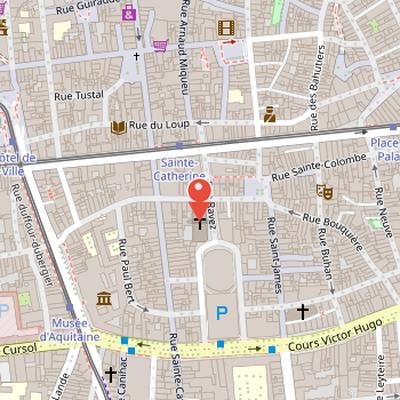
Nearby Objects
-
 Aquitaine Museum 200 m away
 -
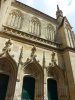 Église Saint-Éloi 200 m away
 -
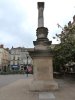 Place Camille Jullian 250 m away
 -
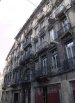 Hôtel Saint-François 350 m away
 -
 Place Pey-Berland 350 m away
Location and Heritage Status
Saint-Paul-Saint-Fran?ois-Xavier is a French church located in central Bordeaux, in the Gironde department of Nouvelle-Aquitaine. Since its construction, it has been used for Catholic worship, giving it a continuous religious role in the city. The church has also been classified as a historic monument, reflecting its recognized heritage value within Bordeaux's urban fabric.
Construction and Early Jesuit Use
Jesuits settled in Bordeaux at the end of the century to establish a college in the former Saint-James priory. The college included a large chapel called Madeleine and served pilgrims of Compostelle as well as abandoned children. A novitiate was founded in Bordeaux in 1607, becoming one of the largest in France after Avignon and Toulouse. It was first located on rue du Hault, then moved near Sainte-Croix church. The church of Saint-Paul was built between 1661 and 1673 under the architect Mathurin Biziou with support from Olive de Lestonnac. It was consecrated to Saint Francois Xavier by the Archbishop of Bordeaux. The main altar was later built between 1741 and 1748 by Guillaume Coustou the younger and Pierre Vernet. It depicts the apotheosis of Saint Francois Xavier, and the statue was disguised to protect it from revolutionary iconoclasm.
Architecture and Interior Design
The church Saint-Paul-Saint-Francois-Xavier was designed in the Baroque style of the Counter-Reformation, and its architecture was derived from the church Saint-Nom-de-Jesus in Rome and the church Saint-Paul-Saint-Louis in Paris. It was built with vaults of double arches and multiple shallow but wide side chapels. A dome was planned at the crossing of the transept and the nave, but it was never realized because of a lack of funds. In its place, a metallic chandelier was installed in 2007 by Jean-Francois Buisson.
The main altar is described as a complex but coherent ensemble made up of the altar, tabernacle, choir background, and baldachin. It includes the apotheosis of Saint Francois Xavier sculpted by Guillaume Coustou when he was 28 years old. The altar and tabernacle are in green marble, while the decoration in red Languedoc marble and the baldachin were made by Pierre Vernet. The baldachin is supported by four columns and two pilasters topped by Corinthian capitals. The chandelier installed at the crossing is a large metal and glass work with a central sphere and seven orbiting elements, and its lights change color to adapt to liturgical times.
Dominican Administration
Since 1992, the Dominicans of the province of Toulouse have served the Church of Saint Paul and the adjacent convent. This arrangement is noted in the section on miscellaneous information and reflects the ongoing religious presence connected with the site. The church and convent therefore remain under the care of a Dominican community, linking the building to a continued ecclesiastical use rather than only a historical or architectural significance.