The Sanctuary of the Three Gauls, or Le sanctuaire fédéral des Trois Gaules, was a Roman architectural ensemble located in Lugdunum, now Lyon. It was erected at the request of Nero Claudius Drusus and functioned as the place where federated Gallic nations celebrated the imperial cult. The Gallic assembly of the Confluence is generally admitted to have met on August 1, although the choice of this date has been explained by both cultic and political reasons.
The site’s location is reconstructed from ancient authors such as Tite-Live, Suétone, and Strabon, as well as from archaeological remains, including a fragment of the Table Claudienne discovered on the southern slope of the Croix-Rousse at rue des Tables-Claudiennes. Several hypotheses have been proposed for its position, including the Croix-Rousse slopes and the Ainay area, and the question remains debated. The sanctuary is described through multiple architectural elements, including a monumental altar dedicated to Rome and Augustus with a marble base 9 meters long, flanked by two gilded bronze winged victories holding crowns.
Nearby Objects
-
 Amphitheater of Lyon 0 m away
 -
 Montée de la Grande Côte 80 m away
 -
 Bon-Pasteur Church 130 m away
 -
 Place Sathonay 150 m away
 -
 Passage Thiaffait 200 m away
The Federal Sanctuary of the Three Gauls
The Sanctuary of the Three Gauls, known in the introductory fact as Le sanctuaire federal des Trois Gaules, was an architectural Roman ensemble located in Lugdunum, now Lyon. It was erected at the request of Nero Claudius Drusus, the brother-in-law of the emperor and father of the future Claude. The sanctuary served as the place where the federated Gallic nations celebrated the imperial cult.
It is admitted that the Gallic assembly of the Confluence met there on August 1. The choice of this date, and the reasons behind it, have been interpreted in both cultic and political terms. Among the cultic explanations are continuity with a Celtic cult dedicated to Lug, a transposition of a druidic assembly, or a transposition of an imperial cult dedicated to Auguste. Among the political explanations are the birthday of Claude, the anniversary of the battle of Actium, or the transposition of a provincial assembly to the Gauls.
The importance of Lugdunum in this context is also reflected by its role as the site of the second imperial mint workshop, the presence of an urban cohort, and the collection there of the tax of federated Gallic nations such as the Parisii, Arvernes, Namnetes, and Remes.
Location Hypotheses and Archaeological Evidence
The location of the Sanctuary of the Three Gauls is known through ancient authors such as Tite-Live, Suetonius, and Strabo, as well as through archaeological remains, including a fragment of the Table Claudienne found on the southern slope of the Croix-Rousse at rue des Tables-Claudiennes. Several hypotheses have been proposed over time. For a long period, the sanctuary was placed in the Ainay area of the presqu'ile, based on a reading of the Latin expression for Confluent. More recent proposals have shifted the discussion to the Croix-Rousse slopes. In 2011, Daniel Frascone suggested a location between the lower rue Burdeau and the upper rue des Tables-Claudiennes, based on a partial analysis of the 2006 excavations and excluding earlier results. In 2016, Armand Desbat considered this proposal attractive, but noted that it lacked justification for the ancient origins of the montees Saint-Sebastien and Grande-Cote. Despite these competing interpretations, the proposal of Amable Audin continues to be accepted by some scholars.
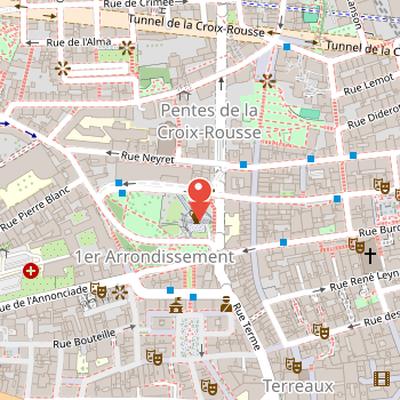
Audin imagined the sanctuary as a large esplanade facing a cliff, with an altar placed on a podium that may have been attached to the amphitheater. In his interpretation, the site would be located on a marked slope, about fifteen meters above sea level, northeast of the Saone, west of the Rhone near pont Morand, and northwest of place des Terreaux. He also placed the amphitheater of the Trois Gaules between rue Lucien-Sportisse to the south and rue des Tables-Claudiennes to the north, and compared the sanctuary's plan to the sanctuary of Fortuna Primigenia at Preneste.
Monumental Features and Surviving Vestiges
The Sanctuary of the Three Gauls is described through several monumental architectural elements, although only some vestiges remain. Its altar dedicated to Rome and Augustus had a marble base 9 meters long. Beside the altar stood two winged victories in gilded bronze, each holding crowns. Amable Audin postulated that the columns supporting these figures were later cut for reuse in the transept of the Ainay basilica, and he noted that their capitals had a simplified Doric style comparable to imperial Trajan and Antonine columns. The two granite shafts were identified through macro and XRF analysis as having either Egyptian or Corsican origin.
The sanctuary also carried strong political meaning. Strabo reports that the names of Gallic peoples were inscribed on the altar, with statues representing each nation. In addition, the Table Claudienne, a bronze plaque bearing Emperor Claudius' speech of AD 48, was displayed in the sanctuary. The plaque granted Gallic chiefs eligibility for Roman magistracies and the Senate according to Claudius' speech. The lower part of the bronze tables was found in 1528 by a draper in a vineyard on the sanctuary site, and the surviving bronze fragments are now preserved at the Museum of Gallo-Roman Civilization in Fourviere.
The Amphitheater on the Sanctuary Esplanade
The amphitheater associated with the Sanctuary of the Three Gauls was built under Tiberius around 20 AD on the sanctuary esplanade. It was later enlarged under Hadrian, raising its capacity to 20,000 spectators. Part of the southern section now lies beneath the carriageway of Lucien Sportisse street. Excavations in the 1960s temporarily uncovered remains in this southern area, while a tunnel built in 1860 for a funicular and converted to road use in 1967 destroyed part of the amphitheater remains. At the center of the amphitheater stands a wooden post commemorating the Christian martyrs of Lyon, which was inaugurated by Pope John Paul II in 1986.
Hypotheses for the Sanctuary Layout
The proposed reconstruction of the Sanctuary of the Three Gauls is based on observations made in the caves of rue Burdeau in the 1950s, where thick masonry and lines of walls were noted. It suggests a monumental terrace leading to both the amphitheater and the federal altar in the rue Burdeau sector. This interpretation is strengthened by the nearby rediscovery, under rue des Fantasques, of the Claudian table and a bronze crown fragment covered with gold leaves. According to D. Frascone, the sanctuary entrance would have been located at the intersection of rues Burdeau and Pouteau, with the altar at the top of the hill. The entrance and altar are then linked by ramps between montée de la Grande-Cote and montée Saint-Sebastien, and the present street layout is said to follow their course. The hypothesis is compared with tiered sanctuaries elsewhere in the Empire, including the Sanctuaire de la Fortuna Primigenia and sanctuaries at Zeugma and Tarragone. It also maintains Amable Audin's hypothesis, which was based on limited excavation findings from 2006.
Council and Sanctuary Functions
The origin of the sanctuary is linked to Drusus's decision to gather notable Gauls at the confluence of the Saone and the Rhone. According to Historique, Drusus completed the census of the Gauls in 12 BCE, as reported by Emperor Claude, and this process was connected to the formation of the council of the Gauls, or concilium Galliarum. The assembly was made up of around 60 or 3,000 notable individuals, with each delegate chosen by the decurion assembly of their city.
The council had religious functions centered on the worship of the imperial deities, Rome, and Augustus. Its annual ceremonies included sacrifices, processions, games, and contests in eloquence and poetry, with the main celebrations held each year starting on August 1. At the same time, the council had administrative and political roles. It communicated directly with the emperor to convey the wishes and complaints of the Gaulish populations and sometimes tried to negotiate amicable solutions.
The sanctuary itself included an amphitheater, a federal altar, a temple, and a large sacred grove, or lucus. Sixty statues represented cities, former sanctuary priests, deities such as Bonus Eventus and Fortuna Favens, and important figures. Historique also notes that the organization of the cult was intended to preserve Gaulish identity and to allow tolerance toward conquered peoples. Over the centuries, the object of the cult changed, and it originally focused on the worship of Rome and Augustus while they were living.
Priests and the Cult of the Sanctuary
Historical records note that priests held the title sacerdos and were associated with the monument at the confluence of the Arar and the Rhodanus. A priest was appointed each year for the cult. Seventeen priests are known by name, including the first, the Eduan Caius Julius Vercondaridubnus, who was appointed in 12 BCE. He is uniquely identified through texts, while the remaining priests are known from epigraphy, the inscriptional evidence common in Roman civilization. These inscriptions provide little biographical detail about them.