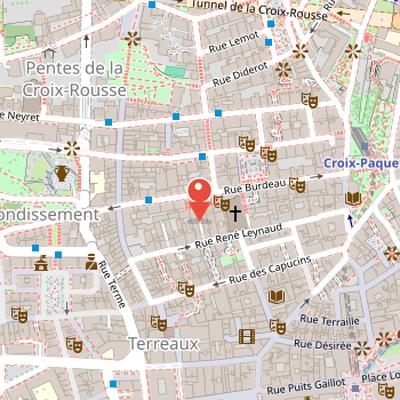
Passage Thiaffait is a passage in the quartier des pentes de la Croix-Rousse, in Lyon’s 1st arrondissement, France. It is entered through a portico on rue René Leynaud and forms a traboule ending with a double staircase that ascends to rue Burdeau. The passage was built in 1827 and takes its name from Monsieur Thiaffait, who built the house and the passage. He was a member of the Bureau de Bienfaisance and president of the Société d'Instruction Élémentaire.
In the late 1970s, the buildings on rue René-Leynaud became dilapidated, and the district acquired a bad reputation. In the 1980s, the passage became a crime hotspot in Lyon, with squatted apartments, clandestine brothels, drug trafficking, prostitution, and delinquent gangs using the traboules network. Renovation was decided in 1997 and completed in 2001. The restoration helped allow the broader Grand'Côte district project to proceed, and some premises were converted into studios and workshops for young fashion designers.
Nearby Objects
-
 Église Saint-Polycarpe 50 m away
 -
 Rue des Capucins 90 m away
 -
 Montée de la Grande Côte 140 m away
 -
 Rue Sainte-Catherine 200 m away
 -
 Sanctuary of the Three Gauls 200 m away
Passage Thiaffait
Passage Thiaffait is a passage in the quartier des pentes de la Croix-Rousse in the 1st arrondissement of Lyon, France. It is entered through a portico on rue Rene Leynaud. The passage forms a traboule and ends with a double staircase leading up to rue Burdeau.
Origins of Passage Thiaffait
According to Histoire, Passage Thiaffait was built in 1827 and takes its name from Monsieur Thiaffait. He built both the house and the passage. Monsieur Thiaffait was a member of the Bureau de Bienfaisance and served as president of the Societe d'Instruction Elementaire. His date of death is not specified in the available facts.
From Decline to Renovation
In the late 1970s, the buildings on rue Rene-Leynaud became dilapidated, and the district acquired a bad reputation that caused tenants and owners to leave. By the 1980s, passage Thiaffait had become a crime hotspot in Lyon. Most apartments were squatted by marginalized groups, and some were turned into clandestine brothels. Drug trafficking, prostitution, and delinquent gangs used the traboules network in the passage, which gave the area a reputation as a coupe-gorge. As a result, most nearby businesses left, while the passage also attracted marginalized people because of its conditions and notoriety.
Renovation of the passage was decided in 1997 and completed in 2001. The success of the work helped make possible the wider restoration project for the Grand'Cote district. After renovation, however, no businesses initially wanted to settle there because of its location and security issues. Public financial aid was therefore provided to help artisan small and medium enterprises establish themselves in the passage. Some premises were converted into studios and workshops for young fashion designers, and the workshops and shops were named Le village des createurs. Crime virtually disappeared after the renovation. During the work, a plaque named Thiaffait was placed at the entrance of passage Donat.