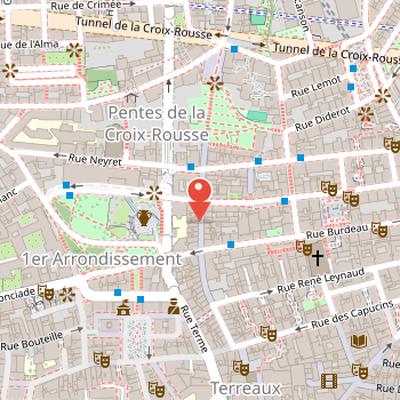
Montée de la Grande Côte is a street in the La Croix-Rousse quarter of Lyon’s 1st arrondissement. It connects the Terreaux quarter with the Plateau de la Croix Rousse and is characterized by a high elevation and a narrower lower section. The street belongs to the zone classified as a UNESCO World Heritage Site.
In the Middle Ages, it was a country path bordered by agricultural land, including vineyards. The western part was bought by the nuns of the desert in 1296. Urbanization took place in the 16th century, when the street became a major axis of entry and exit from the Presqu'île by the north. It was also known as Grand'Côte Saint-Sébastien and Grand'Côte de La Croix-Rousse, while the upper part was called Pierres-Plantées because of planted stones installed there.
The street is closely linked to the history of the canuts. In 1788, there were 705 looms on the Grand'Côte, and it remained a crossing place for workers. It was also the scene of the Revolt of Canuts in 1831 and 1834. Despite later restoration and urban renewal, it continues to be presented as a typical example of a canuts street.
Nearby Objects
-
 Amphitheater of Lyon 80 m away
 -
 Sanctuary of the Three Gauls 80 m away
 -
 Passage Thiaffait 140 m away
 -
 Bon-Pasteur Church 150 m away
 -
 Église Saint-Polycarpe 200 m away
Urban Setting and Heritage Status
Montee de la Grande Cote is a street in the La Croix-Rousse quarter of the 1st arrondissement of Lyon. It connects the Terreaux quarter and the Plateau de la Croix Rousse. The street is marked by a high elevation, and it becomes narrower toward the bottom. It is also located within the zone classified by UNESCO as a World Heritage Site, which places it within an area of recognized urban and cultural significance.
History and Social Role of Monttee de la Grande Cote
In the Middle Ages, Monttee de la Grande Cote was a country path bordered by agricultural land, including vineyards. In 1296, the nuns of the desert bought the western part of the street. Urbanization took place in the 16th century, when the street became a major axis for entering and leaving the Presqu'ile from the north. It was originally known as Grand'Cote Saint-Sebastien and Grand'Cote de La Croix-Rousse, while the upper part was called Pierres-Planttees because planted stones had been installed there.
The street also carried signs of religious and civic history. In 1628, a small statue of Saint-Roch and a Latin plaque were installed to mark the point where the plague epidemic stopped. These elements were removed after the French Revolution. At the same time, the Grand'Cote became closely associated with the canuts. While much of the plateau and the slopes of La Croix-Rousse were mainly occupied by religious congregations, the Grand'Cote hosted many weavers. In 1788, there were 705 looms on the street, and their number increased as the slopes urbanized. The Grand'Cote was also a crossing place for workers heading to Lyon, Capuchins, the merchants' district, or Condition des soies.
The street later took part in social conflict. Demonstrators used it during the Revolt of Canuts on 21 November 1831 and 14 February 1834. In 1835, Michel Derrion and Joseph Reynier established a cooperative store there, and a plaque on the street states that the first French consumer cooperative was founded in that year. Despite restoration of the upper part, the street is still described as a typical example of a canuts street. It also appears in the history of early automotive trials, since Marius Berliet tested his first car, the Pantoufle, there in 1895, and the vehicle later ended up in the window of a butcher.
Urban Renewal and Street Transformation
In the last decades of the 20th century, urban renewal altered the upper part of Montee de la Grande Cote and the adjacent islands, including the demolition of houses at the top of the street in 1975. The upper section was later transformed with staircases, gardens, and an esplanade offering a city view. Some sections of the street are now exclusively pedestrian. Between Rue des Tables Claudiennes and Rue Burdeau, the street kept its original width.
Architectural Character Along the Montuee de la Grande Cote
The architecture of Montuee de la Grande Cote is described as more varied and interesting in its southern part. North of Rue Imbert Colomes, the street includes 19th century canut styled buildings as well as four buildings from the 1970s. Before Rue des Tables Claudiennes, there is a 20th century school and two old houses, while before Rue Burdeau the street has two floor houses. Near Rue Leynaud, six floor public housing replaced houses before 1988, and a covered parking is also present in this area. Beyond Rue Leynaud, the street becomes narrower and is lined with a wide variety of old houses. To the east, there are old two to four floor houses, including the oldest houses, which were built in the early 16th century. At No. 100, the architecture includes mullioned windows created in the 13th century. Sidewalks were added in 1859, and the houses along the street are classified as a World Heritage Site. The name Grand Cote also gave its name to the Littr de la Grand Cote, a dictionary of the Lyon speaking written by Nizier of Puitspelu.