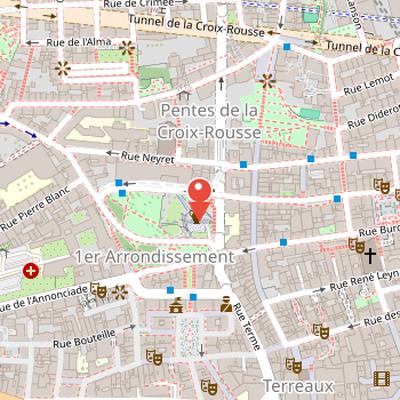
The amphitheater of Lyon is a Roman amphitheater located in Lugdunum, the present-day city of Lyon. In ancient times, it formed part of the Bundesheiligtums der drei gallischen Provinzen, also known as the Ara trium Galliarum, where the Gallic tribes organized in three provinces worshipped Roma and Augustus. Its central location in Lugdunum reflected the city’s role as the center of Gallia Belgica, Gallia Aquitania, and Gallia Lugdunensis. The structure was probably built in the second decade of the 1st century AD, making it one of the oldest amphitheaters outside present-day Italy. Originally, it was a comparatively small venue intended mainly for the upper class and delegates of Gallic tribes, with a capacity of about 3,000 seats. It was later expanded in the mid-2nd century into a much larger complex to accommodate the entire city population. The amphitheater stands on the slope of the La Croix-Rousse hill, where the Rhône and Saône converged in antiquity.
Nearby Objects
-
 Sanctuary of the Three Gauls 0 m away
 -
 Montée de la Grande Côte 80 m away
 -
 Bon-Pasteur Church 130 m away
 -
 Place Sathonay 150 m away
 -
 Passage Thiaffait 200 m away
Location and Historical Development
The amphitheater of Lyon was a Roman amphitheater in Lugdunum, the present-day Lyon. It stood as part of the Bundesheiligtums der drei gallischen Provinzen, also known as the Ara trium Galliarum, and was used for the worship of Roma and Augustus by the Gallic tribes organized in three provinces. Its central location in Lugdunum reflected the citys role as the center of the three Gallic provinces Gallia Belgica, Gallia Aquitania, and Gallia Lugdunensis. The amphitheater was probably constructed in the second decade of the 1st century AD, making it one of the oldest amphitheaters outside present-day Italy, along with those at Ucubi and Emerita Augusta. It was originally a comparatively small structure intended mainly for the upper class and delegates of Gallic tribes. In the mid-2nd century, it was expanded into a significantly larger complex to accommodate the entire citys population. The site is located on the slope of the La Croix-Rousse hill, where the rivers Rhone and Saone converged in antiquity.
Inscription, Dating, and Original Use
Professional excavations in February 1958 uncovered a building inscription at the amphitheater. The inscription had originally stood above an entrance and consisted of three large limestone blocks. Two of the right-hand blocks were preserved because they had been reused to cover a well, and the blocks were later found broken in the middle after this reuse. They measured 1.78 m by 80 cm by 27 cm, with letter heights of 10 to 15 cm. The inscription named Tiberius Caesar Augustus, Gaius Julius Rufus, his son, and grandson. It stated that Gaius Julius Rufus, a priest of Roma and Augustus, built the amphitheater with podium at his own expense. Erste Bauphase connected him to an old Gallic aristocratic family from Saintes with Roman citizenship, and linked the inscription to the Germanicus Arch in Saintes, which he built in 18 to 19 AD. The unusual phrase filii f(ilius) was interpreted as probably indicating an extensive ancestral lineage. While the amphitheater was often dated to the same year as the Germanicus Arch, no evidence showed that Gaius Julius Rufus served as high priest in Lugdunum at the same time. Louis Maurin suggested a date of approximately 10 to 15 AD.
The amphitheater served the games accompanying the imperial cult and had an original capacity of about 3,000 seats. It was constructed mainly for delegations of the 60 Gallic districts rather than for the entertainment of a large urban population. Excavations revealed a basement formed by three elliptical walls connected by transverse walls and a channel surrounding the central oval arena. Because of the slope of the site, the south side was supported by a now missing arch. The fighting area inside the arena measured 67.6 m by 42 m, a size comparable to structures in Nimes and Arles. The amphitheater had fewer seating rows, apparently four tiers, and its external dimensions of 81 m by 101 m were smaller than those of Nimes.
Arena Events and Historical Accounts
The amphitheater of Lyon appears in historical accounts connected with public spectacle and political conflict. Suetonius mentioned games held by Emperor Caligula in Lugdunum that included various sports and intellectual disciplines. Tacitus later reported that in 69 AD, Mariccus attempted to restore Gallic freedom from Roman control. According to the same historical tradition, Emperor Vitellius had Mariccus executed in the arena after wild animals failed to harm him. These references show the amphitheater as a setting linked not only to entertainment, but also to dramatic imperial and political events.
Second Building Phase and Expansion
In the first half of the 2nd century, the Amphitheater of Lyon underwent a major second building phase that greatly expanded the original structure. The earlier building was retained only as the substructure for a new arena, and the enlargement added two tiers to the old theater. This transformation increased the external dimensions to 105 m by 80 m and raised the capacity to 26,000 seats, making the monument large enough to accommodate the population of Lugdunum and its surroundings. Even so, the resulting building remained modest in size compared with the amphitheaters of Nimes or Arles.
The expansion has been linked to an inscription fragment found near the building complex in 1957, which included the letters AE LIGN. One interpretation connected this fragment with the official title Curator Viae Lignariae Triumphalis, a street commissioner, and identified Gaius Iulius Celsus as the only known holder of the Curator Viae title. On this basis, the amphitheater extension was associated with his governorship of Gallia Lugdunensis between 130 and 136 AD, and it was proposed that he had the amphitheater extended during his term. The extension also included a building inscription listing his offices. Another interpretation by Maria Letizia Caldelli read the inscription as a tombstone of a woman and took the letter D as part of the formula Dis Manibus. The expansion is also considered likely to have taken place under Hadrian between 117 and 138 AD, a period in which he expanded the federal sanctuary of the Three Gauls. Hadrian's name may also appear on an inscription inside the amphitheater.
Second Construction Phase and Later Traditions
The second construction phase is linked in later tradition with Pothinus, the first recorded bishop of Lyon, who was said to have likely suffered martyrdom at this time. However, the manner of Pothinus's death is not recorded. The account also notes that contradictions have led to doubts about the historicity of these events.
Inscriptions and Reserved Seating
Archaeological finds from the amphitheater include various stone and metal small finds, several coins, and a number of inscriptions. By 2007, a total of 18 epigraphic finds had been recorded. Most of these inscriptions were stone tablets placed over individual seats and used to mark reservations. They were often preserved only in fragmentary condition, which made it impossible to complete many of them securely. As a result, dating many of the inscriptions to either of the two construction phases was also often impossible.
The surviving inscriptions show that some seats belonged to the Augustales, while others were assigned to representatives of Gallic tribes such as the Arverners, Tricasses, and Bituriges. Additional seats were identified as belonging to wholesalers from Macedonia or to individual persons. This distribution reflects the amphitheater's role as part of the federal sanctuary and as a project of pan-Gallic significance.
One personal reservation inscription is attributed to the amphitheater builder Gaius Iulius Rufus, whose preserved letters are given as C(aius) IV(lius). Another reservation inscription may refer to Emperor Hadrian, who stayed in Lugdunum and initiated the amphitheater's expansion; the preserved letters for this possible inscription are NVS. These inscriptions provide direct evidence for the organization of seating and for the historical associations attached to the building.
Later History and Excavation
After its abandonment, the theater became a quarry. A 16th century plan already showed arches and a depression referred to in French as corbeille de la deserte. The first archaeological work took place between 1818 and 1820, when excavations uncovered the surroundings of the arena, but the area was reburied after 1820. In the 19th century, urbanization destroyed the south part of the complex.
Serious excavations began in 1956, and the first results were presented in 1962. Further campaigns followed in 1966 to 1967, 1971 to 1972, and 1976 to 1978. These investigations made more precise architectural studies possible. They showed that only the base structures of two to three podium steps remain on about half of the original surface. A partially preserved entrance also survives on the north side through the seating rows. The remaining ruins were integrated into the Jardin des plantes and can be visited. No further excavations took place after the late 1970s, although some inscriptions were rediscovered and published after that period.
In 1986, a wooden memorial column was erected in the center of the amphitheater for Pope John Paul II's visit. The column commemorates ancient Christian persecutions located there.